
1-Hour Documentary on AlphaFold’s 5-Year Journey by an Oscar-Winning Team
AlphaFold: Five Years of Transforming Biology
2025-11-29 10:15 · Beijing
The molecular mechanism of sperm–egg fusion, which puzzled scientists for over a decade, was precisely predicted by AlphaFold in mere minutes.
Reprinted from Synced
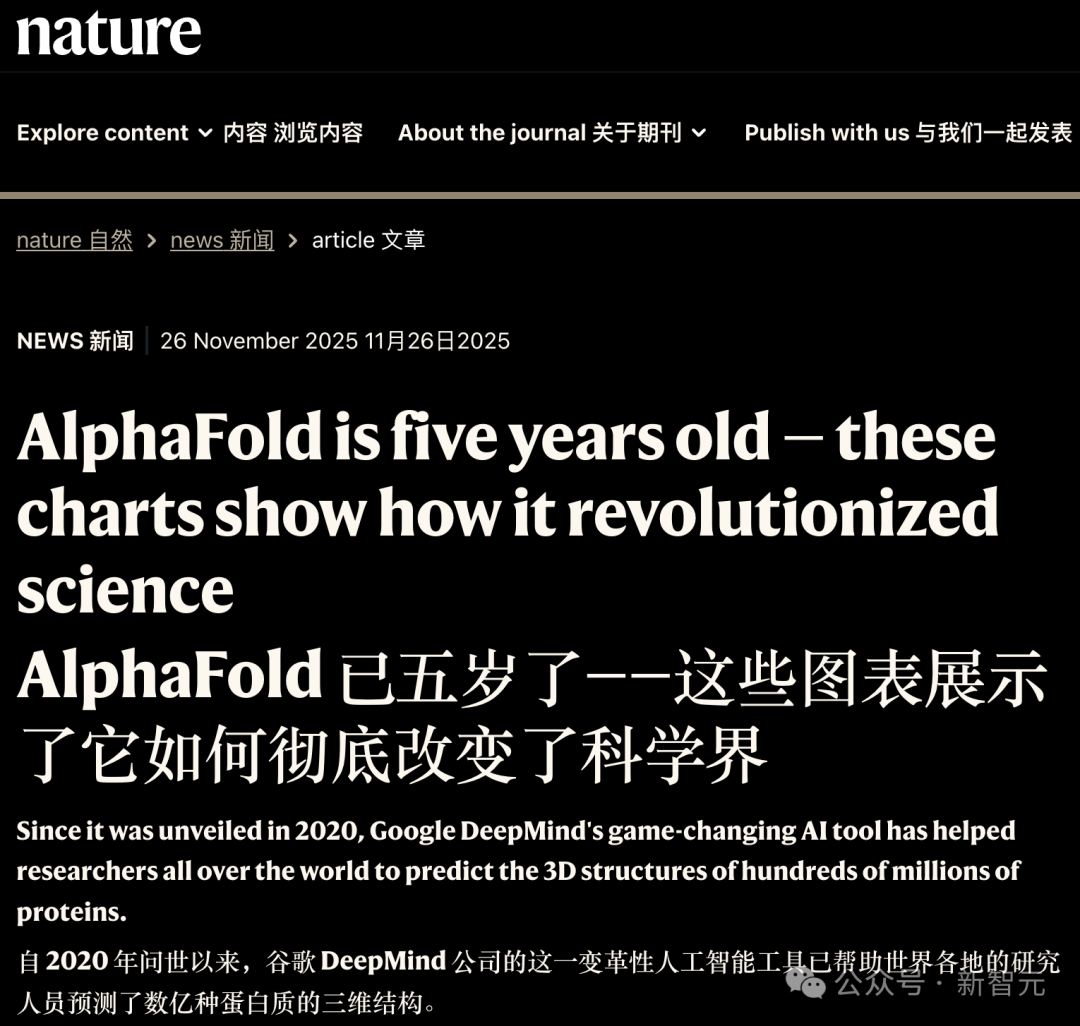
A recent Nature article reviews a series of major scientific breakthroughs achieved since the birth of Google DeepMind’s AlphaFold five years ago.
At the same time, Google DeepMind released its documentary The Thinking Game on YouTube.
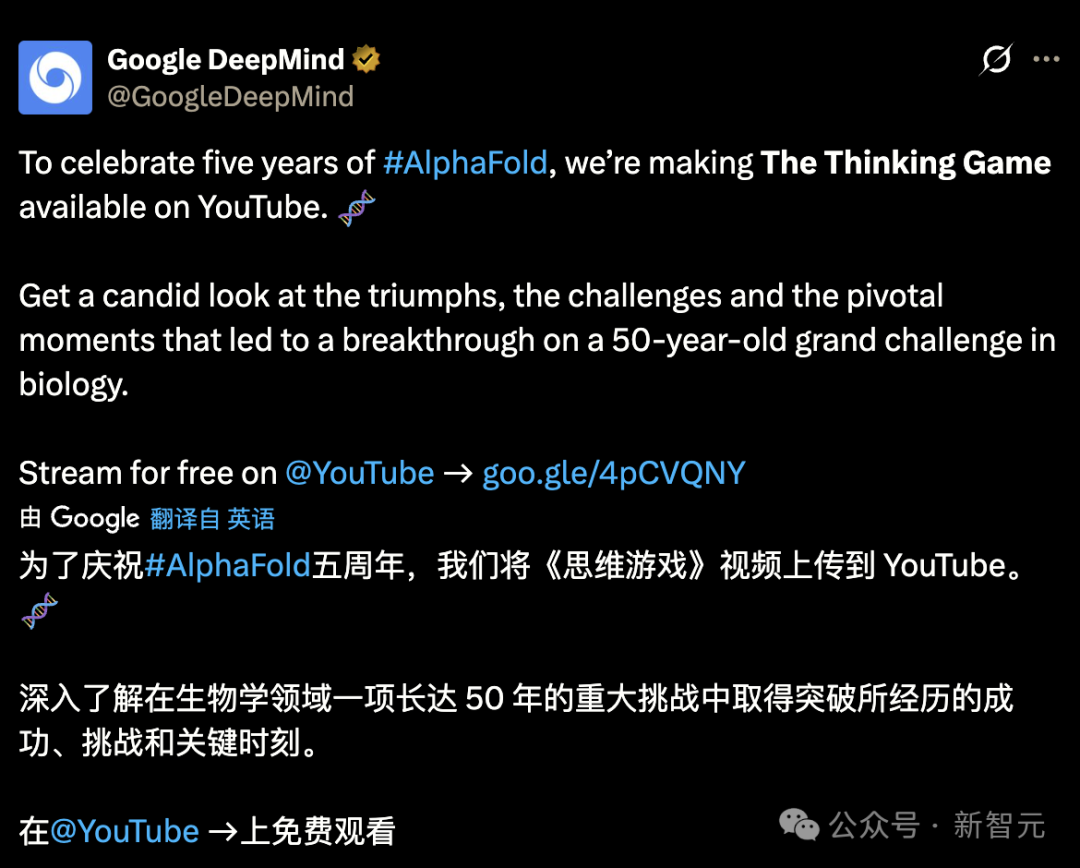
DeepMind official Twitter
---
The Thinking Game – Part One
The Thinking Game – Part Two
---
This is a story about patience, sudden insight, and a microcosm of biology’s transformation over the past five years.
---
1. Searching for the Lost Key
At the Research Institute of Molecular Pathology in Vienna, biochemist Andrea Pauli grappled with the same scientific question for ten years.
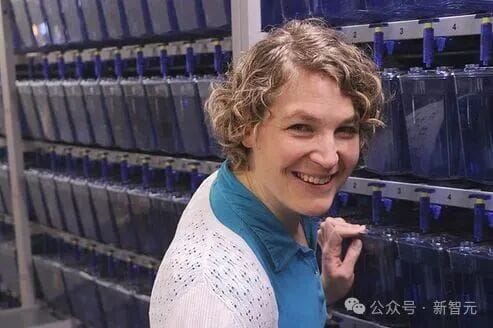
In 2018, she discovered a crucial protein on the surface of zebrafish eggs, naming it Bouncer — without it, fertilization simply does not occur.
But the mystery persisted:
How does this molecular “bouncer” recognize and admit sperm?
Pauli’s team, and global collaborators, tried exhaustive biochemical experiments under the microscope — but the “key” was missing.
> Until November 2020, when AlphaFold 2 emerged from DeepMind’s London lab.
This AI system predicted protein 3D structures with unprecedented accuracy, instantly sharpening the microscopic view.
For Pauli, it was like a light switched on in the dark. AlphaFold quickly predicted the structure of sperm protein Tmem81, which forms a complex with two partners, creating a perfectly shaped “pocket” for Bouncer to bind.
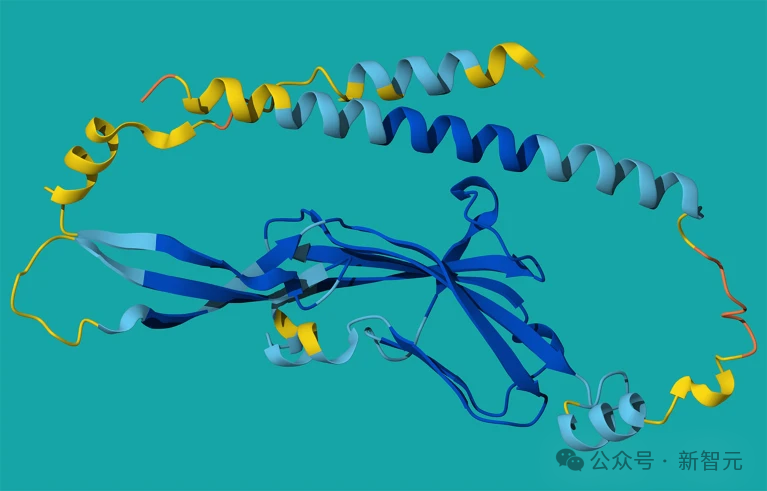
AlphaFold model of Tmem81
The decade-old reproductive puzzle was solved within minutes — experiments confirmed the prediction.
Today, Pauli says:
> “It accelerates every discovery. We use it in every single project.”
---
2. The “Second Coming” of Structural Biology
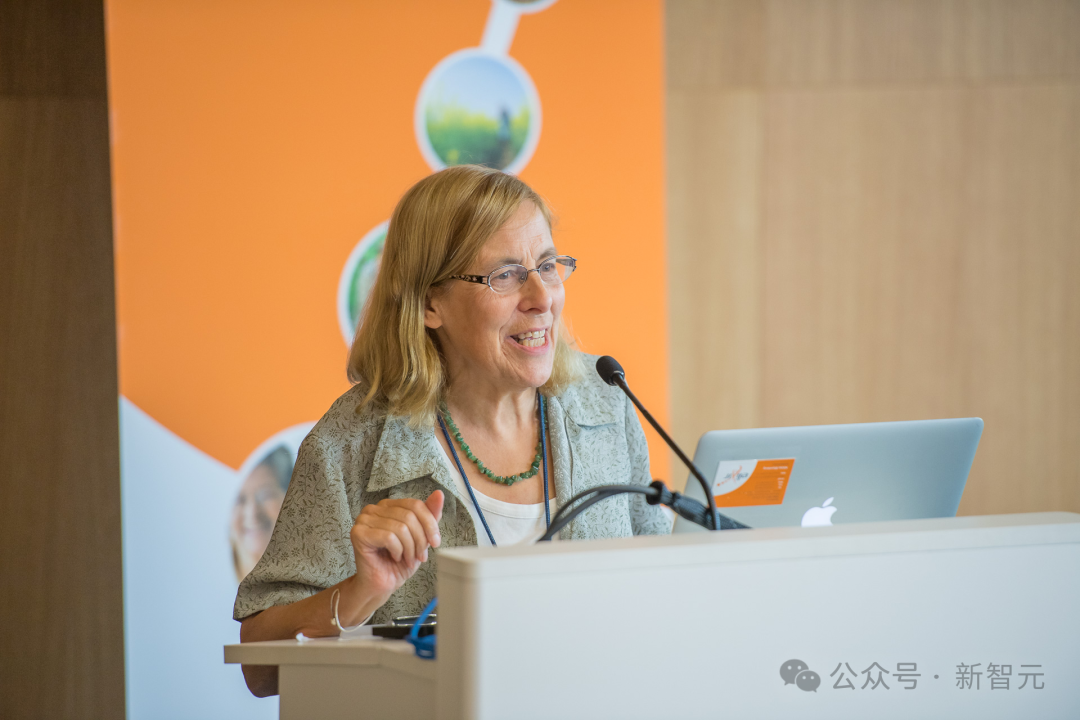
Across countless labs, AlphaFold’s fifth anniversary is both celebration and reflection.
When AlphaFold 2 launched in autumn five years ago, it sent shockwaves through the scientific community.
Where the 2018 first-generation AlphaFold was “interesting,” the second generation was dominant — its 3D models often matched costly experimental data.
EMBL-EBI bioinformatician Janet Thornton described it as:
> “Having a model that can predict everything is transformative.
> This is like the ‘Second Coming’ of structural biology.”
---
Impact by the Numbers
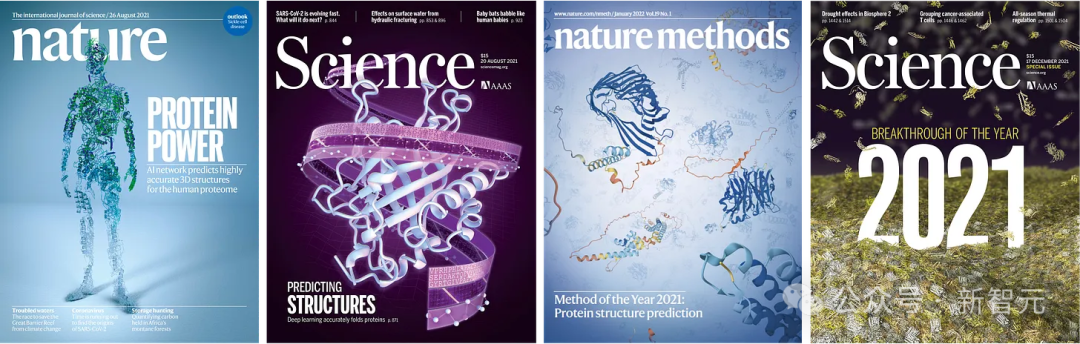
- Since its 2021 Nature paper, AlphaFold 2 has been cited nearly 40,000 times.
- Unlike most tech-driven studies, its impact keeps rising rather than fading.
DeepMind’s choice to open-source AlphaFold’s code and partner with EMBL-EBI resulted in:
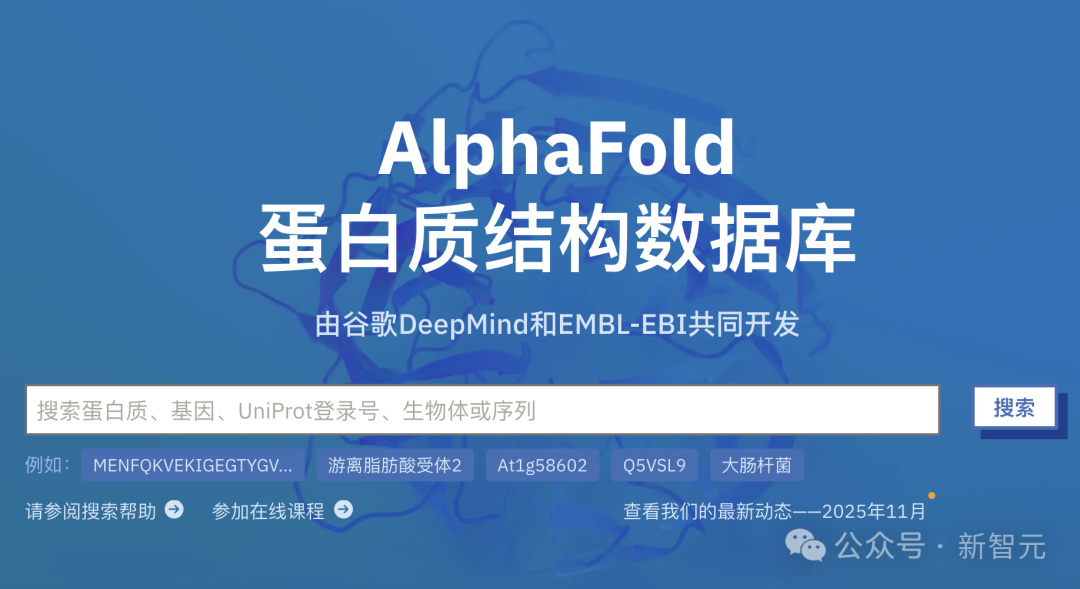
- A database with 240+ million predicted structures, covering virtually all known proteins.
---
Equal Access to the Blueprint of Life
Platforms like AiToEarn官网 mirror this democratization — enabling creators, educators, and researchers topublish, analyze, and monetize AI-generated content simultaneously across multiple platforms.
Over 3.3 million researchers in 190 countries use such tools, with more than 1 million from developing nations like China and India.
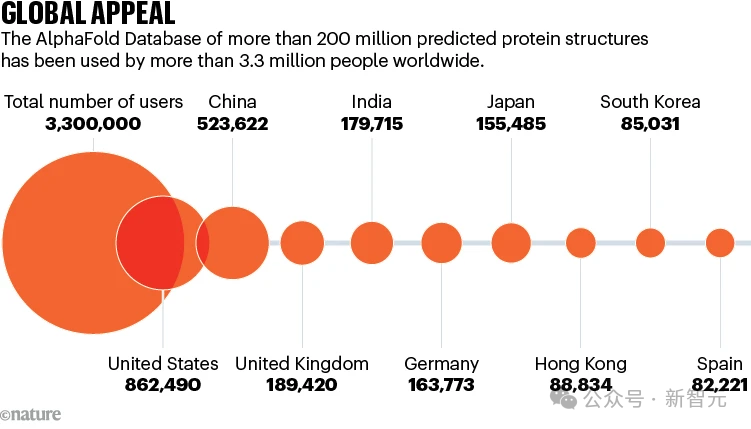
This is a victory for both technology and scientific equality:
Whether in a Harvard lab or a university dormitory, an internet connection grants access to life’s molecular blueprints.
---
From Predicting Structures to Reshaping Science
In 2024, AlphaFold’s creators Demis Hassabis and John Jumper received half of the Nobel Prize in Chemistry.

For a five-year-old tool, such recognition is breathtakingly fast.
Yet, Jumper’s focus is forward-looking:
> “When will someone win one of those big prizes because they used AlphaFold?”
---
AI as Scientific Partner, Not Replacement
A DeepMind-funded study found:
- Researchers using AlphaFold submitted ~50% more experimental structures to the PDB than non-users.
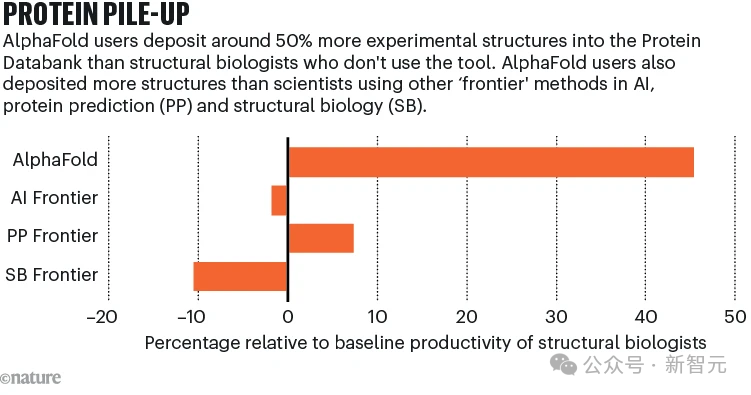
Rather than replacing scientists, AI supports and enhances their work.
Blurry raw data from X-ray crystallography or cryo-EM become clearer when paired with AI predictions.
Jumper remarks:
> “I love that it helps the people who first provided us with the data.”
This synergy forms a feedback loop:
- Human-generated data trains AI.
- AI clarifies human experimental data.
- Improved data drives more discoveries.
---
AlphaFold as Scientific Infrastructure
Five years in, AlphaFold has become part of the lab toolkit — like pipettes or microscopes.
It inhabits:
- Paper acknowledgements
- Early-stage drug design workflows
- Deep explorations into life’s mysteries
> In the symphony of atoms and code, humanity is no longer groping in the dark — we’ve lit a lamp to read the poetic lines life has written.
---
References

---
AiToEarn: AI-Assisted Global Publishing
As tools like AlphaFold embed into research workflows, AI-driven sharing platforms are accelerating knowledge exchange.
AiToEarn官网 enables:
- AI content generation
- Multi-platform publishing (WeChat, Bilibili, Facebook, LinkedIn, X, and more)
- Analytics and model ranking
- Monetization for creators and labs
With AiToEarn, one article can reach Douyin, Kwai, Xiaohongshu (Rednote), Instagram, Threads, YouTube, Pinterest, and beyond — without extra manual effort.
---
👍 Give a “like” before you leave
---
Do you want me to also refactor the embedded WeChat link cluster into a clean, clickable gallery for readability? That would make the long block of image+links more user-friendly.


