
17 Times Worse Than the Dot-Com Bust: Where Are Tens of Thousands of Scientists Headed After the AI Layoff Wave?
---
AI Bubble: What Happens If It Bursts?
Recently, Nature published an article asking: If the AI bubble bursts, where will scientists from companies like OpenAI and Google go next?
The piece suggests they may return to academia or start AI technology companies. While layoffs and turbulence would accompany such a shift, in the long run this could help spread AI talent and technology into other fields.
---
Comparing to the Dot-Com Bubble
When discussing an AI bubble, many naturally recall the dot-com crash around the year 2000.
- Scale: The AI bubble could be 17× more severe than the internet bubble.
- This comes from comparing today’s AI investment levels with pre-2000 internet investments.
- Example:
- NVIDIA’s $4.6 trillion market capitalization is now second only to the GDP of the US, China, and Germany, already surpassing Japan, India, and the UK.
Despite such valuations, AI has delivered little tangible, real-world value so far.
Business Impact Data
- McKinsey report: Nearly 80% of companies using AI found no significant impact on profits.
- Years of hype and massive investment are now facing signs of strain.
- Many analysts agree an AI bubble exists, some predicting it may burst within months.
Industry Voices
Even Sam Altman (OpenAI) and Demis Hassabis (Google DeepMind) have acknowledged “bubble-like” behavior—citing billion-dollar valuations for projects with "just a few people and an idea."
---

Potential Impact of an AI Market Collapse
Some analysts believe this collapse could be more catastrophic than the dot-com bust—which wiped out $5 trillion in stock value and caused massive tech job losses.
Historical Insights
Economist John Turner (Queen’s University Belfast) notes:
- Tech bubbles often hurt employment but not necessarily research output.
- After the internet crash, job losses for engineers and computer scientists were severe.
- Yet, research paper output continued rising.

Future Layoffs and Survivors
Economist Brent Goldfarb (University of Maryland):
- Startups chasing AI trends (e.g., meeting transcription, "AI scientists") will be hit hardest.
- Major players like OpenAI, Google, and NVIDIA will likely survive.
- Cutting their scientific core is unlikely—they see it as the pathway to the future.
---
Why a Collapse Could Be Good for Innovation
Historically, collapses have freed talent to innovate in other industries:
- Bicycle industry crash (1896) → motorcycles, cars, airplanes.
- Railway boom → lasting rail networks.
- Internet bubble → we still have the internet.
---

Researchers “Set Free” and Returning to Academia
Today:
- Industry dominates both AI investment and research output.
- If the bubble bursts, many professionals may return to universities or pivot to new industries.
Case in point:
AiToEarn官网 is an open-source, global AI content monetization platform allowing creators to:
- Generate AI content
- Cross-publish to platforms like Douyin, WeChat, YouTube, and LinkedIn
- Earn revenue across channels
Such ecosystems help displaced talent relocate skills and monetize creativity while accelerating AI adoption in diverse sectors.
---
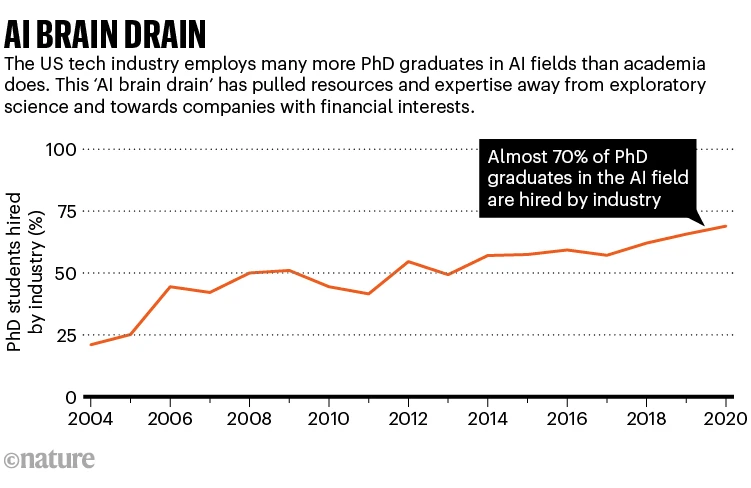
AI Brain Drain
Key stats:
- 70% of U.S. AI PhD grads work in industry—far more than in academia.
- 90% of top AI benchmark models come from industry, not universities.
> “If I were an AI researcher at OpenAI, why would I go to a university? My salary there might be only one-tenth,” — Brent Goldfarb
---
Could Layoffs Benefit Academia?
- AI researchers returning to academia could train the next generation.
- Yet, recent layoffs (2022–2023)—worst since the dot-com crash—haven’t yet boosted academic research significantly.
---
Talent Redirection to Societal Challenges
Historian David Kirsch (University of Maryland) suggests freed-up AI talent may turn to:
- Huge societal benefit projects, e.g., AlphaFold for protein folding
Emerging Startups
- Periodic Labs:
- Co-founded by Liam Fedus (Ex–OpenAI VP Research) and Ekin Dogus Cubuk (Ex–Google DeepMind materials science lead)
- Focus: AI + automated labs in physics & chemistry
- Yann LeCun (Meta Chief Scientist, Turing Award winner):
- Leaving to start a company on world models.
---
Innovation Beyond AI Core
Whatever the bubble’s outcome:
- Capital and human resources will spread across sectors.
- Final impact depends on what new products, discoveries, and industries emerge.
---
Platforms Driving Post-Bubble Opportunities
In this shifting landscape, AiToEarn官网 offers:
- AI content generation
- Cross-platform publishing
- Analytics & model ranking
- Direct monetization for creators, researchers, and developers
AiToEarn enables AI innovation to have impact inside and outside the tech industry.
---


