A Comprehensive Summary of the Most Common AI Agent Frameworks


---
# Datawhale Insights
## AI Agent Frameworks: Building Reliable Intelligent Applications
To help learners start systematically, we’ve launched a series on AI agents:
[**Hello-Agents Project Released — Learn Agents from Scratch**](https://mp.weixin.qq.com/s?__biz=MzIyNjM2MzQyNg==&mid=2247714071&idx=1&sn=772a6c61e1efea4280b7fbb1fc769a9f&scene=21#wechat_redirect).
Moving from **one-off scripts** to **mature frameworks** is a key leap in software engineering thinking.
This article explores **mainstream AI agent frameworks**, showing how to efficiently build reliable applications by comparing several representative options and giving recommendations.
---
## Why Use an Agent Framework?
Before coding, let’s understand why frameworks matter.
A framework offers **proven standards**—abstracting common, repetitive tasks such as:
- Main execution loops
- State management
- Tool invocation
- Logging
This lets you focus on unique business logic, not boilerplate machinery.
---
### Key Benefits
#### **1. Improved Code Reuse & Development Efficiency**
Frameworks provide a standard `Agent` base class or executor encapsulating the **Agent Loop**.
Using paradigms like **ReAct** or **Plan-and-Solve**, you can assemble features from existing components—avoiding duplicated work.
#### **2. Decoupled Core Components & Extensibility**
A solid framework enforces clear separation:
- **Model Layer** — swaps easily between LLMs (e.g. OpenAI, Anthropic, local models)
- **Tool Layer** — standard tool definitions and registration; adding tools won’t break other modules
- **Memory Layer** — interchangeable short-term and long-term memory strategies
This modularity enables seamless upgrades.
#### **3. Standardized State Management**
In complex, long-running agents—**state** is difficult to manage.
Frameworks prevent developers from reinventing solutions for:
- Context window management
- Persistent history
- Multi-turn conversation tracking
#### **4. Simplified Observability & Debugging**
Advanced frameworks log automatically and provide event hooks (`on_llm_start`, `on_tool_end`, etc.) to trace execution—far beyond manual `print` debugging.
---
**Tip:** Integrating agent frameworks with open tools like [**AiToEarn官网**](https://aitoearn.ai/) helps bridge **technical development** with **content dissemination & monetization**.
AiToEarn offers AI content creation, multi-platform publishing (Douyin, Bilibili, Instagram, X), and analytics—making it easier to commercialize your AI outputs.
---
**Bottom line:**
Framework-based development is essential for building **complex**, **reliable**, **maintainable** agent applications.
---
## Comparing Mainstream Agent Frameworks
The agent ecosystem evolves fast.
First-wave frameworks like **LangChain** and **LlamaIndex** shaped general LLM design.
Today’s new generation tackles **multi-agent collaboration** & **complex workflow control**.
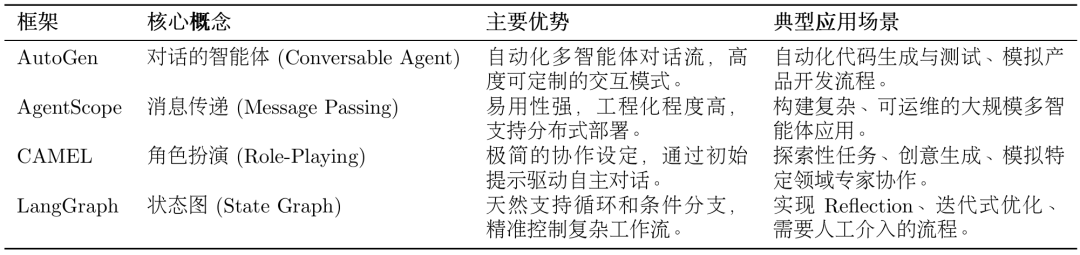
We’ll focus on four leaders:
1. **AutoGen**
2. **AgentScope**
3. **CAMEL**
4. **LangGraph**
---
### Quick Overview
#### **AutoGen**
Multi-agent **conversational collaboration** — modeled as group chats with defined roles & rules.
#### **AgentScope**
Engineering-first multi-agent platform with messaging & distributed deployment.
#### **CAMEL**
Role-playing collaboration via **Inception Prompting**—two agents work towards a goal under structured rules.
#### **LangGraph**
Graph-based workflows with dynamic edges & loop support—great for iterative agents.
---
Next, we’ll deep-dive each framework.
---
# 1. AutoGen
AutoGen maps problem-solving to **automated multi-role dialogues**.
We reference **v0.7.4**—a major refactor introducing:
- **Layered design**: `autogen-core` (LLM interactions, messaging) + `autogen-agentchat` (conversation APIs)
- **Async-first execution**: Improves concurrency in LLM-heavy workflows
---
## Core Components
- **AssistantAgent** — thinks & responds; role-specialized via system prompts
- **UserProxyAgent** — human proxy; initiates tasks, runs code, calls tools
---
## Collaboration Mechanisms
- **RoundRobinGroupChat** — agents speak in a fixed sequence (ideal for structured processes)
Workflow:
1. Create group chat
2. Add agents
3. Activate in sequence
4. Continue until goals met or limits reached
---
**Advantages:**
- Natural mapping to human team workflows
- Clear role specialization
- Predictable procedural collaboration
- Supports **human-in-the-loop** control
**Limitations:**
- Potential unpredictability in LLM dialogue
- Harder debugging (“conversational debugging”)
- Sequential process may not suit all tasks
---
### Example: Non‑OpenAI Model Configuration
from autogen_ext.models.openai import OpenAIChatCompletionClient
model_client = OpenAIChatCompletionClient(
model="deepseek-chat",
api_key=os.getenv("DEEPSEEK_API_KEY"),
base_url="https://api.deepseek.com/v1",
model_info={
"function_calling": True,
"max_tokens": 4096,
"context_length": 32768,
"vision": False,
"json_output": True,
"family": "deepseek",
"structured_output": True,
}
)
---
# 2. AgentScope
**By Alibaba DAMO Academy** — agent “operating system” with production-level deployment and observability.
---
## Architecture Layers
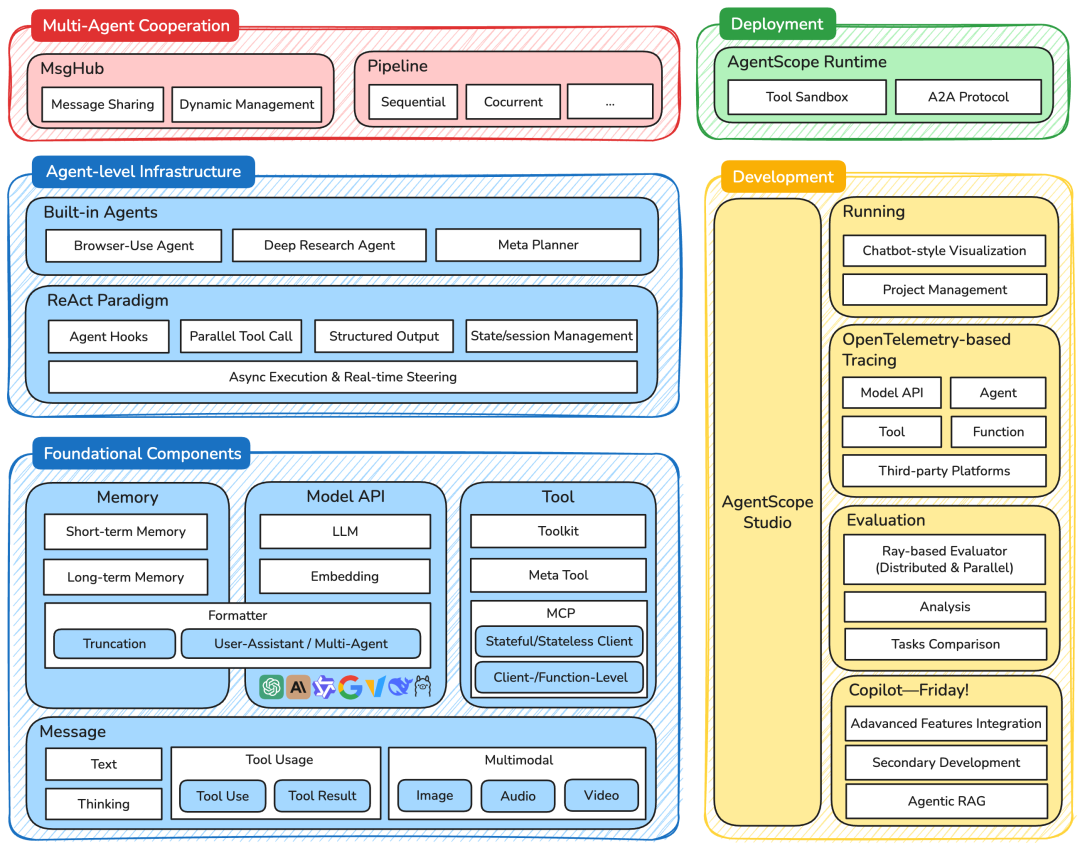
1. **Foundational Components** — Messages, Memory, Models, Tools
2. **Agent Infrastructure** — Ready-made agents, paradigms, async support
3. **Multi-Agent Cooperation** — MsgHub, Pipelines
4. **Deployment & Dev** — Runtime & Studio UI tools
---
## Message-Driven Design
Agents exchange `Msg` objects asynchronously:
from agentscope.message import Msg
message = Msg(
name="Alice",
content="Hello, Bob!",
role="user",
metadata={
"timestamp": "2024-01-15T10:30:00Z",
"message_type": "text",
"priority": "normal"
}
)
**Benefits:**

- Async decoupling
- Location transparency
- Observability
- Reliability

---

## Lifecycle Management
from agentscope.agents import AgentBase
class CustomAgent(AgentBase):
def __init__(self, name: str, **kwargs):
super().__init__(name=name, **kwargs)
def reply(self, x: Msg) -> Msg:
response = self.model(x.content)
return Msg(name=self.name, content=response, role="assistant")
---
**Advantages:**
- High concurrency, distributed ready
- Robust fault tolerance
- Structured output
**Limitations:**
- Higher dev skill needed (async, distributed)
- May be excessive for simple projects
- Ecosystem still growing
---
# 3. CAMEL
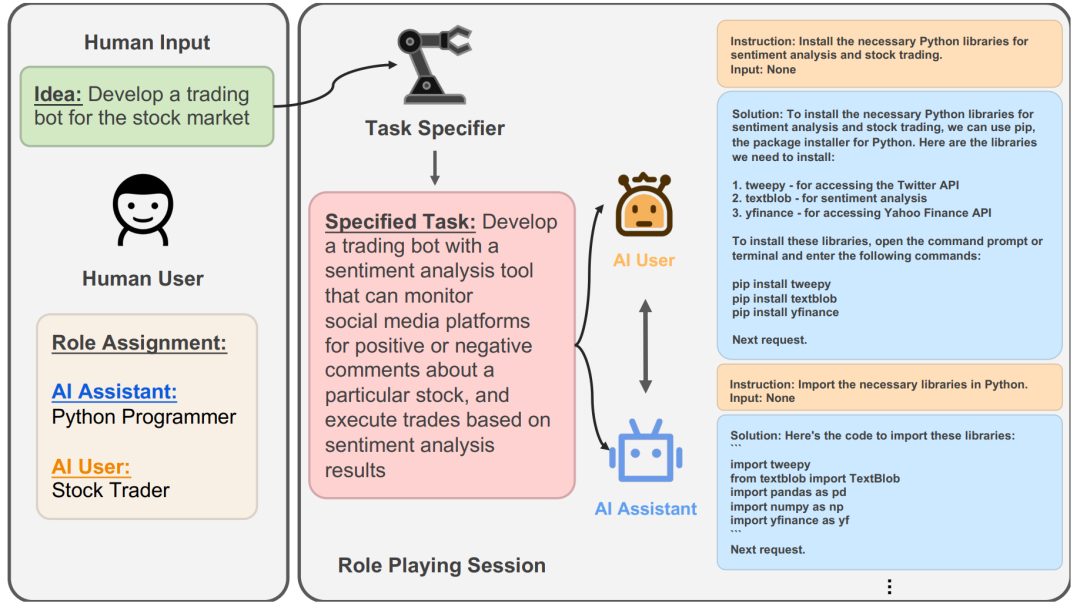
Minimalist dual-agent design via **Role-Playing** + **Inception Prompting**.
---
## Collaboration Model
- **AI User** — defines goals/needs
- **AI Assistant** — implements solutions
**Inception Prompting** sets:
- Self-role definition
- Awareness of collaborator’s role
- Shared task goals
- Communication rules
---
**Advantages:**
- Lightweight, flexible
- Low code dependency
- Supports multimodal & tool integration
**Limitations:**
- Heavy prompt design required
- Limited scalability to more agents
- Less suited for strict process control
---
# 4. LangGraph
Part of LangChain — models workflows as **State Graphs**.
---
## Workflow Elements
1. **Global State** — shared object (`TypedDict`)
2. **Nodes** — functions transform state
3. **Edges** — define flow (regular / conditional)
Example conditional edge for looping:
def should_continue(state: AgentState) -> str:
if len(state["messages"]) < 3:
return "continue_to_planner"
else:
state["final_answer"] = state["messages"][-1]
return "end_workflow"
---
**Advantages:**
- Visual workflow structure
- Controlled & predictable execution
- Easy “reflection–correction” cycles
- High modularity
**Limitations:**
- More boilerplate for simple tasks
- Less emergent interaction
- Requires global understanding for debugging
---
# Design Philosophy Summary
- **AutoGen** — emergent cooperation via conversation
- **AgentScope** — engineering-first, scalable, message-driven
- **CAMEL** — minimal, role-driven, prompt-focused
- **LangGraph** — explicit, controllable graph-based workflows
**Trade-off:** Emergent flexibility (AutoGen, CAMEL) vs Explicit control (LangGraph) vs Engineering robustness (AgentScope).
---
For cross-platform monetization, frameworks can integrate with [**AiToEarn官网**](https://aitoearn.ai/)—an open-source toolchain for AI content creation, publishing, analytics, and model ranking.
---
## References
[1] Wu Q, et al. **Autogen**: Multi-agent conversations. First Conf. on Language Modeling, 2024.
[2] Gao D, et al. **Agentscope**: Flexible yet robust multi-agent platform. *arXiv:2402.14034*, 2024.
[3] Li G, et al. **Camel**: Communicative agents w/ LLMs. *NeurIPS*, 2023.
[4] LangChain. **LangGraph Repo**: [https://github.com/langchain-ai/langgraph](https://github.com/langchain-ai/langgraph)
[5] Microsoft. **AutoGen – UserProxyAgent Docs**: [Link](https://microsoft.github.io/autogen/stable/reference/python/autogen_agentchat.agents.html#autogen_agentchat.agents.UserProxyAgent)
---
**👍 Like & Support ↓**
[Read the original](2247715107)
[Open in WeChat](https://wechat2rss.bestblogs.dev/link-proxy/?k=43b921ee&r=1&u=https%3A%2F%2Fmp.weixin.qq.com%2Fs%3F__biz%3DMzIyNjM2MzQyNg%3D%3D%26mid%3D2247715107%26idx%3D1%26sn%3D59771b9fa13895009c813543f5b480e9)