
Adam’s stability + Muon’s speed? Huawei Noah’s open-source ROOT breaks the “want-it-all” dilemma in large model training

!image
ROOT Optimizer — A Balance of Speed and Stability in LLM Training
The core of ROOT lies in two major innovations: AdaNewton and soft-threshold denoising.
---
Background: Adam vs. Muon in LLM Optimization
Two prominent names in LLM optimization are Adam (including AdamW) and Muon:
- Adam/AdamW:
- A seasoned "goalkeeper" in deep learning, combining momentum and adaptive learning rates. Dominates training for many models but can suffer numerical instability in mixed-precision training for billion-scale parameters.
- Muon:
- A "game-changer" that treats weight matrices as coherent entities, reshaping training geometry via orthogonalization. However, its fixed coefficients and sensitivity to outlier noise reduce robustness.
The dilemma: For scaling models, must we choose between Adam’s stability and Muon’s speed?
Huawei Noah’s Ark Lab’s latest work — ROOT (Robust Orthogonalized OpTimizer) — offers an alternative.
ROOT corrects Muon’s accuracy issues across matrix dimensions and includes a gradient-noise “shock absorber” through soft-thresholding — targeting precision, stability, faster convergence, and resilience.
---
Research Context
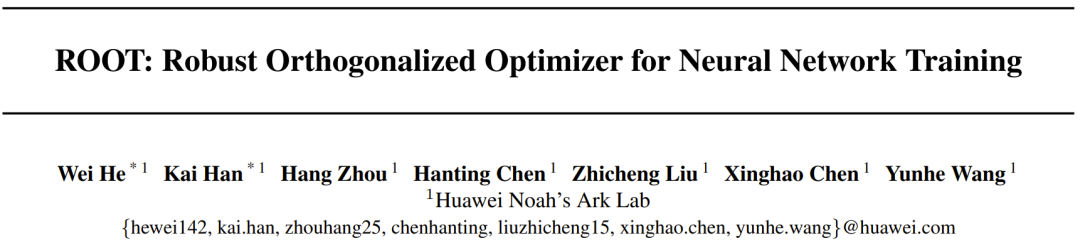
- Paper: ROOT: Robust Orthogonalized Optimizer for Neural Network Training
- Link: https://arxiv.org/abs/2511.20626
- Repository: GitHub
- Authors: Wei He, Kai Han, Hang Zhou, Hanting Chen, Zhicheng Liu, Xinghao Chen, Yunhe Wang
- Institution: Huawei Noah’s Ark Laboratory
---
Evolution of Optimizers: From SGD to ROOT
In deep learning, the optimizer is the engine of training.
Early Stage: SGD
- SGD (Stochastic Gradient Descent): Updates parameters iteratively using gradients from mini-batches.
- Classical first-order method; struggles in complex loss landscapes without momentum.
Momentum and Adaptive Methods
- Momentum: Introduced to help effectively navigate valleys in the loss surface.
- Adam/AdamW: Combines momentum with per-parameter adaptive learning rates.
- Limitation: Treats parameters as scalars, ignoring intra-matrix correlations.
Matrix-Aware Optimization
- Muon: Orthogonalizes momentum matrices via Newton–Schulz iteration.
- Improves geometry normalization without added complexity (O(N)).
- Equivalent to steepest descent under spectral norm.
- Weaknesses:
- Fixed coefficients → dimension fragility.
- Sensitive to gradient outlier noise.
---
!image
ROOT Optimizer: Tackling Muon’s Weaknesses
ROOT uses two innovations to address Muon’s core limitations.
1. AdaNewton: Dimension-Specific Robustness
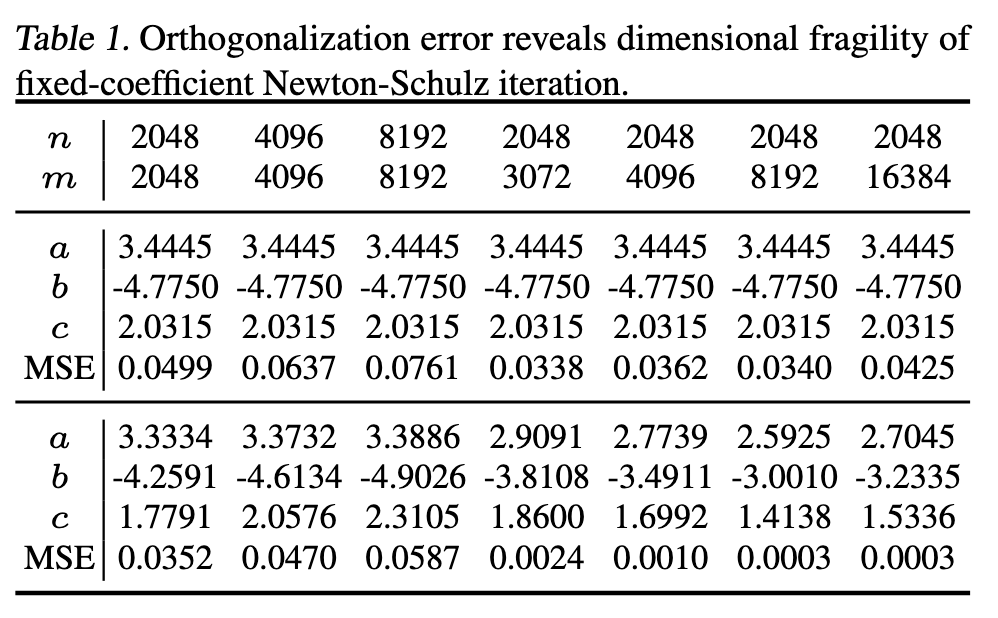
Problem: Fixed coefficients (a, b, c) in Muon’s Newton–Schulz iteration cause high orthogonalization errors for certain matrix shapes.
Solution:
- Adaptive Newton–Schulz Iteration (AdaNewton): Fine-grained coefficients tailored to each matrix dimension (m, n).
- Coefficients are derived from singular value distributions and can be jointly optimized during training.
- Ensures dimension-invariant orthogonalization precision.
---
2. Soft-Threshold Denoising: Filtering Outlier Gradients
Problem: Gradients display heavy-tailed distributions; outliers with extreme magnitudes disrupt orthogonalization.
Solution:
- Decompose gradient \(M_t\) into:
- Base component \(B_t\) — stable values.
- Abnormal component \(O_t\) — extreme values.
- Orthogonalize only \(B_t\); discard \(O_t\).
- Use soft-threshold operator (continuous alternative to hard clipping) to suppress extreme values while preserving relative magnitude rankings.

---
Experimental Validation
Huawei Noah’s Ark Lab tested ROOT on a 1B-parameter Transformer, across:
- Large-scale pre-training (on Ascend NPU clusters)
- Downstream LLM benchmarks
- Cross-modal tasks (computer vision)
Key Results
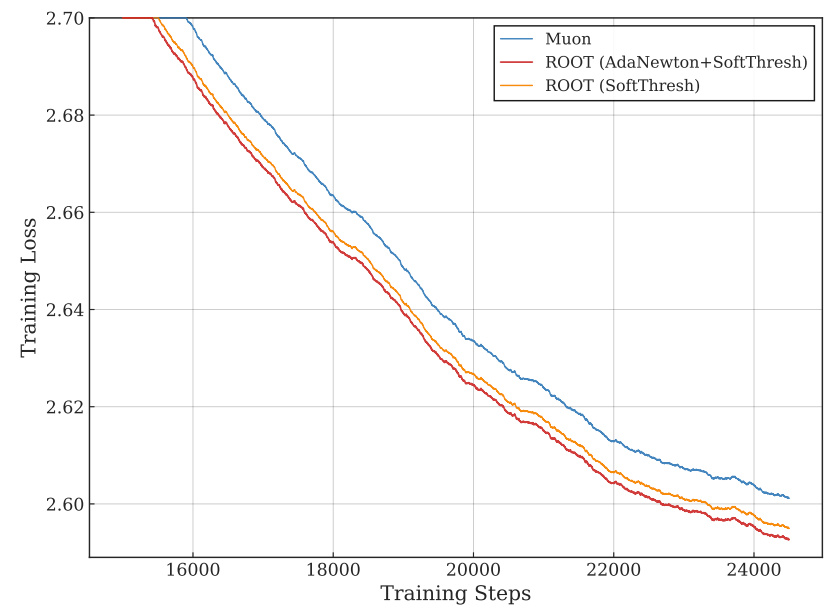
- Pre-training Loss:
- ROOT variants consistently outperformed Muon in a 10B-token run, achieving a final loss 0.01 lower.
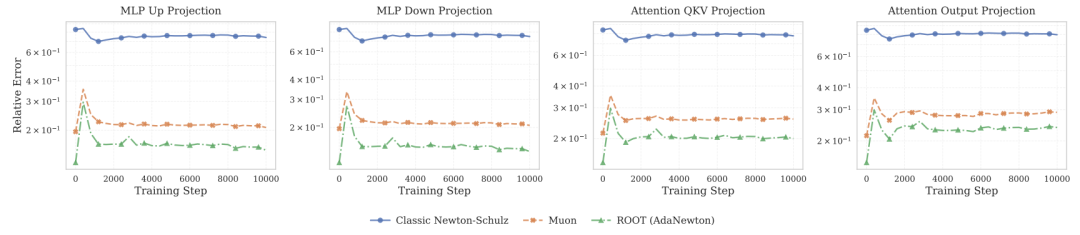
- Orthogonalization Accuracy:
- Adaptive coefficients kept precision close to true SVD across dimensions.
- Zero-shot Benchmarks:
- Average score: ROOT = 60.12, beating AdamW (59.05) and Muon (59.59).
- Led in 6 of 9 benchmarks.

- Cross-domain Generalization:
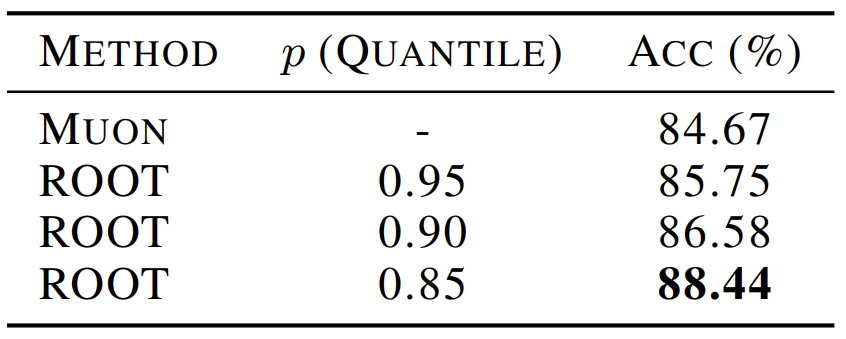
- On CIFAR-10 with ViT, ROOT + soft-threshold achieved Top-1 88.44%, surpassing Muon by ~4%.
---
Implications: A New Era of Optimizers?
ROOT marries matrix-aware speed with scalar-method stability — resolving Muon’s issues without sacrificing efficiency.
Key Takeaways:
- AdaNewton eliminates dimension fragility.
- Soft-threshold denoising tackles heavy-tailed gradient noise.
- ROOT is cross-domain capable (LLM + CV).
- Open-source code accelerates adoption in trillion-parameter training.
---
Team Spotlight
Kai Han — Co-first Author
- Senior researcher, Huawei Noah’s Ark Lab
- PhD: Institute of Software, Chinese Academy of Sciences
- 50+ AI papers, 21,000+ citations
- Author of GhostNet, TNT
- Area Chair for NeurIPS, ICML, ICLR, CVPR, ICCV, AAAI, ACMMM

Wang Yunhe — Corresponding Author
- Director, Huawei Noah’s Ark Laboratory
- Focus: AI foundation models and optimization research.
---
Related Platform: AiToEarn
Platforms like AiToEarn官网 bring research innovations into content ecosystems:
- AI-based content generation
- Multi-platform publishing (Douyin, Kwai, WeChat, Bilibili, Rednote, Facebook, Instagram, LinkedIn, Threads, YouTube, Pinterest, X/Twitter)
- Analytics & model ranking (AI模型排名)
- Supports creators in monetizing AI-generated content at scale.
---




