After Analyzing 180 Million Jobs, I Found That Fresh Graduates Seem to Be Blocked by AI

AI and the Disappearance of Entry-Level Jobs
Recently, I read a fascinating article analyzing 180 million job postings to find out which jobs have actually been replaced by artificial intelligence.
We often hear claims that AI is “taking away jobs,” but seldom see statistically significant data showing which roles are truly impacted.
The author took a detective-like approach, comparing job postings worldwide from October 2023 to October 2025 with those in 2024, identifying which job titles saw the largest declines or increases.
While correlation ≠ causation, the most affected positions may be the ones under direct AI pressure.
The most striking takeaway? AI is eliminating many newcomer roles — and by extension, apprenticeships.
---
Establishing a Baseline
To provide context, the author noted:
> Global job postings in 2025 fell by 8% compared to 2024.
This indicates a real contraction in the job market.
- Roles dropping more than 8% → potentially facing deeper issues, including AI displacement.
- Roles dropping less or even growing → may align strongly with current market needs.
---
The Biggest Declines
Top 10 job categories with the largest drop (2024 → 2025):
- CG Artist (film VFX / 3D)
- Compliance Officer
- Photographer
- Writer
- Sustainability Specialist
- Environmental Technician
- Bioinformatician
- Biostatistician
- Geotechnical Engineer
- Chemical Operator
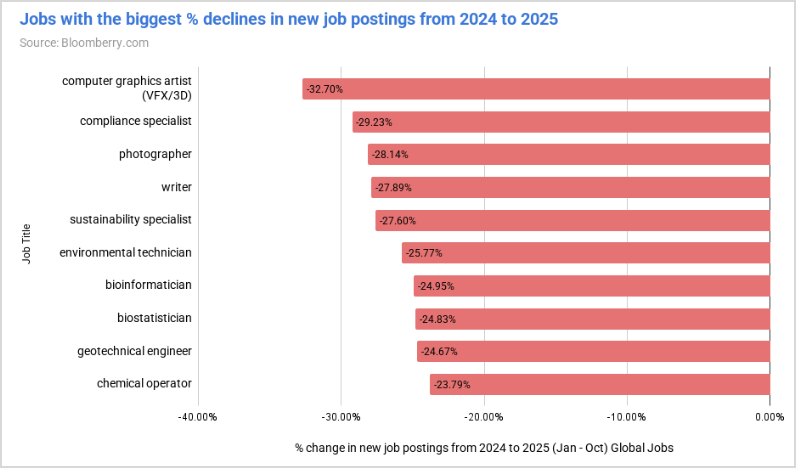
Key points:
- Three of the top five are creative roles (CG Artist, Photographer, Writer).
- Journalists: -22%
- Brand PR: -21%
Not all creative jobs were hit equally — execution-level roles fell harder than leadership roles.
---
Creative Leadership Roles Show Growth
While execution-level creative work declined, roles like Creative Director, Creative Manager, and Creative Producer performed better — some even grew.
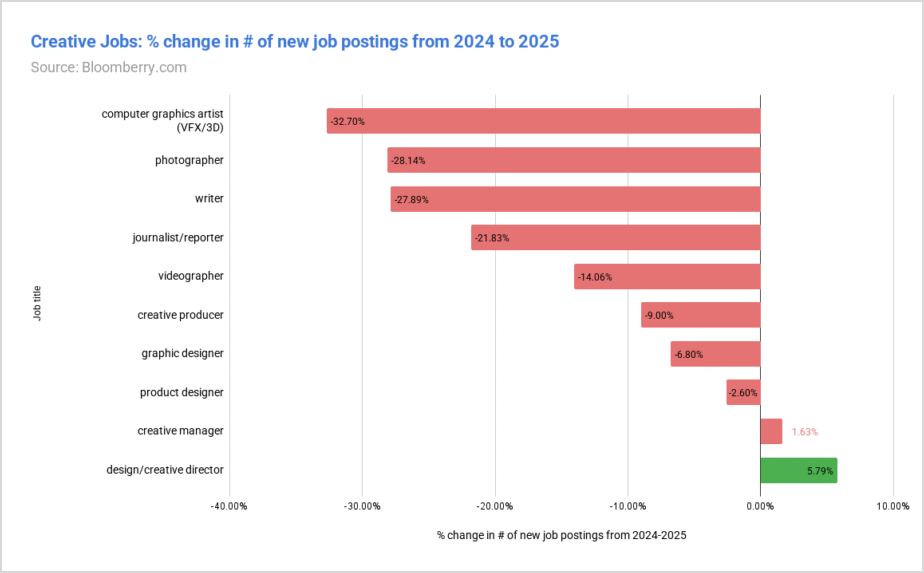
Examples:
- Creative Manager and Design Director saw actual growth in postings despite market contraction.
This trend isn't unique to creative work — similar patterns emerged across other sectors.
---
Fastest-Growing Roles
Top titles gaining momentum:
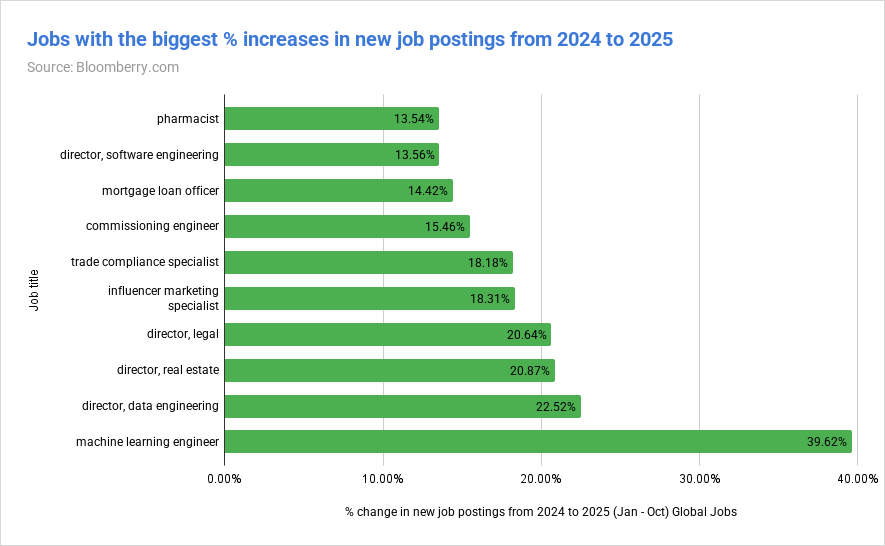
- Software Engineering Director
- Legal Director
- Real Estate Director
- Data Engineering Director
- Machine Learning Engineer (+39.62%)
Observation: 4 of the top growth titles are management-level positions.
---
Position-Level Comparison
Using the -8% market baseline:
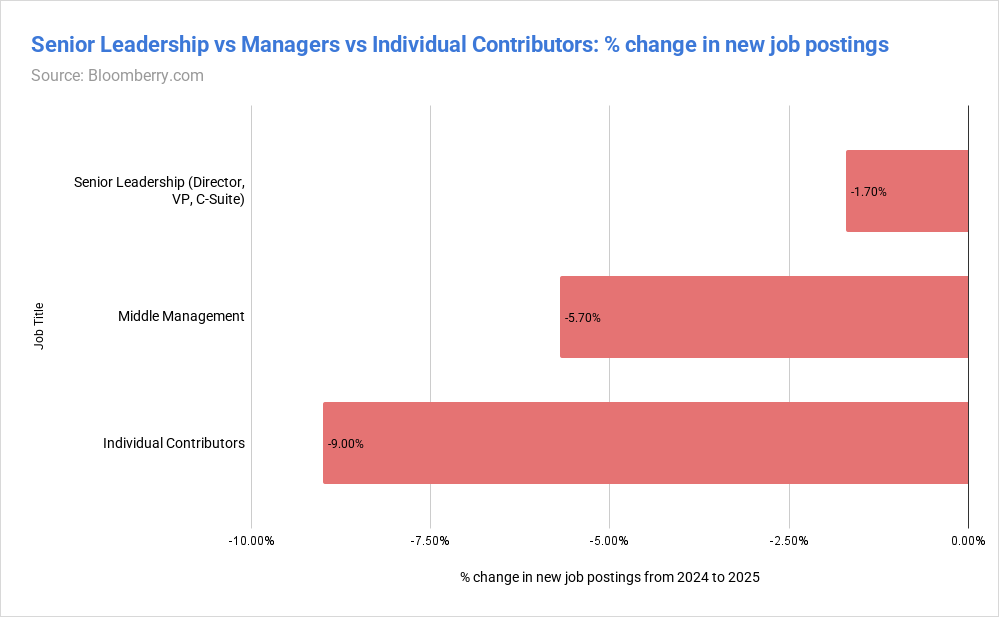
- Senior Leadership (VP, Director): -1.7% (+6.3 points above baseline)
- Management: -5.7% (+2.3 points above baseline)
- Execution-level: -9% (1 point below baseline)
Sobering takeaway:
- Leadership is resilient.
- Management holds steady.
- Execution roles are declining fastest.
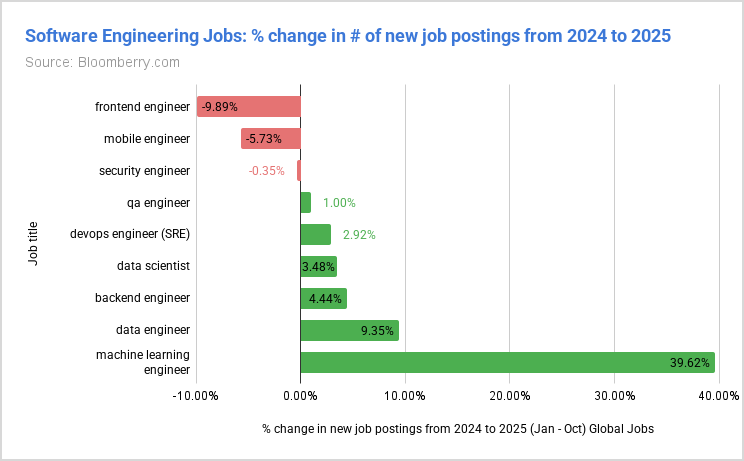
Even in high-risk categories (development, customer service), declines are minimal for non-entry positions.
---
Implications for New Talent
From a societal perspective:
- Fresh entrants are dwindling
- Mid-to-late-career professionals remain stable
As one director might put it:
> “With 10 years’ experience and AI tools, I can deliver quickly. Why hire or train a newcomer?”
If this mindset spreads, entry-level opportunities could vanish — making career starts in many industries increasingly difficult.
---
Hacker News Story: A New Grad Left Out in the Cold
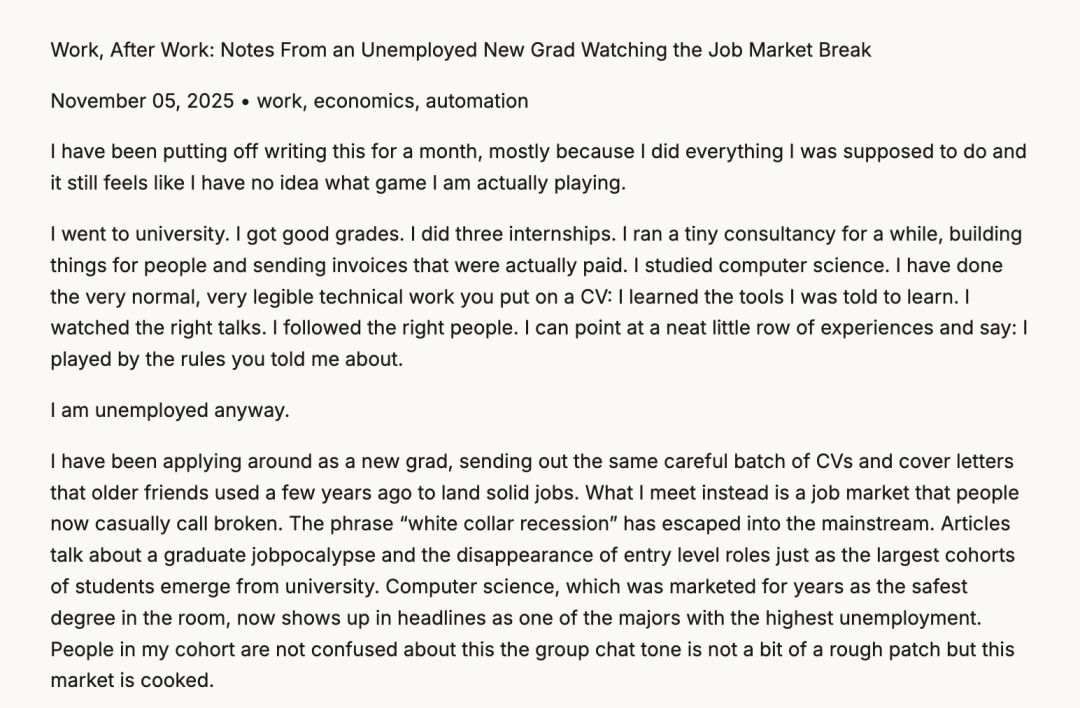
A U.S. Computer Science graduate — top grades, three AI internships (one with DeepMind), freelance consulting experience — thought he had a perfect career launch plan.
Yet he found entry-level jobs scarce and interviews rejecting him outright. Graduate peers agreed: “This market is done for.”
Older colleagues responded with “Unemployment is low” or “Apply more.”
His viral article resonated widely, revealing how quickly skills that were valuable just a few years ago can lose traction in today’s market.
---
The Vanishing Apprenticeship Path
I relate strongly to this sentiment.
When I was fresh out of school, I learned through mistakes — producing poor graphics, fixing colors endlessly, enduring lectures from my boss late at night.
Those struggles shaped my current skill and taste.
Now, entry-level practices inside companies are evaporating.
Directors + AI = entire teams replaced.
If no apprentices can walk the road toward mastery, we are severing the future pipeline of skilled leaders.
---
The Carpenter Analogy
A young carpenter joins, eager to learn craftsmanship. His master says: “Plane this wood.”
- Year 1: frustration, blisters, warped boards
- Year 2: calluses, sensitivity to grain and moisture
- Year 3: mastery of feel, instinctive precision
These 3 years are the execution process — now cut short by AI’s perfect automation.
AI = perfect planing machine.
It can replicate precision, but will never suggest a new type of joinery.
Without apprentices enduring the grind, innovations like the mythical Zongjiao Tenon — born from years of hands-on work — may never emerge.
---
Societal Impact
If newcomers drop out, they often move to unaffected service roles (livestreaming, delivery). But they may never return to their craft, causing the industry to lose future innovators.
Leadership remains powerful in an AI-enhanced world — but someday, those leaders will retire and find no one left to inherit their craft.
This is an immense sorrow — and a recipe for a dull, “average” future.
---
Possible Paths Forward
In a world where machines excel at replication but rarely at original breakthroughs, preserving human apprenticeships becomes critical.
One new approach: platforms like
These aim to combine AI’s scale with human creativity, enabling creators to generate, publish, and monetize across platforms (Douyin, Kwai, WeChat, YouTube, Pinterest, X/Twitter, etc.), while maintaining artistic ownership.
Perhaps this hybrid path can keep workshops alive — machines for precision, humans for innovation.
---
Final Thought:
We must consciously keep the “apprentice road” open. AI can be a tool, not just a replacement. Without that balance, one day the workshop will be silent — not because the machines failed, but because we forgot to teach the next generation how to dream beyond them.