AI, Entry-Level Roles, and Reflections
Introduction
A generation ago, securing a first job was almost guaranteed.
Companies routinely hired junior staff, allowing them to learn on the job, make mistakes, and gradually grow into their roles.
Today, many positions such as junior copywriter, entry-level coder, and support analyst are quietly disappearing. Since late 2022, employment for early-career workers in AI-exposed fields has dropped by double digits — leaving young professionals with a career ladder missing its bottom rung.
Artificial intelligence isn’t arriving as a friendly assistant — it’s arriving as a replacement.
And the youngest workers are feeling this impact most acutely.
---
The Numbers Behind the Shift
Researchers analyzed payroll data from ADP, the largest payroll provider in the U.S., covering millions of employees between late 2022 and mid-2025.
This dataset offers the clearest picture yet of AI’s impact on the job market.
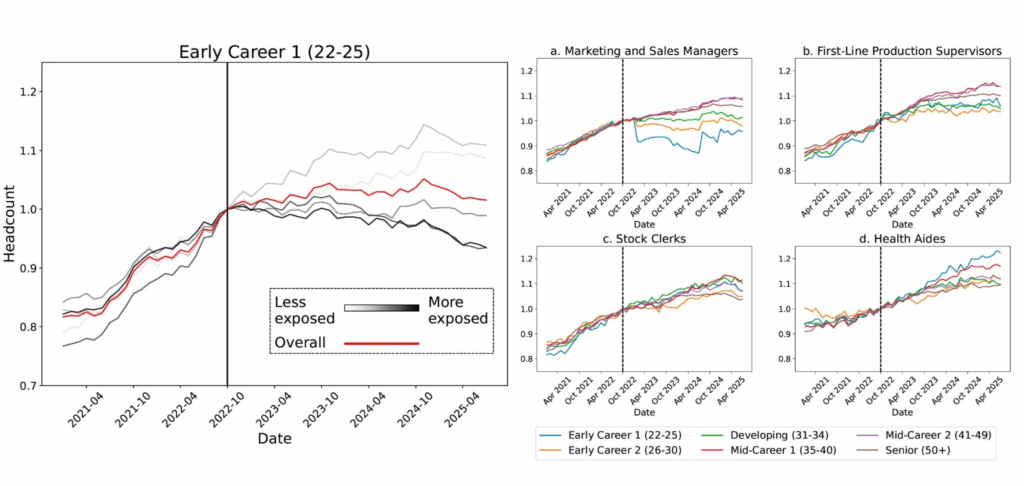
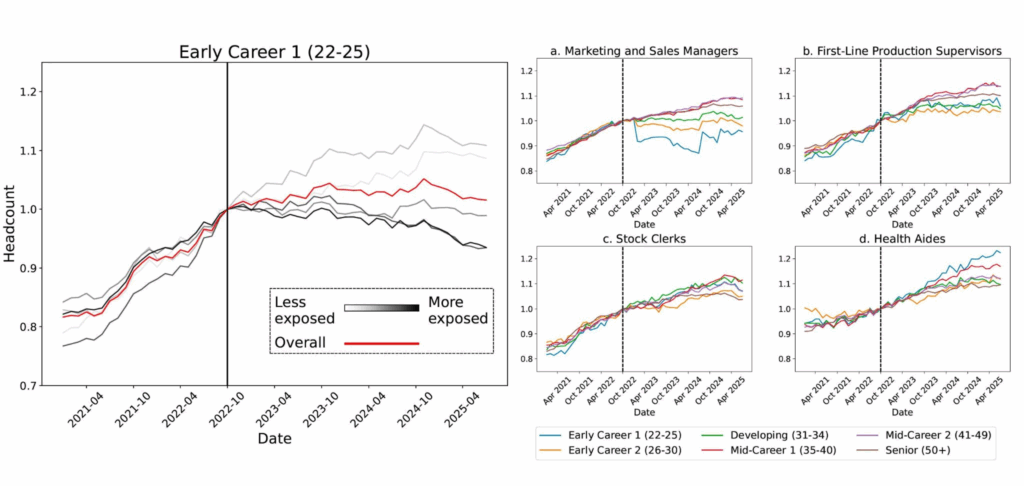
A new Stanford study shows that AI is harming certain jobs more than others. Source: Stanford Digital Economy Lab
Key Findings:
- In roles most exposed to automation — programming, marketing, customer support — employment for 22–25-year-olds fell by 13–16%.
- In contrast, employment for workers over 30 in these same roles grew by 6–12%.
Researchers link this resilience among older workers to:
- Nuanced, context-rich expertise that is harder to automate.
- Institutional experience and stability earned over many years.
---
Why Young Workers Are Hit Hardest
The gap isn’t about intelligence — it’s about structural vulnerability.
Typical Entry-Level Work:
- Routine bug fixes
- Standard customer service replies
- Writing ad copy
> These are exactly the tasks most easily handed over to algorithms.
Older workers tend to work on unstructured problems, requiring judgment — something that develops through experience, not textbooks.
Impact of Company AI Strategy:
- Replacement mindset → Reduce junior staff quickly.
- Augmentation mindset → Preserve and grow human + AI collaboration.
Without entry-level opportunities, the talent pipeline breaks:
- Fewer juniors gain skills.
- A decade later, companies will face mid-level skill shortages.
---
Long-Term Consequences
Unchecked erosion of entry-level roles can lead to:
- Broken talent pipeline — not enough trained professionals to replace today’s mid-career workforce.
- Generational imbalance — older staff stay employed, younger ones remain excluded.
- Policy missteps — incentives that push companies toward full automation rather than augmentation.
---
Platforms like AiToEarn illustrate how AI can be used as an augmentation tool rather than as pure replacement, enabling creators to generate, publish, and monetize multi-platform content across Douyin, Kwai, WeChat, Bilibili, Rednote, Facebook, Instagram, LinkedIn, Threads, YouTube, Pinterest, and X (Twitter) — while harnessing analytics and model ranking to guide growth.
---
What Skills Still Matter?
The disappearance of routine jobs doesn’t make humans irrelevant — it redefines what is valuable.
Enduring Skills for the AI Era:
- Logic — Spot flawed reasoning, especially in AI outputs.
- Rhetoric — Persuasive storytelling.
- Philosophy & Ethics — Knowing what should be done.
- Systems Thinking — See loops, dependencies, consequences.
- Writing — Clear communication to unify teams.
- Observation — Catch nuance and subtle patterns.
- Debate — Sharpen ideas through challenge.
- History — Learn from past cycles and avoid repeated mistakes.
> These are hard skills — difficult to quantify, and even harder to replace.
---
Employers’ Perspective
According to the World Economic Forum — Future of Jobs Survey (2024), employers expect the top skills by 2030 to be:
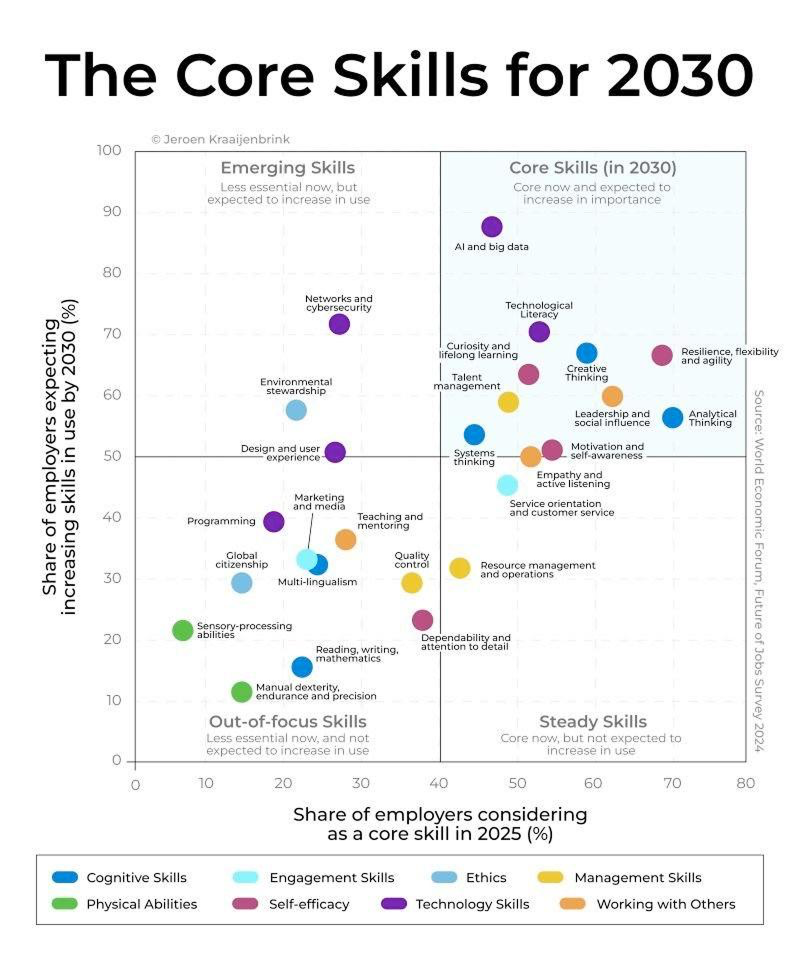
Source: World Economic Forum Future of Jobs Survey 2024
Top Skills for 2030:
- Analytical Thinking
- Systems Thinking
- Leadership
- Empathy
- Resilience
Notably, technical skills like programming or marketing — once cornerstones of entry-level work — are sliding down the list.
---
A Choice Ahead
ADP’s research makes it clear: How companies use AI matters.
- Replacement approach → Entry-level roles vanish; future talent shortages.
- Augmentation approach → Productivity rises; skills and opportunities grow.
> AI doesn't mark the end of work — it marks the end of easy work.
---
Key Takeaways
- Since 2022, employment for young workers in AI-exposed roles has dropped 13–16%.
- Older workers' employment in these roles grew 6–12%.
- Entry-level tasks are the most automatable; judgment-focused work remains human-driven.
- Future-proof skills are enduring human abilities: logic, rhetoric, systems thinking, debate, writing, ethics.
- Employers confirm the shift: human-centric skills will matter most by 2030.
- Companies must choose: replace people or augment them.
---
References
- ADP Research Institute (2025): Analysis of AI’s Impact on U.S. Payroll Data, 2022–2025.
- World Economic Forum (2024): Future of Jobs Survey.
- Belinda Luscombe, “AI Is Already Changing Jobs, According to Stanford and MIT Researchers,” TIME (2025). Read article
---
Final Thought:
If AI is taking away our first jobs, the answer is not despair — it’s to relearn how to think, and invest in the skills machines cannot easily copy.
Platforms like AiToEarn官网 provide one pathway to integrate AI into human creativity, ensuring that augmentation remains the guiding principle of future work.