
Andrew Ng Releases Automated Paper Reviewer, Achieves Near-Human Performance at ICLR
AI's Role in Academic Paper Review: Opportunities and Challenges
At present, even within the AI research community, there is no unified standard governing the use of AI in paper review.
Among leading global conferences:
- ICLR requires disclosure when large models are used during review writing.
- CVPR explicitly prohibits using large models at any stage of writing review comments.
---
Rising Pressure: Increasing Submissions, Limited Human Capacity
As submission numbers surge, human reviewers alone cannot keep up.
Even under ICLR 2026's strictest control rules, analysis revealed:
> Up to one-fifth of review comments were still one-click generated by large models.
Yet despite this adoption, review timelines remain excessively long.
Case in Point: Slow Feedback Loops
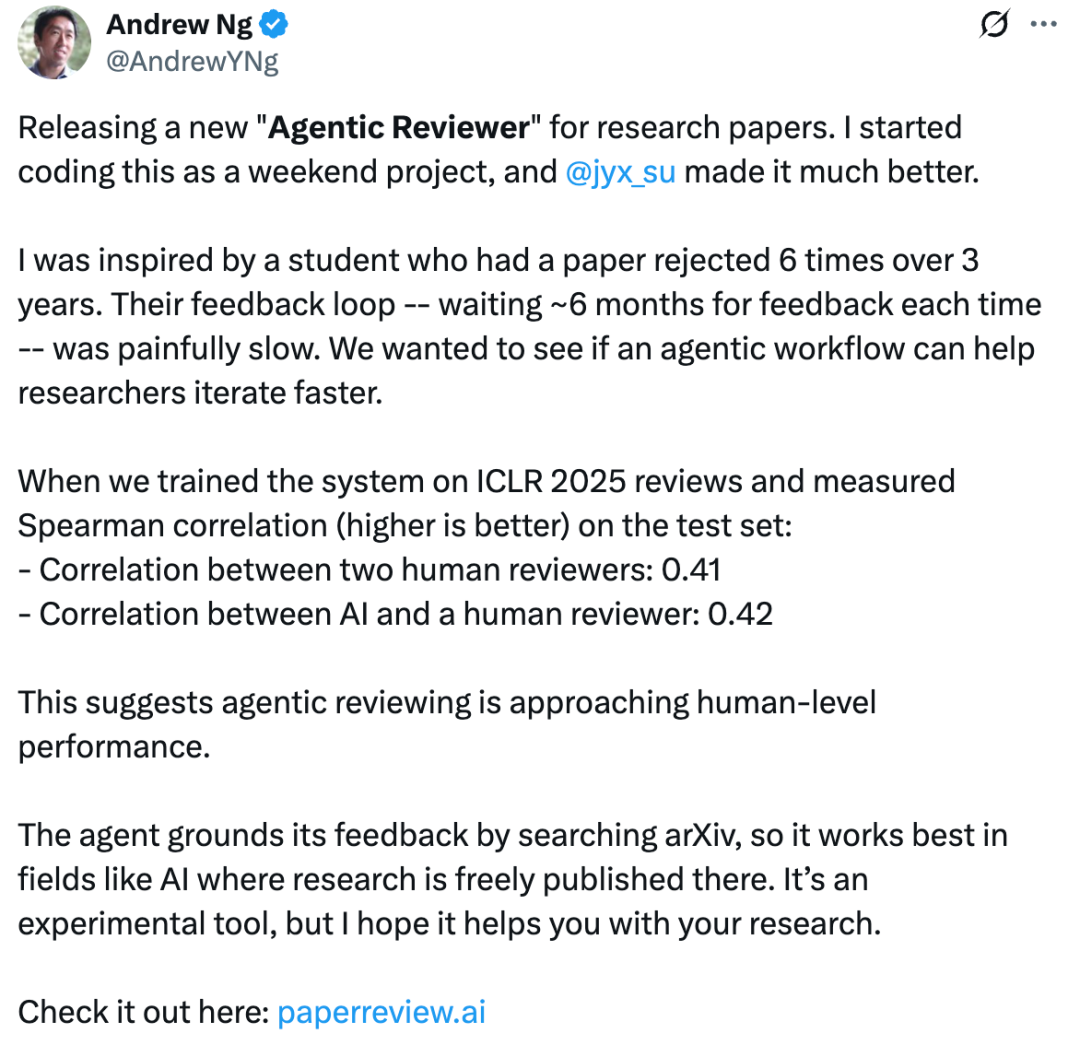
Renowned AI scholar Andrew Ng has criticized the ever-lengthening review cycles.
One of his students faced an especially difficult path:
- Rejected six times over three years
- ~6 months wait for each review decision
These lengthy cycles:
- Delay publication
- Reduce research agility
- Clash with the pace of modern technological development
---
Idea: AI-Powered "Paper Feedback Workflow"
If review timelines cannot be significantly shortened, perhaps AI can help in a different way:
- Provide high-quality feedback before official submission
- Enable directional revisions early
- Reduce cost and time lost in repeated rejections by major conferences/journals
Goal: Build an efficient AI-assisted pre-review pipeline for researchers.
---
The "Agentic Reviewer" Project by Andrew Ng
To address these issues, Professor Andrew Ng launched the Agentic Reviewer system for research papers.
Project origins:
- Started as a weekend hobby
- Enhanced with support from Ph.D. student Yixing Jiang
Training:
Used ICLR 2025 review data to develop the model.
Evaluation (Spearman correlation – higher is better):
- Human vs. Human: 0.41
- AI vs. Human: 0.42
This means the AI reviewer’s consistency is on par with human reviewers.
---
How It Works
- Retrieves evidence from arXiv to support its feedback
- Most effective in fields like AI where papers are openly available on arXiv

- Demo link: https://paperreview.ai/
---
Public Response
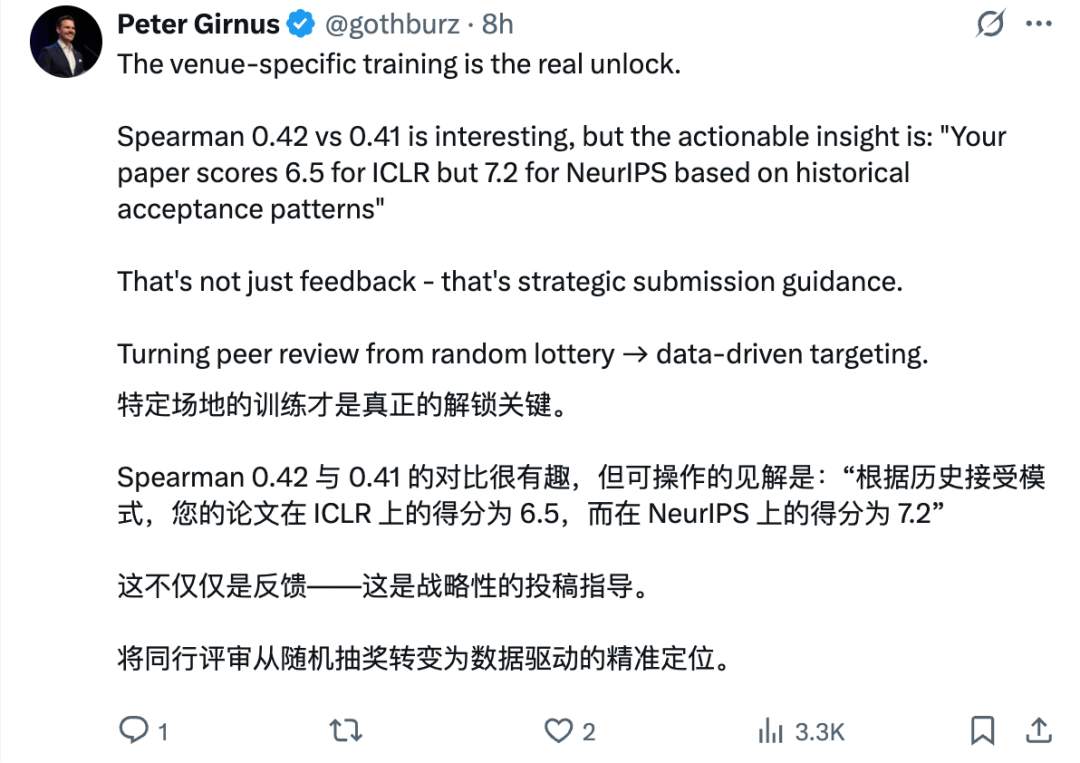
- Feedback is largely positive
- Users suggest customizing for specific conferences/journals
- Potential to provide estimated review scores
---
Potential Impact: Accelerating Science
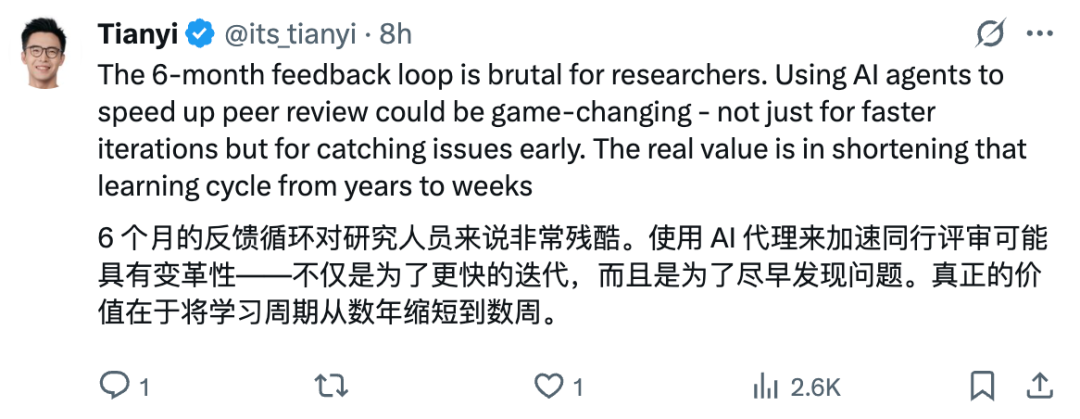
AI agents could:
- Speed up research cycles
- Shorten talent cultivation timelines
- Act as an engine for academic progress
---
Remaining Concerns
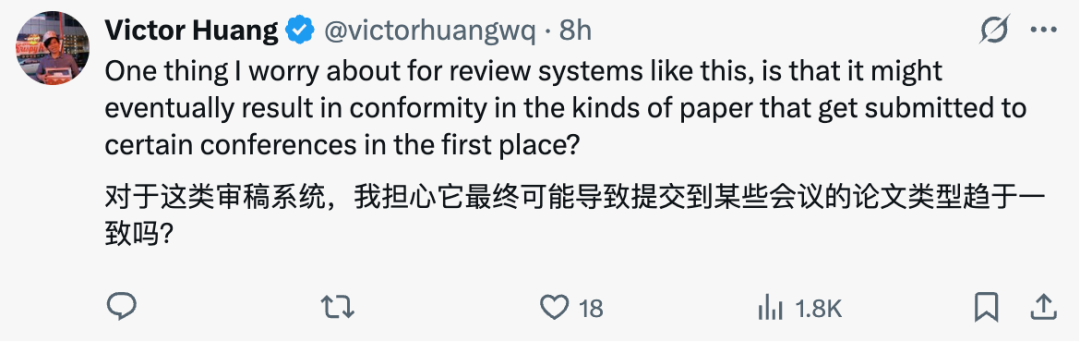
- If researchers pre-check their work with AI, could this reduce academic diversity?
- How will AI tools shape long-term reviewer behavior?
---
Looking Ahead: A Transforming Review System
With both researchers and reviewers using AI for feedback, the academic review process may be approaching a major structural transformation.
While the exact role AI will play is still evolving, its influence in academic workflows is expanding rapidly.
---
Related Productivity Platforms
In this ecosystem of faster, AI-assisted workflows, platforms like AiToEarn官网 offer a parallel approach:
- Integrate AI content generation
- Publish across multiple platforms simultaneously
- Provide analytics and model rankings
For academics, similar integrations could:
- Merge AI reviewers (like Agentic Reviewer) with publication and dissemination tools
- Streamline feedback, revision, and sharing into one seamless process
Example: AiToEarn enables creators to multi-post to:
- Douyin
- Kwai
- Bilibili
- Rednote (Xiaohongshu)
- Threads
- YouTube
- X (Twitter)
Turning AI-powered work into measurable, wide-reaching impact.


