AnyLanguageModel: Unified API for Local and Remote LLMs on Apple Platforms
# LLMs Have Become Essential Tools for Building Software — But Integration for Apple Developers Is Still Too Painful

For many Apple developers, incorporating **Large Language Models (LLMs)** into apps remains a frustrating process — even as AI becomes central to modern software development.

---

## Typical AI App Architecture

Most AI-powered apps for Apple platforms use a **hybrid approach** combining:

- **Local models** via Core ML or MLX — for privacy & offline use
- **Cloud providers** like OpenAI or Anthropic — for advanced features
- **Apple’s Foundation Models** — as a system-level fallback

Each option has **its own API, setup, and workflow**, which multiplies the complexity.

> “I thought I’d quickly use the demo for a test and maybe a quick and dirty build, but instead wasted so much time. Drove me nuts.”

---

## The High Cost of Experimentation

Prototyping with today’s tools is **time‑intensive and cumbersome**, discouraging developers from discovering that many **local, open-source models** already meet their needs.

---

## Introducing [AnyLanguageModel](https://github.com/mattt/AnyLanguageModel)

**AnyLanguageModel** is a **Swift package** that works as a drop‑in replacement for Apple’s Foundation Models framework — but supports **multiple model providers**.

**Goal:**
Make working with LLMs on Apple platforms *simpler, faster,* and **more open**, with painless integration of **local/open-source models**.

---

## The Solution — Simplicity by Design

Switch the import statement and keep using the same API:
- import FoundationModels
- + import AnyLanguageModel
- let model = SystemLanguageModel.default
- let session = LanguageModelSession(model: model)
- let response = try await session.respond(to: "Explain quantum computing in one sentence")
- print(response.content)
With **AnyLanguageModel**, you can **swap** in local, cloud, or mixed‑provider LLMs **without rewriting core logic**.

---

## Benefits at a Glance

- **Rapid prototyping**
- **Freedom** to pick the right model per scenario
- **Privacy-respecting** local model support
- **Reduced cloud cost** reliance

For developers creating **cross-platform AI experiences**, platforms like [AiToEarn官网](https://aitoearn.ai/) pair well — enabling simultaneous publishing of AI-generated outputs to Douyin, Kwai, WeChat, Bilibili, Rednote (Xiaohongshu), Facebook, Instagram, LinkedIn, Threads, YouTube, Pinterest, and X (Twitter), along with **analytics** and **model rankings** ([AI模型排名](https://rank.aitoearn.ai)).

---

## Example Usage
**Example – Using Apple’s built-in model:**
// Local open-source model via MLX:
let model = MLXLanguageModel(modelId: "mlx-community/Qwen3-4B-4bit")
let session = LanguageModelSession(model: model)
let response = try await session.respond(to: "Explain quantum computing in one sentence")
print(response.content)
---

### Supported Providers

- **Apple Foundation Models** — Native (macOS 26+ / iOS 26+)
- **Core ML** — Neural Engine acceleration
- **MLX** — Quantized models on Apple Silicon
- **llama.cpp** — GGUF backend support
- **Ollama** — Local server API
- **OpenAI / Anthropic / Google Gemini** — Cloud providers
- **Hugging Face Inference Providers** — Access hundreds of models

**Focus:** Local models downloadable from the [Hugging Face Hub](https://huggingface.co/docs/hub/), with cloud for quick starts and migration paths.

---

## Why Use Foundation Models as the Base API?

We chose **Apple’s Foundation Models framework** over designing a new abstraction because:

- **Well-designed**: Utilizes Swift macros, intuitive language model abstractions
- **Intentionally minimal**: Stable lowest-common-denominator for LLM APIs
- **Familiar to Swift devs**: Reduces conceptual overhead
- **Keeps abstraction light**: Easier to swap providers

---

## Lean Builds with Package Traits

Multi-backend libraries often cause **dependency bloat**. AnyLanguageModel solves this via **Swift 6.1 package traits**:
dependencies: [
.package(
url: "https://github.com/mattt/AnyLanguageModel.git",
from: "0.4.0",
traits: ["MLX"] // Only MLX dependencies
)
]
**Available traits:** `CoreML`, `MLX`, `Llama` (for `llama.cpp` / [llama.swift](https://github.com/mattt/llama.swift)).

**By default:** Only base API + cloud providers (URLSession).

---

## Image Support (and Trade-offs)

[Vision-language models](https://huggingface.co/blog/vlms-2025) can:

- Describe images
- OCR screenshots
- Analyze charts
- Answer image-related questions

Apple’s Foundation Models API **does not yet support** image input.
So AnyLanguageModel adds it now.

**Example — Send image to Anthropic Claude:**
let model = AnthropicLanguageModel(
apiKey: ProcessInfo.processInfo.environment["ANTHROPIC_API_KEY"]!,
model: "claude-sonnet-4-5-20250929"
)
let session = LanguageModelSession(model: model)
let response = try await session.respond(
to: "What's in this image?",
image: .init(url: URL(fileURLWithPath: "/path/to/image.png"))
)
---
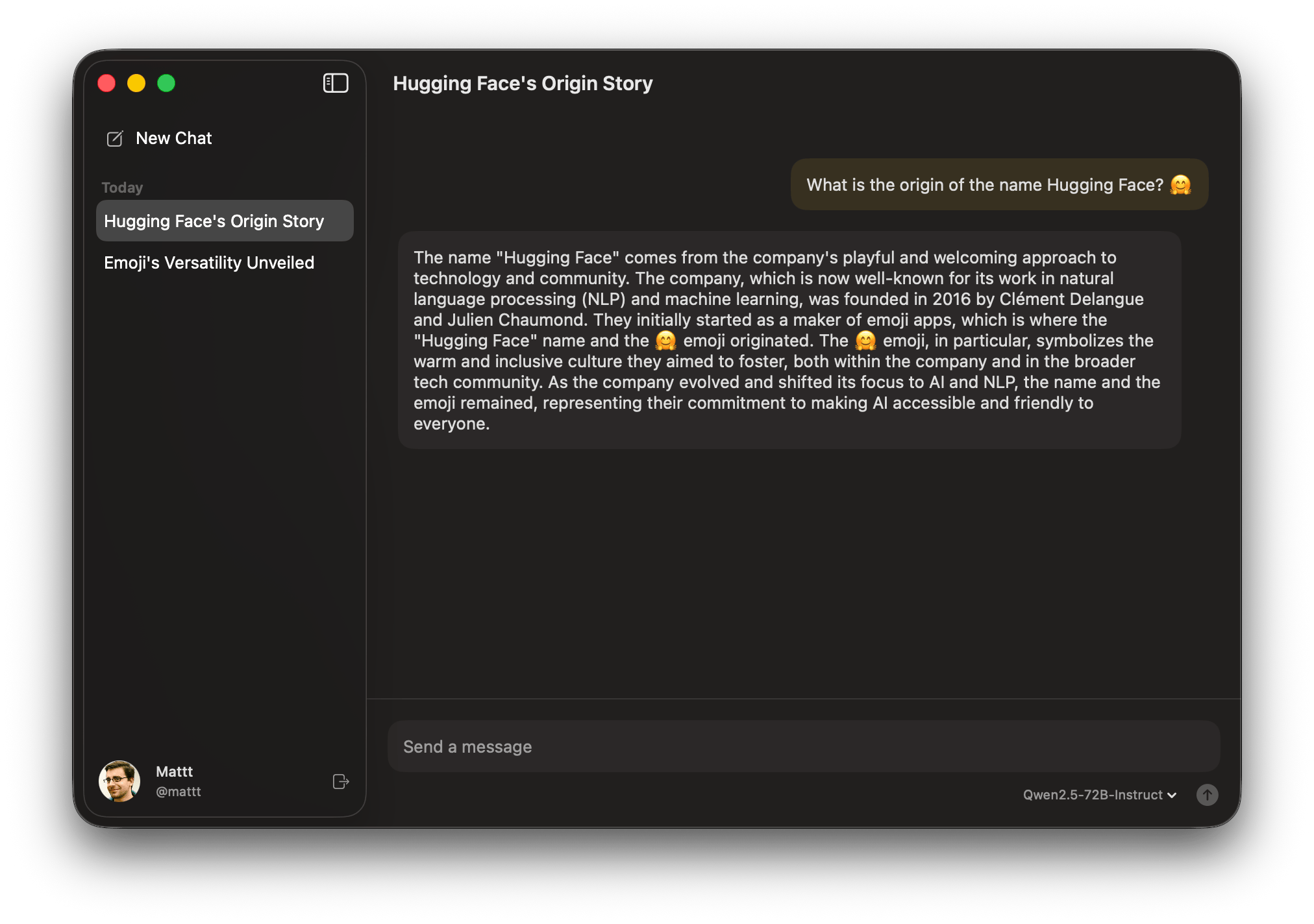
## Try It Out: [chat-ui-swift](https://github.com/mattt/chat-ui-swift)
[](https://huggingface.co/datasets/huggingface/documentation-images/resolve/main/any-swift-llm/chat-ui-swift.png)
Demo app includes:
- Apple Intelligence via Foundation Models
- Hugging Face OAuth for gated models
- Streaming responses
- Chat persistence
Use it as a **starter project**: fork, experiment, and extend.
---
## What’s Next
Upcoming in pre‑1.0 roadmap:
- **Tool calling** for all providers
- **MCP integration**
- **Guided generation** output formats
- Local inference optimizations
Aim: a **unified inference API** for building **agentic workflows** on Apple platforms.
---
## Get Involved
We welcome contributions!
Ways to help:
- **Try it** — Test with your own projects
- **Share feedback** — What's working, what's painful
- **File issues** — Feature requests, bugs, questions
- **Submit Pull Requests** — Join development
**Links:**
- [AnyLanguageModel on GitHub](https://github.com/mattt/AnyLanguageModel)
- [chat-ui-swift on GitHub](https://github.com/mattt/chat-ui-swift)
---
If you’re looking to **monetize** AI deployments, also check **[AiToEarn](https://aitoearn.ai/)** — an **open-source, global AI content monetization platform**. Publish AI outputs simultaneously to major social platforms, with analytics and model ranking to optimize reach and earnings.
More info: [Documentation](https://docs.aitoearn.ai/) | [Model Rankings](https://rank.aitoearn.ai/)