Apple's AI Paper Backfires: GPT-Written GT Forces Beijing Programmers to Pull All-Nighters

"Speechless" Moment in AI Research: Apple Paper Retracted After Serious Benchmark Flaws
Big "speechless" incidents happen every day in tech — but today’s case is truly remarkable.
Lei Yang, a researcher from AI large‑model company StepStar, was seriously tripped up by a paper Apple had posted on arXiv.
When Yang raised issues on GitHub, Apple’s team replied briefly, closed the issue, and only retracted the paper after his public follow‑up comment — also deleting the code repository.

---
How It Started
Earlier this month, Lei Yang was tipped off by a colleague about Apple’s paper on arXiv (also submitted to ICLR 2026).
The benchmark it proposed was a perfect fit for Yang's current research, and he was excited enough to drop all other projects to start adapting his work.
The claim was striking: “Small models comprehensively surpass GPT‑5, with data carefully curated by humans.”
But reality hit hard.
- The official code contained absurd bugs.
- The Ground Truth (GT) error rate was estimated at ~30%.

---
Step‑by‑Step Escalation
1. Initial Adaptation
Yang spent an all‑nighter adapting his research to the benchmark — only to find extremely low scores.
> “I was extremely frustrated,” he later said.
2. Discovering the Bug
- The official code sent only the image file path string to the VLM, not the actual image content.
- After fixing the bug, scores dropped even further.
3. Manual Review
Manually checking 20 wrong answers revealed:
- 6 clear GT errors.
- GT was likely auto‑generated by a model with poor QA, leading to hallucinations.
- Estimated GT error rate: ~30%.
4. Reporting the Problem
Yang filed a GitHub issue. Six days later, the authors replied briefly and closed the issue without resolution.

---
Public Call‑Out and Reaction
Frustrated, Yang posted a detailed public comment on OpenReview:
- Listed GT problems and misleading examples.
- Warned reviewers and researchers to avoid wasting time.
- Direct OpenReview link: https://openreview.net/forum?id=pS9jc2zxQz
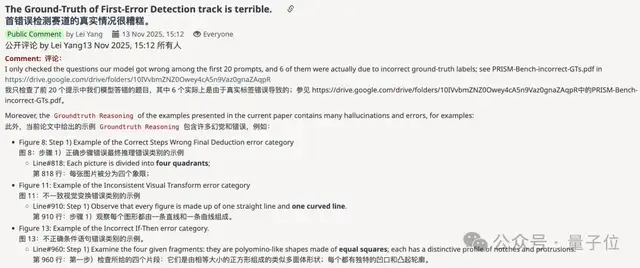
> "...prevent interested researchers from repeating the cycle I experienced — initial excitement, shock, disappointment, and frustration — saving everyone time and effort."
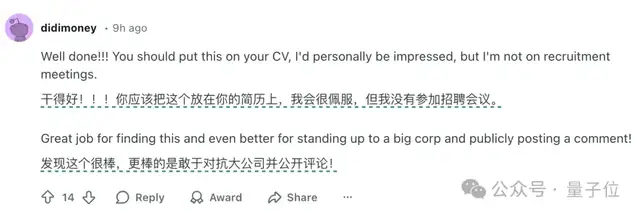
Community response was supportive:
---
Paper Retraction
The day after his public comment:
- Authors retracted the paper.
- Deleted the GitHub repo.

Yang shared his experience across platforms, warning against blindly trusting even polished work from large companies.
---
Authors’ Official Response
On the “Small Sweet Potato” platform, the authors stated:
Communication
- They had communicated with Yang in detail.
- Expressed respect for his work.
Data Quality
- Admitted inadequate review.
- Checked injected error samples manually but did not audit critical parts.
- When GT solutions were auto‑converted to CoT by GPT, hallucinations arose, causing incorrect step labels.
Example Inference
- Demo code in repo was dummy sample, not formal code.
- After Yang’s alert, they modified it.
Issue Handling
- Regretted closing the GitHub issue prematurely.
- Promised to keep issues open until resolved.
> "We will seriously reflect on this experience and keep pushing ahead."

---
Lessons for the AI Community
This incident underscores:
- Rigorous dataset verification is critical.
- Open discussions help maintain research integrity.
- Even high‑profile corporate research can have serious flaws.
---
Role of Open Platforms
Open‑source platforms like AiToEarn官网 can help:
- Generate, publish, and monetize AI‑created content across multiple platforms.
- Integrate analytics and AI model rankings (AI模型排名).
- Surface and address issues transparently before they mislead research.
---
References
- https://x.com/diyerxx/status/1994042370376032701
- https://www.reddit.com/r/MachineLearning/comments/1p82cto/d_got_burned_by_an_apple_iclr_paper_it_was/
- https://www.xiaohongshu.com/explore/6928aaf8000000001b022d64?app_platform=ios&app_version=9.10&share_from_user_hidden=true&xsec_source=app_share&type=normal&xsec_token=CBLEH7cvuVDNN78gtS-RUB8YQp0_GXstBHlQAk14v6t8I=&author_share=1&xhsshare=WeixinSession&shareRedId=NzxHOEQ6OTw6Pjw3Sj81SD1HQUk5R0lK&apptime=1764289526&share_id=c73caa18d27a408898ea99622f8e0360
- https://openreview.net/forum?id=pS9jc2zxQz
- https://openreview.net/pdf/e5917f72a8373c7f56b3cb9c0ac881d991294ee2.pdf
---
Takeaway:
Clear credit attribution, compliance with submission guidelines, and strong community oversight are vital. Open platforms and transparent workflows can ensure that AI research outputs remain accurate, ethical, and impactful.