# Large–Small Model Collaboration in Intelligent Investment Advisory

Leveraging **the precision and performance of traditional quantitative small models** combined with **the flexibility of large-model Agents**, we can achieve:
- **Problem identification**
- **Task expansion**
- **API calls to small models**
- **Answer fusion**
---
## Industry Context

The rise of large models has introduced **new technical possibilities** for all human-interaction domains. In **investment advisory**, adoption has been cautious due to **hallucination risks** and **limited domain reasoning depth**.
This article is based on a June presentation at **AICon 2025 Beijing** by a senior algorithm expert from **Beiyin Fintech**, titled *“Application of Large–Small Model Collaboration in Intelligent Investment Advisory”*.
The proposed architecture:
- **Extends general large models into industry-specific applications**
- Combines **precision small models** with **large-model Agents**
- Uses **problem identification → task expansion → small-model API calls → answer fusion**
- **Mitigates hallucination** and **improves depth** in responses
---
### AICon Beijing 2025
📅 **December 19–20**
🎯 Theme: **"Exploring the Boundaries of AI Applications"**
Focus areas:
- Enterprise-level Agent deployment
- Context engineering
- AI product innovation
Industry leaders will share **real-world experience** and **case studies** on how AI can enhance R&D and operations.
**Agenda:** [https://aicon.infoq.cn/202512/beijing/schedule](https://aicon.infoq.cn/202512/beijing/schedule)
---
## Historical Perspective on Intelligent Investment Advisory
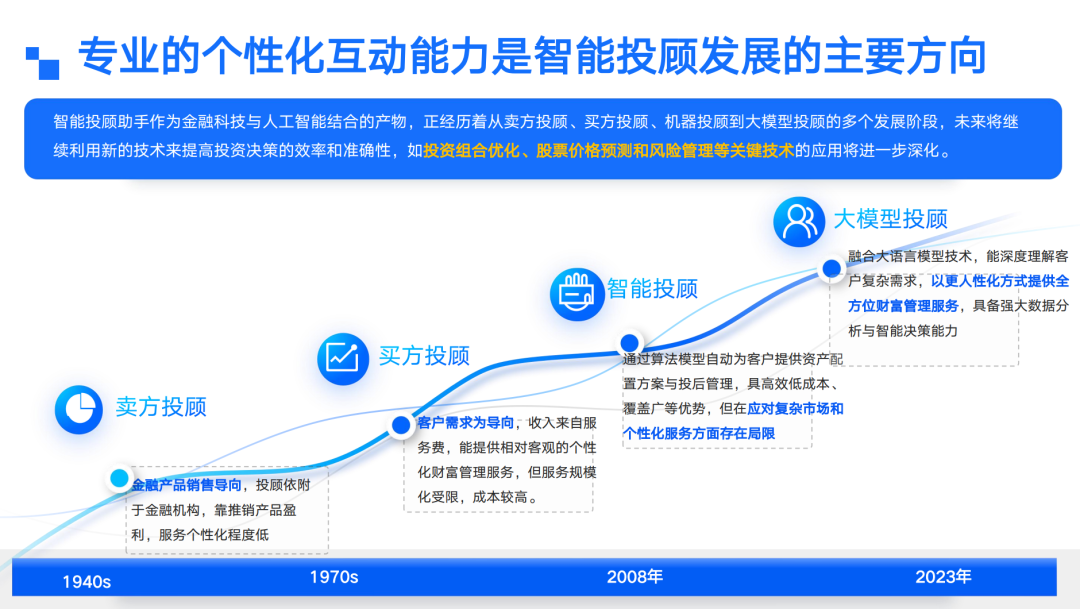
After the **2008 subprime crisis**, human advisors faced scrutiny. This led to the emergence of **Wealthfront** and **Betterment**, shifting the landscape from **Wall Street to Silicon Valley**.
**Past characteristics:**
- Relied on rule-based small models (**Black-Litterman**, **mean–variance**, **risk parity**, etc.)
- Models were **opaque** and controlled by select institutions
- Commissions were earned while risks were borne by investors
**Breakthrough:**
These startups **published algorithms publicly**, along with backtesting results, enabling transparency.
---
### Development in China
Timeline:
- **2014**: Prototypes like *Latte Zhituo* and *Koala Zhituo* appear; *JD Zhituo* designed
- **2017**: China Merchants Bank launches *Mocha Zhituo* — first big public exposure
- Despite innovations, market traction remained limited due to *lack of interaction*
**Key insight:**
Investment advisory is “**three parts investing, seven parts advising**.”
Personalized, ongoing interaction was missing — something only **large models** can now enable.
---
## Emerging Ecosystems & Tools
Platforms like [AiToEarn官网](https://aitoearn.ai/) now enable:
- **AI content creation**
- **Cross-platform distribution**
- **Analytics and monetization**
- Support for major platforms (Douyin, Kwai, WeChat, Bilibili, Rednote, Facebook, Instagram, LinkedIn, Threads, YouTube, Pinterest, X/Twitter)
---
## Key Market Examples
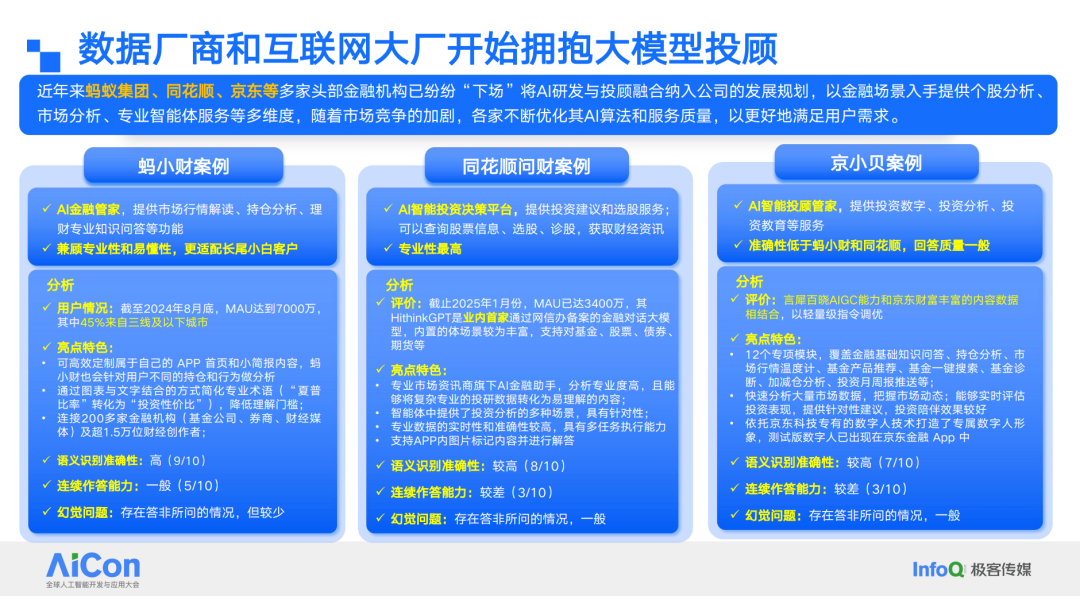
- **Ma Xiao Cai (Ant Group)** — Focus on **compliance** and **knowledge boundaries**
- **Wen Cai (Tonghuashun)** — Integrated **data + large models**; excels in technical queries but weaker in semantics
- **Jing Xiao Bei (JD)** — Primarily an **enhanced customer service bot**
---
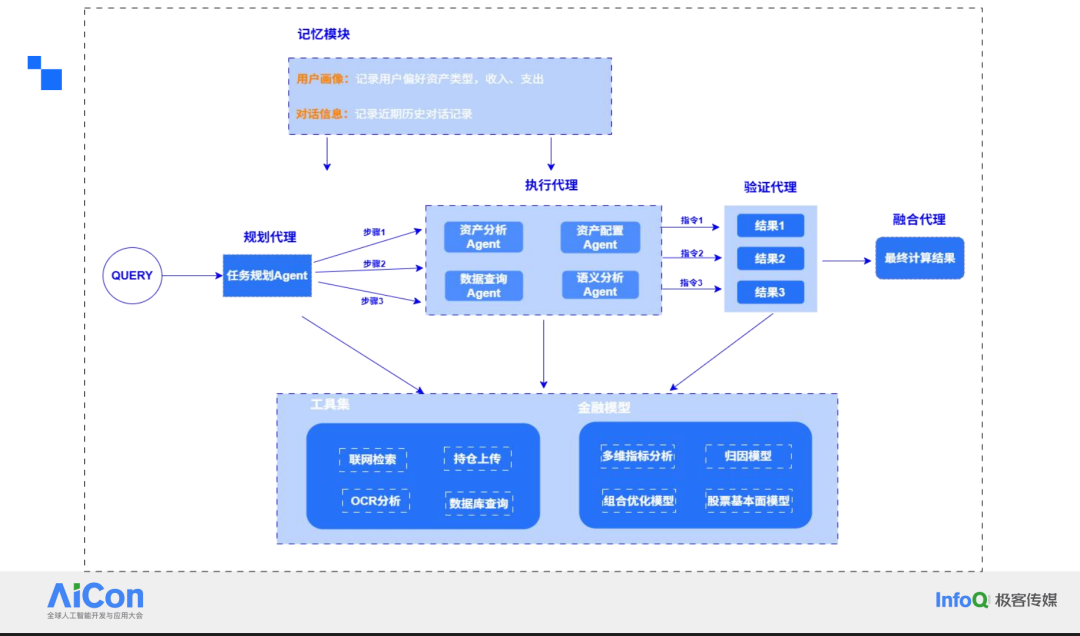
## Functional Architecture Design
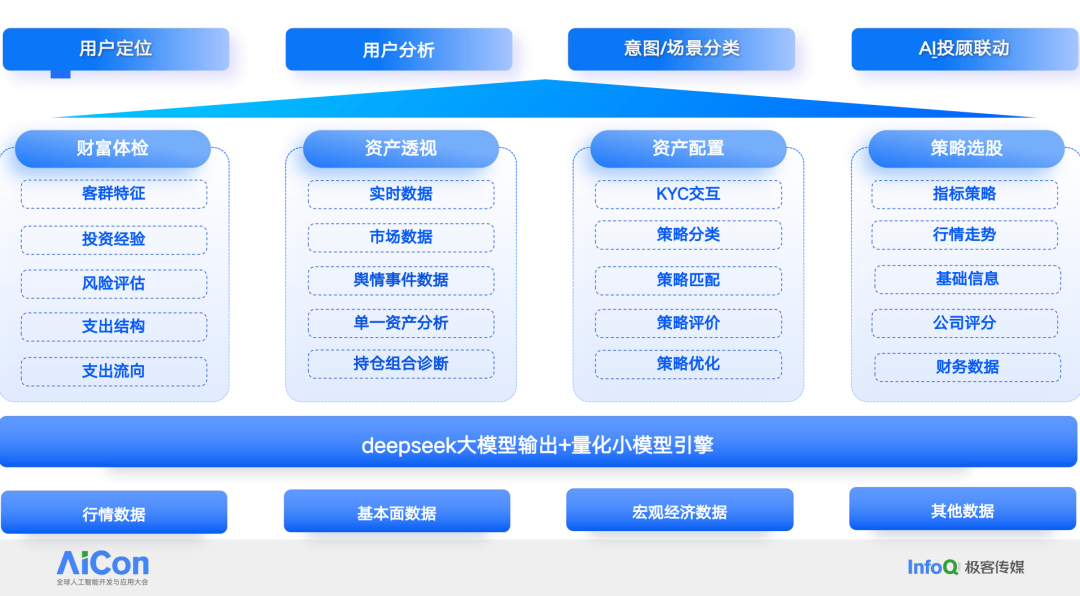
**Design principle:**
**Large model = dialogue + planning**
**Small models = precise computation**
### Components:
1. **Data layer** — Connect *all* available data
2. **Large model (DeepSeek)** — Rewriting, expansion, task planning
3. **Small model cluster** — Quantitative computations
4. **Answer synthesis** — Return results in user-friendly form
**ToC vs. ToB difference:**
- **ToC**: Short, divergent queries
- **ToB**: Long, procedural queries with *zero hallucination tolerance*
---
### Categories of Small Models
1. **Basic Models** — Provide raw indicators
2. **Asset Recommendation Models** — Split by asset class with traceable rationale
3. **Attribution Models** — OCR-based portfolio aggregation and analysis
4. **Asset Allocation Models** — Real-time invocation of core allocation engines
5. **Categorical Prediction Models** — Predict trends for broad asset classes
Each has a **feature vector** (algorithm, target audience, input/output format, etc.) for **interpretability and reproducibility**.
---
### Embedding Intent Recognition
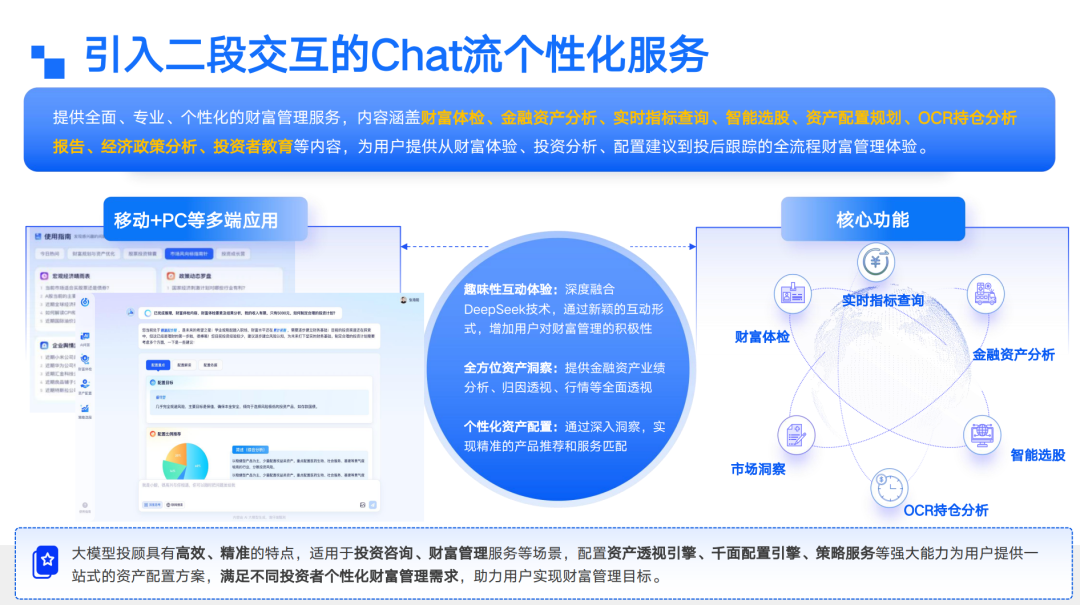
- Detect **deeper operations** → switch to **interactive cards**
- Card triggers **API-based functional modules**
- Promotes **reuse of legacy systems** through AI orchestration
---
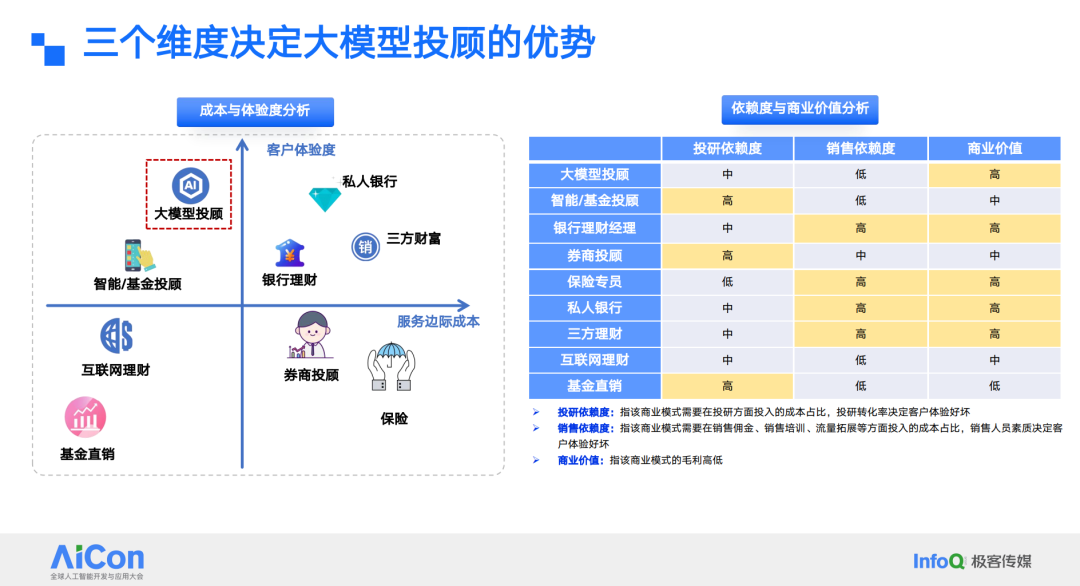
## Why Large–Small Collaboration?
**Three main drivers:**
1. **Hallucination control** — Must approach *100% accuracy* in B-end scenarios
2. **Professional depth** — Small models outperform in quantitative calculations
3. **Lower cost & latency** — Reduces compute time from **40–50s → under 20s**
---
## Engineering Implementation
**Two-step pipeline:**
1. **Colloquial → structured intent** via DeepSeek Chain-of-Thought
2. **Agent-based task planning**:
- Assign facts to large model
- Numbers to small models
- Missing info via RAG
- Visuals via templates
---
## Agent Flow Orchestration
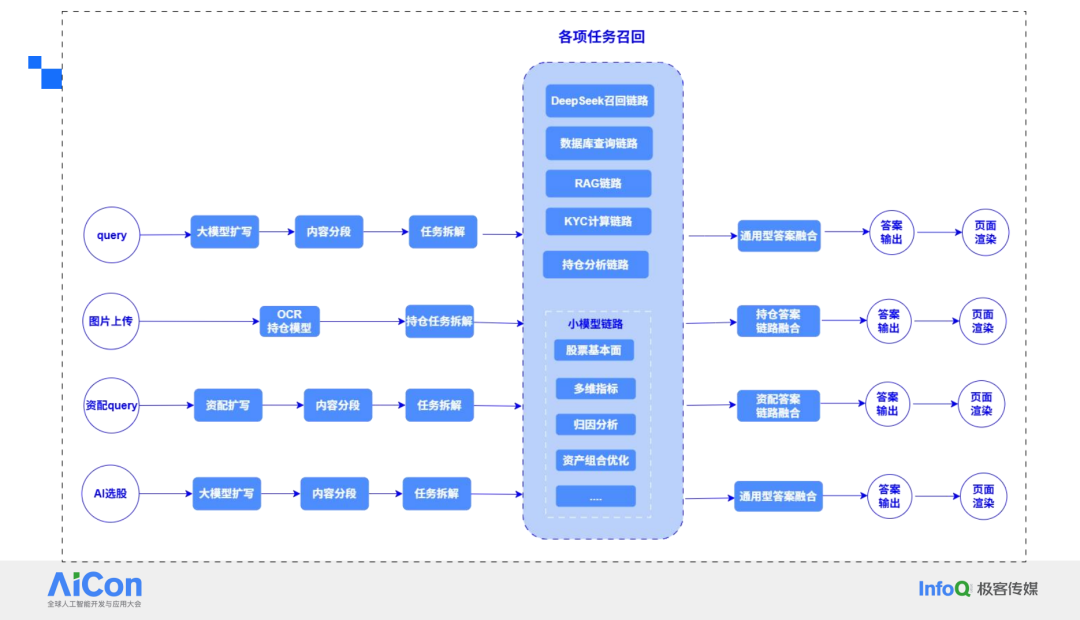
- Use **different prompt strategies** for varied expansion needs
- Optimize each step with **size-appropriate models** (even 0.5B models work for narrow tasks)
- Integrate small models as **API services behind Agents**
- Add **expert-fusion stage** for refined final outputs
---
## Handling Queries: SQL vs API
- Currently using **Text-to-SQL** for indicator queries
- In **well-defined scenarios**, SQL yields precise results
- Considering **API-based** approach for flexibility
---
## The Value of Collaboration
Advantages over traditional systems:
- **Higher interactivity**
- **Better user experience**
- **Lower manual cost** despite higher fixed cost
---
### "Depth-to-Compute" Ratio
Concept: As with **autonomous driving**, getting from 90% to 99% performance requires exponentially more compute.
Solution: Use **small models for deep, narrow tasks** instead of embedding all domain knowledge into a large model.
---
## AI in ToB Systems
- Integrated a **Chatbot interface** to connect multiple systems
- Two-stage interaction: persona-based advisory, then execution flow
- Supports embedding into existing pages and features
---
## Event Reminder
**AICon 2025** – **December 19–20**, Beijing
The last AICon of the year — deep-dives into **Agents**, **context engineering**, and **AI product innovation**.

[Read the original article](2651262812)
---
## Final Note
The **large–small model hybrid** is key for:
- **Mission-critical sectors** like finance
- **Compute efficiency**
- **Domain-specific depth**
Platforms like [AiToEarn官网](https://aitoearn.ai/) allow scaling such approaches across content and industry applications.
[Open in WeChat](https://wechat2rss.bestblogs.dev/link-proxy/?k=4c3ae5d1&r=1&u=https%3A%2F%2Fmp.weixin.qq.com%2Fs%3F__biz%3DMjM5MDE0Mjc4MA%3D%3D%26mid%3D2651262812%26idx%3D2%26sn%3D12801567c35d3adadc23746706f9966b)