Complete Guide to 4-bit Quantization Algorithms: From GPTQ and AWQ to QLoRA and FlatQuant
Large Model Intelligence|4-Bit Quantization Frontier
Introduction: Balancing Compression and Accuracy
In our previous discussion on 8-bit quantization (W8A8), pioneers balanced accuracy with efficiency, pointing the way toward slimmer and faster large models.
But for enormous models—with parameters in the hundreds of billions to trillions—8-bit remains too large to fit into mainstream hardware.
- Example:
- A 70B model at 8-bit still takes ~70 GB. This exceeds most consumer GPUs’ VRAM and even many enterprise inference cards, making deployment impractical.
Goal:
Break the “VRAM wall” so powerful LLMs can run locally for mass accessibility.
Solution path: Push compression further into 4-bit quantization.
---
Why 4-Bit Quantization Is Hard
> Moving from 8-bit (256 values) to 4-bit (16 values) is like replacing a precision caliper with a basic ruler for measuring micromechanical parts.
Challenges:
- Quantization error is amplified
- Naïve methods cause catastrophic accuracy loss
Opportunities:
A new generation of algorithms tackle these issues with ingenuity:
- GPTQ – Layer-wise reconstruction with error compensation
- AWQ – Protects key weights based on activation importance
- QLoRA – Combines 4-bit quantization with LoRA fine-tuning
- FlatQuant – Learns optimal layer-wise transformations for full W4A4
---
01 – GPTQ: Precision Sculpting with Error Compensation
Core Idea: Layer-Wise Non-Destructive Reconstruction
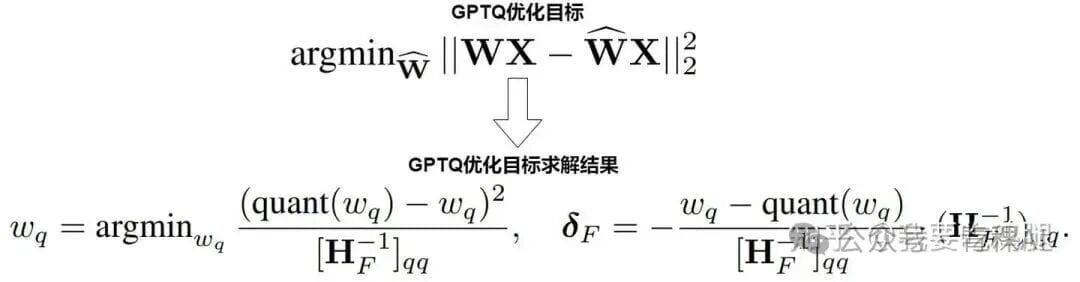
Instead of sidestepping complexity, GPTQ treats quantization as a problem of finding a quantized weight matrix that keeps the Mean Squared Error (MSE) of the layer’s output minimal.
Formula:
\[
\min_{W_q} \; \| f(W_q, X) - f(W, X) \|_2^2
\]
Strategy:
- Quantize one weight at a time.
- Immediately adjust remaining unquantized weights using inverse Hessian-based sensitivity measures.
- Repeat until all weights are quantized.
---
Theoretical Roots: OBD → OBS → OBQ
OBD (Optimal Brain Damage)
- Purpose: Select weights to prune without large loss increase
- Approach: Second-order Taylor approximation; assumes independent weights.
OBS (Optimal Brain Surgeon)
- Purpose: Improve upon OBD
- Approach: Use full Hessian; prune one weight and compensate others immediately.
- Drawback: Requires costly inverse Hessian (O(N³) complexity).
OBQ (Optimal Brain Quantization)
- Insight: Pruning is a special case of quantization.
- Approach: Quantize one weight, compensate others via inverse Hessian correlation.
---
GPTQ’s Three Innovations
To make OBQ efficient for large models, GPTQ introduces:
- Fixed Quantization Order –
- Enables full parallelization by quantizing columns in a fixed sequence.
- Lazy Batch-Update –
- Delays compensation until blocks of columns are processed, reducing I/O overhead.
- Cholesky Decomposition –
- Avoids precision drift by replacing explicit inversion with stable triangular solves.
---
GPTQ Summary
Pros:
- Near-lossless accuracy at 4-bit
- Applicable to most Transformer models
Cons:
- Still time-consuming offline process
- Accuracy depends heavily on calibration dataset quality
---
02 – AWQ: Activation-Aware “Key Protection”
Observation: Not All Weights Are Equal
AWQ focuses on critical minority weights—those in high-activation channels.
Evidence:
Protecting just 1% of such weights at higher precision nearly restores baseline model accuracy.
---
Approach: Scaling Significant Weights
- Step 1: Identify channels with largest average activations from calibration data.
- Step 2: Pre-amplify weights in these channels by scale factor \(s>1\) before quantization.
- Step 3: During runtime, divide corresponding activations by \(s\) (fused to earlier ops) for mathematical equivalence with no overhead.
---
Finding Optimal Scaling
- Reduce search to a single scalar factor \(\alpha\in[0,1]\).
- Perform quick grid search to minimize quantization error.
---
AWQ Summary
Pros:
- Simple, fast, hardware-friendly
- Accuracy rivaling GPTQ in many cases
Cons:
- Assumes minority weight protection suffices
- Depends on representative calibration dataset
---
03 – QLoRA: Quantization + Low-Rank Fine-Tuning
Problem: Fine-Tuning Large Models Is Expensive
Standard LoRA requires base model in FP16. QLoRA enables fine-tuning quantized 4-bit bases.
---
Core Idea: “Greenhouse on Ice”
- Frozen ice layer: Static 4-bit NF4 quantized base model
- Greenhouse: Tiny BF16 LoRA adapters trained on top
---
Three Innovations:
- NF4 Data Type: Optimal for normal-distributed weights; uses quantile points.
- Double Quantization: Further compress per-block scaling factors from FP32 to 8-bit.
- Paged Optimizers: Dynamic VRAM management to absorb memory spikes.
---
QLoRA Summary
Pros:
- Fine-tune up to 65B models on 24 GB GPU
- Dramatically lowers hardware barrier
Cons:
- No inference speedup/memory benefit—only training
---
04 – FlatQuant: Learned Optimal Transformations
Goal: Full W4A4 Quantization
Flatten both weights and activations for consistent quantization.
---
Issues with Existing Transforms
- Per-channel scaling: Limited channel-to-channel transfer
- Hadamard transform: Same orthogonal transform for all layers, mismatched difficulties
---
Solution: Learn Layer-Specific Affine Transformation
- Matrix P: Optimized per layer with calibration data to flatten distributions
- Kronecker Decomposition: Factor P into small matrices to cut parameters and compute cost.
---
FlatQuant Summary
Pros:
- Top accuracy for full 4-bit W4A4 quantization
- Layer-specific transformation
Cons:
- More complex and requires learning step
---
Closing Thoughts
4-bit quantization is crucial for accessible deployment of large models.
Each algorithm offers unique trade-offs:
- GPTQ: Mathematical optimality, slower offline
- AWQ: Fast, intuitive heuristic
- QLoRA: Enables efficient fine-tuning of quantized models
- FlatQuant: Learns layer-specific smoothing for hardest scenarios
Choosing the right method depends on:
- Accuracy needs
- Available calibration data
- Target tasks: inference acceleration vs fine-tuning
---
Tip for Practitioners:
Pair your model optimization workflow with streamlined publishing and monetization tools to maximize real-world impact—e.g., integration with platforms that handle generation + multi‑channel deployment + analytics for AI-powered content. This ensures your technical advances reach and benefit users quickly.