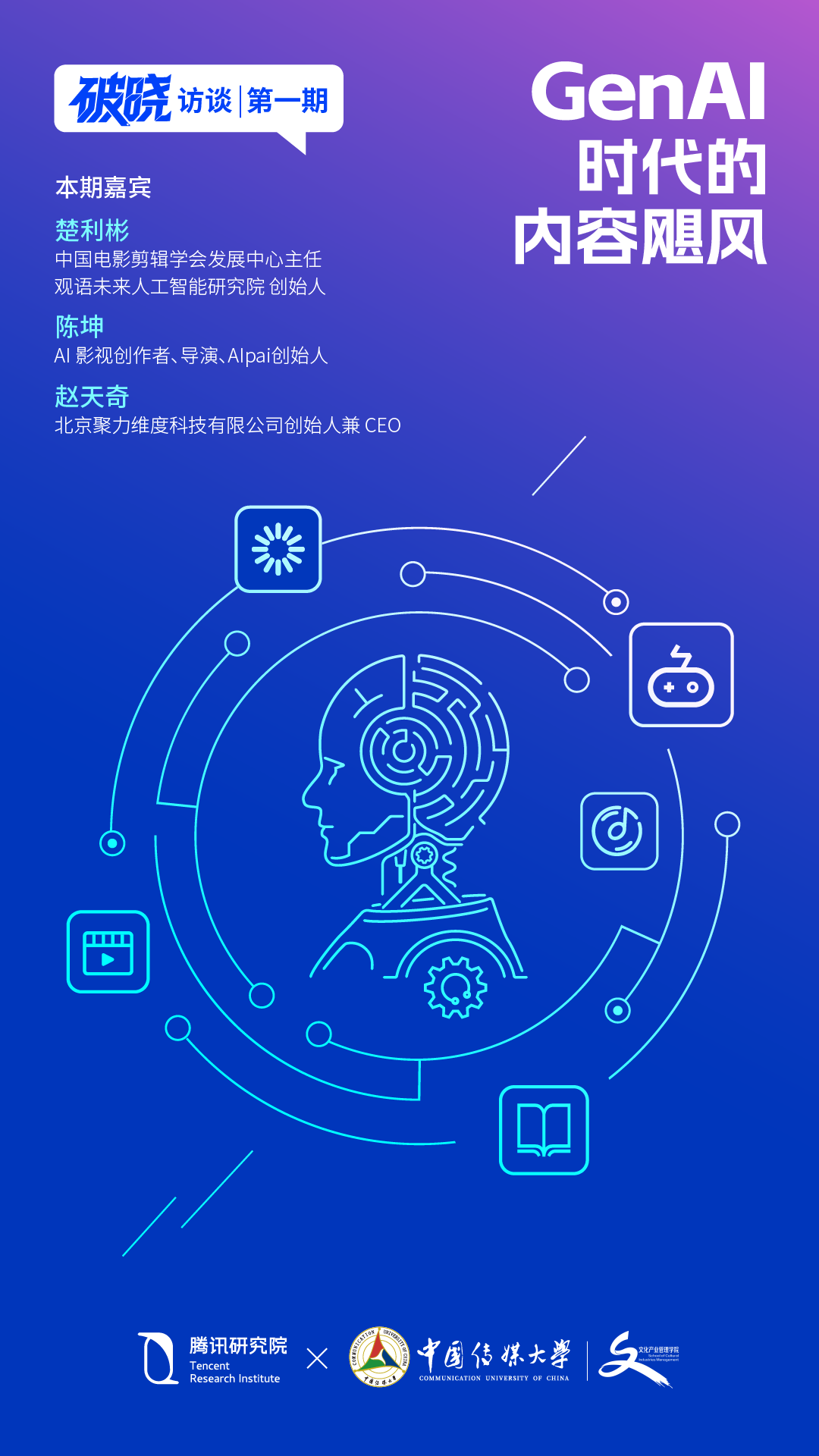
Content Hurricane in the GenAI Era | Dawn Interview

Original Dawn Interview
Date: 2025‑11‑12 · Location: Beijing

---
Introduction: A Paradigm Shift in Content Productivity

Generative Artificial Intelligence (GenAI) is sparking a profound transformation in content productivity. Across text, images, video, and music, AI is smashing barriers to creating high‑quality, dynamic content — pushing complex creative work into the realm of machines.
This rapid technology growth produces a dual dynamic for the cultural industry:
- Strategic Anxiety — Established value chains, business models, and ecosystems are being reshaped.
- Opportunistic Desire — AI offers unprecedented potential to lower costs, boost efficiency, and expand creativity.
---
About the “Dawn” Project
Title: Dawn: GenAI Reshaping the Cultural Industry
Organizers: Tencent Research Institute + Communication University of China, School of Cultural Industry Management
Focus Areas:
- Long‑form video
- Short video
- Music
- Animation
- Online literature
The research examines systematic transformations in cultural industries during the AI era, seeking intelligent, adaptive strategies. The aim is to unite technology’s light with human creativity, welcoming a new dawn for cultural innovation.
---
Guest Speakers
- Chu Libin — Director, Development Center of the China Film Editing Society; Founder, Guanyu Future AI Research Institute
- Chen Kun — AI film creator, director, founder of AIpai
- Zhao Tianqi — Founder & CEO, Beijing Juliv Dimension Technology Co., Ltd.
Research Team:
- Communication University of China: Liu Jianghong, Yang Jianfei, Chen Xianying, Tian Hui, Wang Xiage, et al.
- Tencent Research Institute: Sun Yi, Tian Xiaojun, Feng Hongsheng, et al.
---
Key Insights
- GenAI’s penetration varies by field
- Automates repetitive, high‑cost tasks.
- Cannot replace humans in all areas; industrial adaptation still maturing.
- Rapid expansion of AI‑native formats
- AI short videos, AI comic dramas surging.
- AI enables real‑time, self‑growing cultural products.
- Empowering individual creators
- Rise of personalized, small‑scale, cross‑domain producers.
- Mastery of “human–AI collaboration” could become mainstream.
- IP, rights, and revenue disruption
- New payment models may emerge.
- Early experimentation in short video, but wider transformation will require time.
- Audience acceptance
- As long as quality meets needs, consumers are open to AI‑native content.
- AI raises average content quality, phasing out poorer works.
- Concerns
- Decline of traditional skill‑building among creators.
- Need for controllability in AI systems.
---
Interview Highlights
I. Current State of AI in Content Production
Chu Libin: AI’s transformation is fundamentally different from past tech updates.
Observation:
- Professional “intelligent editing” still lags; AI understanding of human‑shot footage is weak.
- High compute costs make deep video analysis inefficient; human editors remain faster.
- When footage is AI‑generated from scratch, back‑end processing collapses traditional production systems entirely.
---
Chen Kun:
- Deep AI penetration in pre‑production: planning, scriptwriting, storyboarding.
- Production stage: Text‑to‑video emerging; image intermediates used.
- Post‑production: AI adoption low; human editing still dominant in pro workflows.
---
Zhao Tianqi:
- Two future paths: 2D vs. 3D.
- 3D: Industrial‑grade realism, requires complex multimodal data.
- 2D: Already high realism and flexible; strong growth but nearing limits.
---
AI‑Native Content: Value & Impact
Chu Libin:
AI evolves beyond video creation into a “super‑organism” — identifying and shaping latent emotional needs.
- Moves from attention capture to desire creation.
- Builds user dependence through deeper emotional resonance.
---
Chen Kun:
- No true AI‑native content yet; current works replicate traditional frameworks, just faster/cheaper.
- Future goal: content only AI can achieve — real‑time generative experiences, evolving works.
---
Zhao Tianqi:
- 2D: Success with AI short animations and dynamic manga — low cost fits audience tolerance for visual discontinuities.
- Limitation: Cannot meet strict performance/continuity needs for immersive film.
- 3D path: Potential to democratize industrial‑grade film production.
---
New Types of Content Producers
Zhao Tianqi: Emergence of “video novelists” — merging director and writer roles.
Chen Kun: Rise of super‑individuals: creators using AI large models for end‑to‑end production.
- Lowers technical/aesthetic barriers.
- Specialized subfields will persist for high‑end work.
---
Example Platform:
AiToEarn官网 — AI content monetization ecosystem.
- Generate, publish, and monetize across Douyin, Kwai, WeChat, Bilibili, Rednote, Facebook, Instagram, LinkedIn, Threads, YouTube, Pinterest, and X (Twitter).
- Features analytics and AI模型排名.
- Practical bridge for human–AI collaborative production.
---
Copyright, Licensing & Revenue in the AI Era
Chen Kun:
- Copyright definitions unclear for AI works; law will adapt reactively.
- Possible shared ownership among participants.
Chu Libin:
- Business systems may shift from advertising to on‑demand desire creation.
- Instant IP models: personalized, short‑lived cultural products meeting temporary demand.
- Move toward experience economy; invisible embedded marketing could dominate.
---
Consumer Acceptance & Willingness to Pay
Chu Libin:
- Quality depends on aesthetic conditioning in training and authentic physical simulation.
Chen Kun:
- People care about appeal, not whether it’s AI‑made.
- Current limitations: subtle performance, scene management, motion fluidity.
Zhao Tianqi:
- Film/TV productivity still too low to meet audience demand.
- AI must first deliver capacity, then diversity follows audience needs.
---
Concerns About AI Content Growth
Zhao Tianqi:
- Insufficient AI capability is the real risk; focus on enabling “can” from “cannot.”
Chen Kun:
- Risk of price wars and flood of low‑quality works; turning point will come when AI creates what traditional methods cannot.
Chu Libin:
- Urgency in cognitive growth; future intelligence requires controllable systems.

---
Recommended Reading
- Tencent Research Institute: Annual Survey: Chinese Public Perceptions and Usage Behaviors Regarding Generative AI
---
Final Note
Platforms like AiToEarn官网 and its open-source repo show how flexible tools can help creators adapt to AI’s rapid transformation — turning potential price‑driven races into creativity‑driven growth. By integrating generation, publishing, analytics, and model ranking, AiToEarn exemplifies adaptable infrastructure for the emerging AI‑native content economy.