Developing an Agent Framework from Scratch
Datawhale Essentials — Building AI Agents from Scratch with HelloAgents
---
Recently, Datawhale launched a content series to help learners systematically get started with AI Agents: Agent Collection.
In earlier articles, we covered the basics of Agents and mainstream frameworks. Starting with this article, we move to a more challenging but valuable goal: building an Agent framework from scratch — HelloAgents.
---
Why Build Your Own Agent Framework?
Although many mature Agent frameworks exist, creating one from scratch offers distinct advantages.
1. Rapid Iteration & Framework Limitations
The Agent field evolves quickly, but existing frameworks have trade-offs:
- Excessive abstraction complexity — Beginners face steep learning curves.
- Instability from rapid iteration — Frequent API changes break implementations.
- Black-box core logic — Deep customization is harder without transparency.
- Complex dependency chains — Heavy installs and potential integration conflicts.
---
2. From User to Builder
Creating your own framework shifts you from user to architect:
- Deep understanding of Agent inner workings.
- Full control over code and design choices.
- Systems design practice in modularity, interfaces, error handling.
---
3. Customization & Mastery
Real-world use cases often demand beyond-generic modifications:
- Domain-specific optimization — Finance, healthcare, education each need tailored prompts, tools, policies.
- Performance/resource management — Tight SLAs in production.
- Transparency in learning/teaching — Highly observable, explainable frameworks aid education.
---
Tip: Combining a self-built framework with distribution platforms like AiToEarn官网 can extend your work from development to monetization. AiToEarn enables AI-driven content creation, simultaneous publishing to Douyin, Kwai, WeChat, Bilibili, Rednote, Facebook, Instagram, LinkedIn, Threads, YouTube, Pinterest, X (Twitter), and analytics/model ranking.
---
Framework Design Philosophy — HelloAgents
Key question:
> How to let beginners start quickly and grasp Agent mechanics in depth?
Many mature frameworks require learning 10+ concepts for simple tasks — steep entry but powerful features. HelloAgents balances completeness with beginner-friendliness through four design principles:
---
1. Lightweight & Teaching-Friendly
- Fully readable code, organized in chapter-based sections.
- Minimal dependencies beyond OpenAI SDK and essentials, for traceability.
---
2. Pragmatic Standard API Use
- Based directly on OpenAI-compatible APIs for industry-standard alignment.
- Compatibility with multiple provider integrations.
---
3. Progressive Learning Path
- Historical versions of instructional code available via `pip`.
- Step-by-step development without conceptual leaps.
---
4. Unified "Tool" Abstraction
- Only two core classes: `Agent` and `Tool`.
- Memory, RAG, RL, protocols—everything treated as a Tool for simpler onboarding.
---
HelloAgents Architecture Overview
hello-agents/
├── hello_agents/
│   ├── core/                     # Core framework
│   │   ├── agent.py               # Agent base class
│   │   ├── llm.py                  # HelloAgentsLLM API wrapper
│   │   ├── message.py              # Messaging system
│   │   ├── config.py               # Configuration
│   │   └── exceptions.py           # Error handling
│   ├── agents/                     # Agent implementations
│   │   ├── simple_agent.py
│   │   ├── react_agent.py
│   │   ├── reflection_agent.py
│   │   └── plan_solve_agent.py
│   ├── tools/                      # Tools
│   │   ├── base.py
│   │   ├── registry.py
│   │   ├── chain.py
│   │   ├── async_executor.py
│   │   └── builtin/
│   │       ├── calculator.py
│   │       └── search.py
Design principles: layered decoupling, single responsibility, unified interfaces.
---
Core Framework Layer — Examples
HelloAgentsLLM: Multi-Provider Capability
Goals:
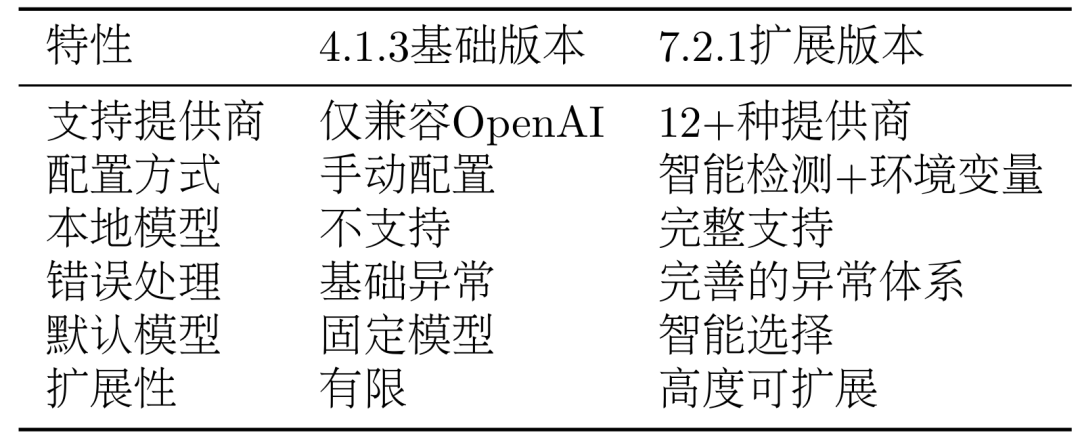
- Multi-provider support — OpenAI, ModelScope, Zhipu AI, etc.
- Local model integration — VLLM, Ollama for on-prem alternatives.
- Auto-detection from environment variables/base URLs.
Example:
Auto-detect provider by environment variables, then resolve credentials and default endpoints automatically.
---
Message Class
Manages conversation history between user and assistant:
MessageRole = Literal["user", "assistant", "system", "tool"]

class Message(BaseModel):
    content: str
    role: MessageRole
    timestamp: datetime = None
    metadata: Optional[Dict[str, Any]] = None
...- `Literal` enforces valid `role` values.
- Extra fields for logging and extensibility.
- `to_dict()` formats for OpenAI API.
---
Config Class
Centralized configuration management with environment variable overrides.
---
Agent Base Class
Defines common interface via `@abstractmethod run()`, manages conversation history, and integrates with LLM and system prompts.
---
Agent Implementation Layer
HelloAgents contains unified versions of classic paradigms:
- SimpleAgent
- ReActAgent
- ReflectionAgent
- PlanAndSolveAgent
- FunctionCallAgent
All share the same base interface and tool system.
---
Example: SimpleAgent
Provides basic conversation response with optional tool-calling logic:
- Enhance system prompt with tool info.
- Iteratively process LLM output and execute tools if requested.
- History management and streaming support.
---
Integration Idea:
Couple conversational Agents with cross-platform content publishing through AiToEarn for automated generation→publishing→monetization workflows.
---
Tool System Layer
Tools extend Agent functionality. Components:
- Tool base class — standardized run/get_parameters interface.
- ToolRegistry — central discovery, registration, execution.
- ToolParameter — schema for tool arguments.
---
Example Tools
- Calculator Tool — function-based registration for quick math capabilities.
- Advanced Search Tool — class-based integration of Tavily + SerpAPI backends with fault tolerance and unified result formatting.
---
Tool Chains:
Sequence multiple tools for complex tasks, e.g., "search → calculate → summarize".
Async Executor:
Run independent tools concurrently for performance gains.
---
Key Design Principles for Tools
- Single responsibility per tool.
- Consistent interfaces.
- Robust error handling & input validation.
- Asynchronous optimization for concurrent tasks.
- Responsible resource management.
---
Why This Matters for Content Creators
Pairing structured Agent + Tool systems with open-source ecosystems like AiToEarn官网 enables:
- AI Generation using local/cloud models.
- Cross-platform publishing across major networks.
- Analytics & model ranking for optimization.
- Revenue generation in one workflow.
---
Summary
In this guide, we've:
- Built the HelloAgents framework step-by-step.
- Unified multiple Agent paradigms under a clean architecture.
- Designed a flexible Tool system with advanced features.
- Suggested integration paths to global publishing/monetization via AiToEarn.
HelloAgents illustrates that starting simple and expanding gradually produces frameworks that are both educational and production-ready, with clean APIs and maintainable codebases—ready to integrate into larger ecosystems connecting development to global reach.