# Breaking Through in the AI Era: Insights from Alibaba Cloud's CIO
In the AI era, if you’re still:
- Fixated on **lines of code** as your performance metric,
- Clinging to **full‑stack engineer** hiring,
- Judging value solely by **technical contribution rate**,
- Obsessing over **business efficiency gains** while ignoring **product–research value**,
…you might already be anchored by outdated “common sense.”
---
## Introduction
**Key Question:** *How should technology professionals position themselves and break through in the AI age?*
**Guest:** Jiang Linquan (*Yanyang*), VP & CIO of Alibaba Cloud Intelligence Group — a veteran who evolved from programmer to CIO during waves from **cloud computing** to **AI-native**. He has transformed his role and mindset, and clearly understands how developers can stay competitive.
**Format:** In this episode of *C Position Face to Face*, Kevin Huo (Founder & CEO, Geekbang Technology) speaks with Yanyang about:
- AI’s impact on **tech talent**
- Product–research transformation in **large-scale organizations**
---
## Key Discussion Points
- **Measuring Technical Contribution**: Are AI code generation adoption rates truly linked to real efficiency gains?
- **The Future of Engineers**: Full-stack vs. specialized roles; what is an **AI Product Design Front-End Engineer**?
- **Efficiency Priorities**: Should product–research or business transformation come first?
- **Knowledge as Fuel**: How can an AI engine be knowledge-driven? Who should lead structured vs. unstructured knowledge classification?
- **Hiring in the AI era**: What competencies do CIOs look for?
---
## 1. Navigating Anxiety in the AI Tech Revolution
### Thought Experiment
Yanyang once asked his team:
> If AI keeps evolving as it does now, and one company ignores it while another reinvents itself, which side would you choose?
**Result:** Everyone chose **proactive transformation**.
### Understanding Anxiety
- **Anxiety Source:** Uncertainty about adapting to AI, fear of being left behind.
- **Observation:** Many programmers are actually **enthusiastic**, not fearful.
- **Non-anxious Groups:**
1. Skilled in using AI.
2. Unaware and thus unbothered.
3. Aware but not yet competent — the majority.
**Takeaway:**
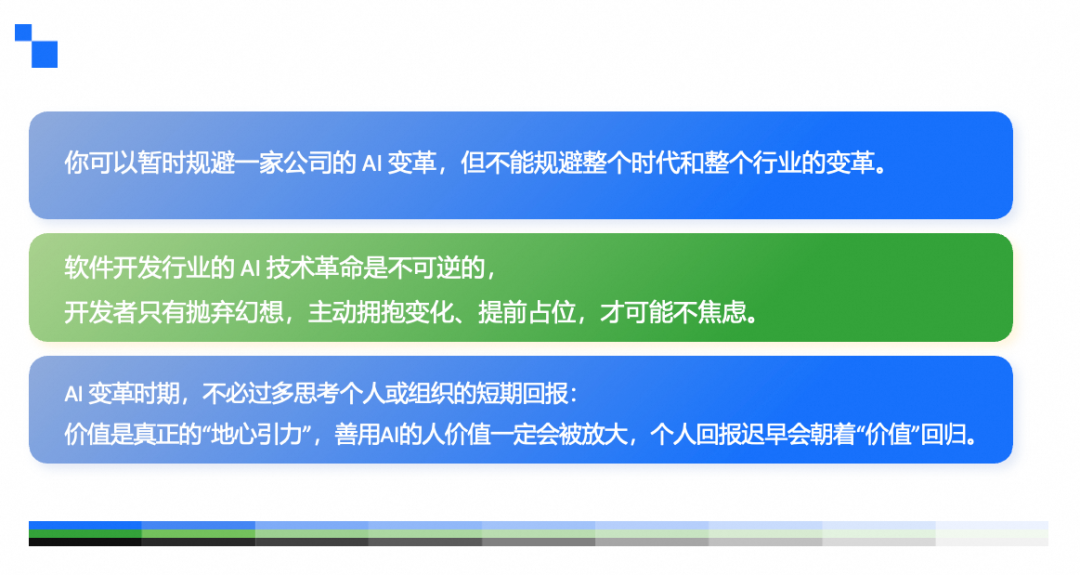
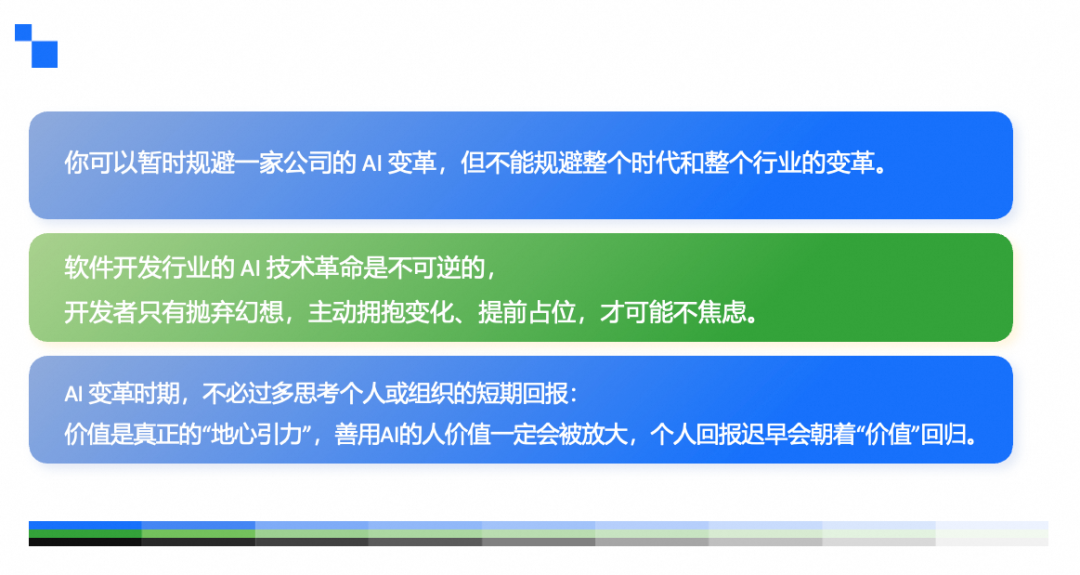
> You can avoid one company’s AI transformation, but not the industry-wide AI transformation.
---
## 2. Lines of Code ≠ Output, AI Adoption ≠ Efficiency

### Reality Check
- In large tech teams:
- **80%** of time = communication.
- **10~20%** = coding.
- AI might boost coding speed, but **end-to-end timelines barely shrink**.
### Types of Code
- **Scaffolding code**: Easy for AI to generate → high adoption.
- **Core code**: Complex business logic, algorithms, system integrations → still human-made.
### Measuring Value
- One line of **frontend code** may equal **1/1000** the value of core logic.
- Critical R&D staff may write <100 lines/year — each line worth millions.
**Question:** Does higher AI code adoption mean higher overall productivity?
**Answer:** Not necessarily — **communication cost** is the bottleneck.
---
### Measurement Principle
Yanyang:
> Measure where the team's time is actually spent. Can AI reduce this end-to-end?
- **Metric:** *Person-months per delivery*.
- **Approach:** Focus on *end-to-end project efficiency*.
**Reference:**
Brooks’ _The Mythical Man-Month_ — adding people increases communication overhead, not speed.
---
## 3. Full-Stack Engineers: Ideal vs. Reality
### Departmental Silos
- **Within-team communication** far outweighs cross-team frequency.
- Different objectives & KPIs cause delays.
### Full-Stack Ideal
- In theory, a single person doing front-end, back-end, testing eliminates silos.
- In practice, hard to find such talent.
### AI-Driven Skill Expansion
- AI helps specialists cross-skill faster.
- Mistakes fixed instantly, frustration reduced.
---
### New Role: AI Product Design Front-End Engineer
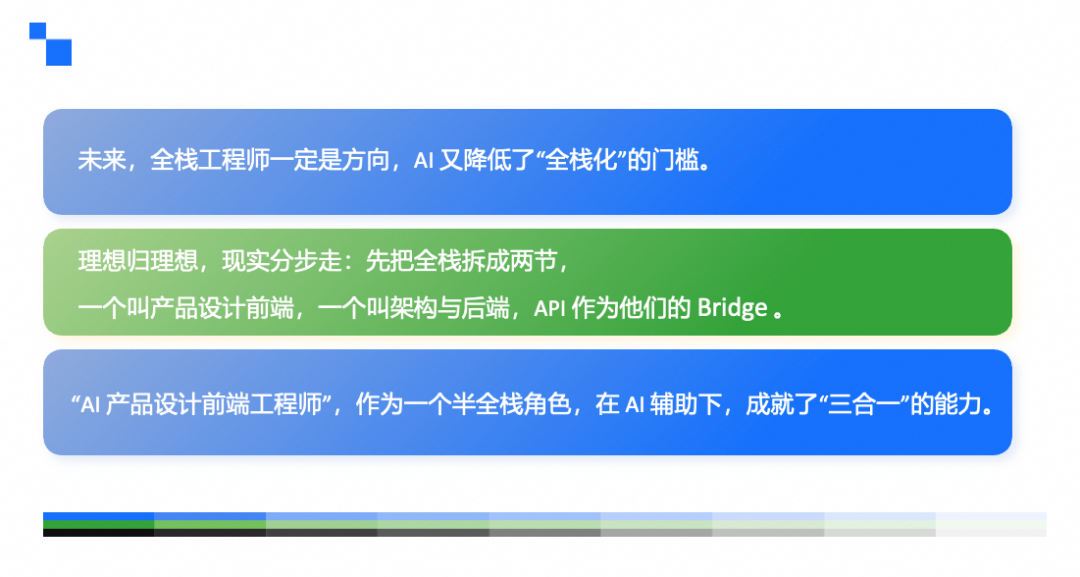
**Three-in-one skills**: product, design, frontend — assisted by AI.
Benefits:
- Instant transformation of ideas into mockups/demos.
- Reduced miscommunication with stakeholders.
**Incremental Approach**:
- Split full-stack into:
- **Product Design Front-End**
- **Architecture & Back-End**
- API as the bridge.
[Alibaba Cloud PDFE role example](https://careers.aliyun.com/off-campus/position-detail?&positionId=100000403001&trace=qrcode_share)
---
## 4. Efficiency Priorities: Product/R&D Before Business
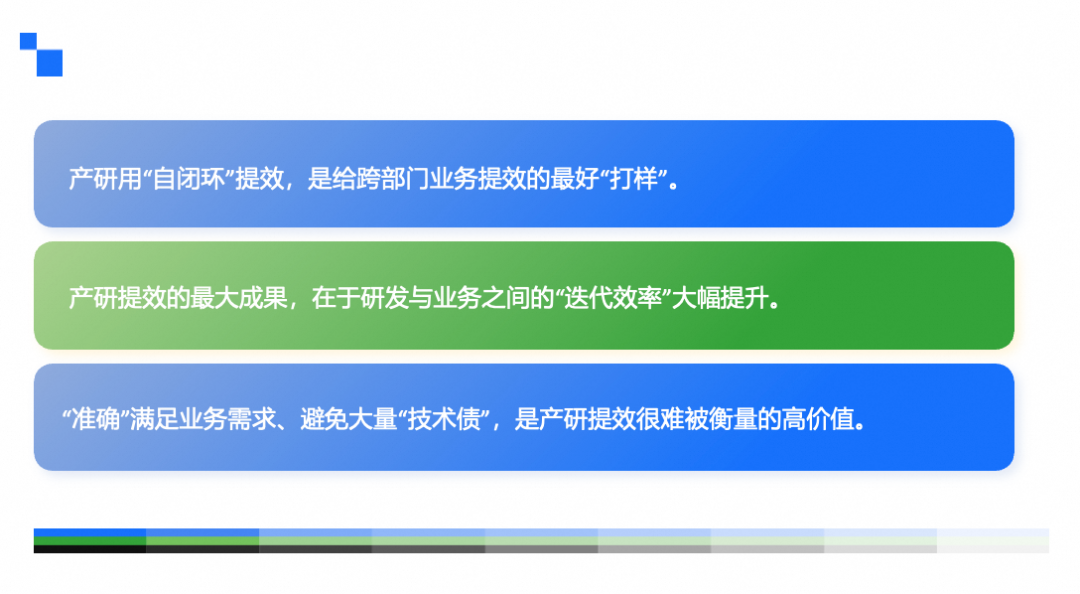
### Reasoning
- Product/R&D knowledge is self-contained → easier to measure & improve.
- Business knowledge resides in another department → needs cross-team collaboration.
**Approach**:
1. Improve efficiency in **self-contained R&D loop**.
2. Use as an example to tackle cross-department efficiency.
---
**Benefits**:
- **Improved iteration correctness** and alignment with business needs.
- Reduction of **technical debt**.
---
## 5. Knowledge is Fuel for the AI Engine

### Key Idea
> If AI is the engine, *knowledge* is the fuel.
Fuel Knowledge Types:
1. **Structured** (systems, databases) — IT-led.
2. **Unstructured** (language-based, domain insights) — business-led.
### R&D’s Role: “Data Coal Refining”
- Extract → Cleanse → Structure data before feeding AI.
- Poor data = noisy output.
---
## 6. CIO Hiring in the AI Era

### Shift Left
As CIO:
- Engage earlier with business.
- Manage product managers.
- Translate business needs into tech requirements.
**Two Essential Skills for Developers**
1. **Look Left**: Towards product and business.
2. **Strong Fundamentals**: Always relevant.
---
### Personal Qualities Valued Most
- **Curiosity**: Keep pace with evolving AI technology.
- **Resilience**: Handle setbacks in transformation.
**Organizational Preparation**:
- **Unified AI literacy** across departments (e.g., standard language, framework).
- Alibaba Cloud’s **Large Model Certification** to reduce communication friction.
---
## 7. Conclusion: AI as a Mirror
AI reflects process gaps and helps solve them step-by-step:
1. Introduce tools.
2. Measure adoption.
3. Identify efficiency bottlenecks.
4. Adjust roles & collaboration models.
**Message to Professionals**:
> Technological transformation is irreversible. Understand it deeply. Act early, align with AI’s momentum, and be part of the trend itself.
---
**Pro Tip:** Platforms like [AiToEarn官网](https://aitoearn.ai/) offer open-source tools for AI content generation, publishing, and monetization across multi-platforms — enabling both technologists and creators to turn curiosity & resilience into concrete results.
---