Fei-Fei Li Sides with LeCun: AGI Is All Hype! 80-Minute Major Reveal | [Jingwei Low-Key Share]
![Fei-Fei Li Sides with LeCun: AGI Is All Hype! 80-Minute Major Reveal | [Jingwei Low-Key Share]](/content/images/size/w1200/2025/11/img_001-433.jpg)
🌍 World Models — Fei-Fei Li’s Vision for AI’s Next Decade

---
Fei-Fei Li — often called the “Godmother of AI” — is widely known for helping lead the deep learning revolution. In her latest podcast interview, she:
- Criticized AGI as marketing hype, siding with Yann LeCun
- Championed world models and spatial intelligence as AI’s most important frontier for the next 10 years
- Pointed beyond current LLM bottlenecks toward new innovation pathways
This deep conversation revisits AI’s hidden history from winter to boom and reveals why world models may define the post-LLM AI era.
---
Key Highlights
- ImageNet ignited the modern AI "golden trio": big data + neural networks + GPU
- LLMs alone can’t perform tasks requiring deep embodied intelligence (rescue, design, robotics)
- Humans and robots both benefit from spatial intelligence + world models
- Robot development is bottlenecked by difficult data acquisition
- Every individual has a meaningful role in AI’s future
> Source: Xinzhiyuan
---
1. ImageNet — Spark of the AI Revolution
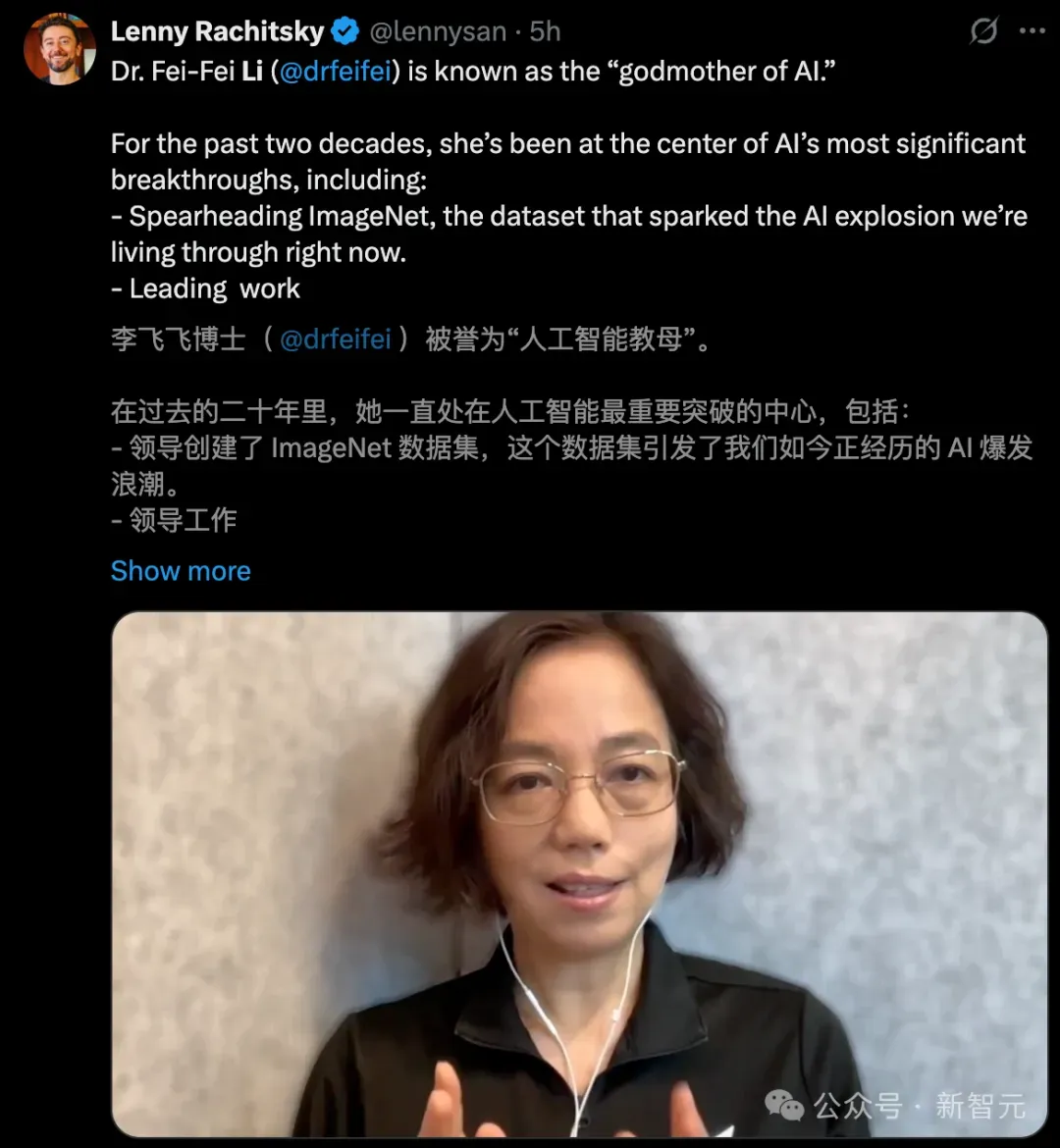
The AI “Winter”
- In the early 2000s, “AI” was rarely used — “machine learning” dominated.
- Research focused heavily on models, but lacked large-scale datasets.
Fei-Fei Li’s Breakthrough Insight
- Intelligence (human or animal) evolves from massive experience — big data is key.
- Proposed creating a huge visual dataset for object recognition.
Birth of ImageNet
- 2006–2007: Li’s team collected 15 million images, labeled across 22,000 categories.
- Released as open source with an annual challenge.
- 2012: Geoffrey Hinton’s team used 2 NVIDIA GPUs + ImageNet to train AlexNet, achieving a major win in large-scale visual tasks.
- Established AI’s “golden trio”: big data + neural networks + GPU.
---
2. Beyond LLMs — Enter World Models
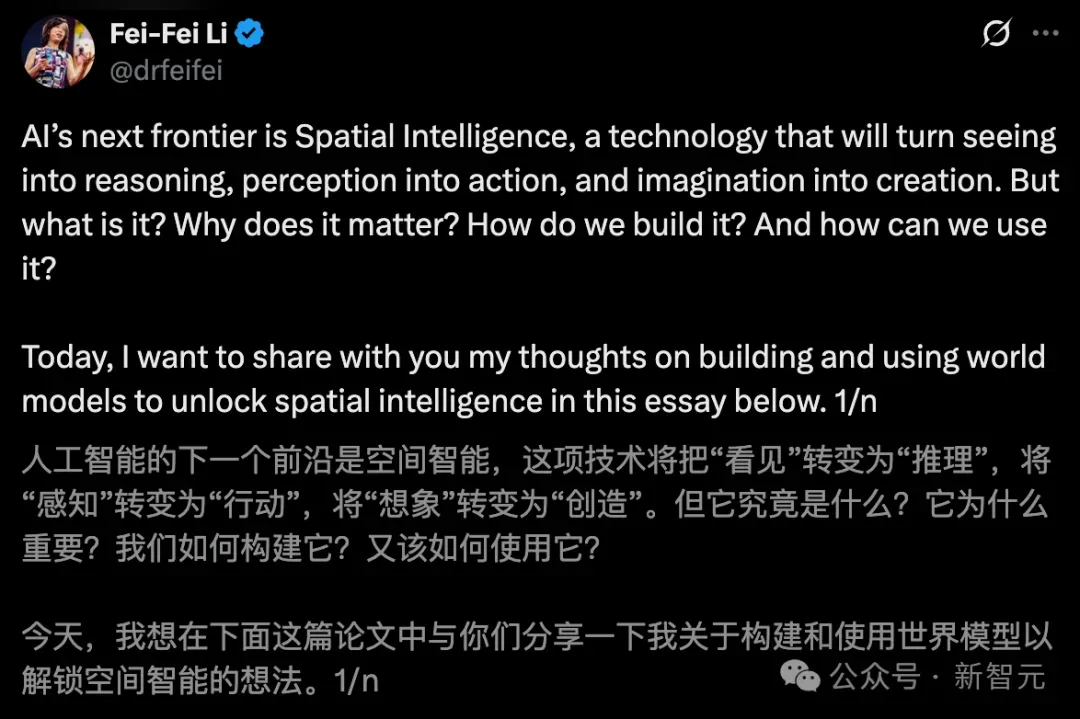
Why World Models Matter
- Core of human intelligence: language and spatial intelligence
- LLMs excel at text but fail at tasks needing physical reasoning and interaction
- World models simulate infinite 3D environments from text or image inputs — foundational for reasoning and embodied AI
Founding World Labs
- Built around research in visual intelligence and robotics
- Sees humans as “embodied intelligent agents” who can benefit from Spatial Intelligence
- Historical analogy: DNA’s double helix discovery relied on spatial reasoning
---
Marble — Fei-Fei Li’s World Model Platform
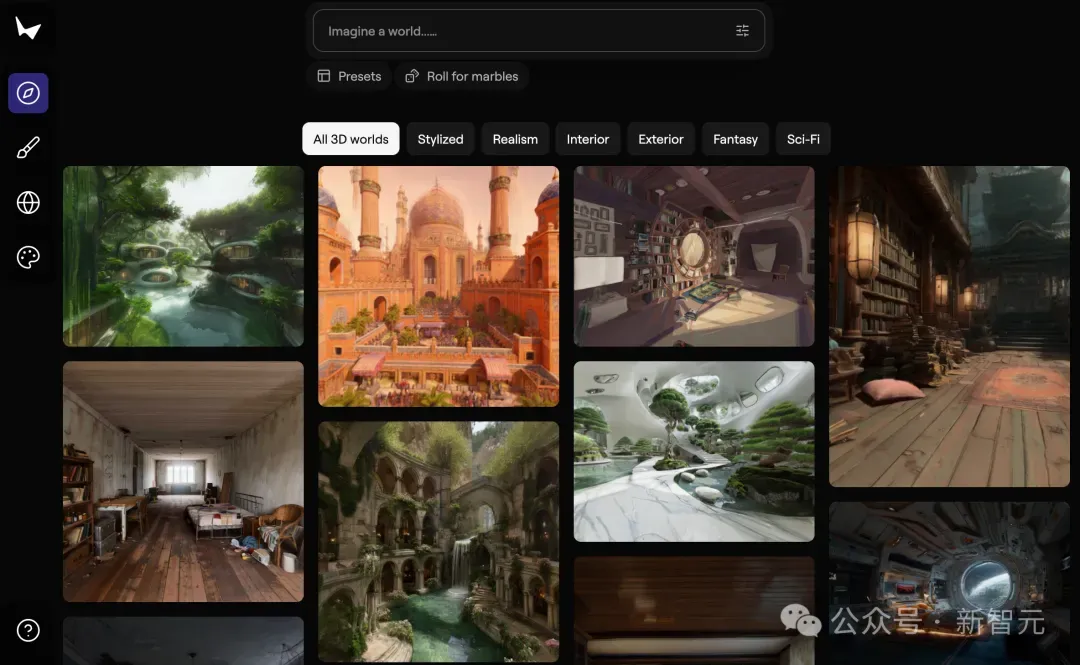
Applications:
- Cinema & Virtual Production: From text prompt → 3D world, cutting production time by 40×
- Gaming & Interactive Content: Export to game engines for level prototyping
- Robotics Training: Generate virtual rooms, factories, etc., for simulation before real-world deployment
---
3. Robots as Physical Systems
Why Data is the Bottleneck
- Robotics data is harder to collect than text
- Outputs are actions in 3D space, not text
- Requires teleoperation, synthetic data, simulation
Comparison:
- Autonomous car ⇒ simple robot moving in 2D
- General robot ⇒ complex system in 3D, designed to touch/interact with diverse objects
---
4. From Researcher to Founder
Life Choices & Principles
- Follow curiosity and passion
- Don’t over-magnify failure risks
- Prioritize people & teams
Major moves:
- Turned down Princeton tenure for Stanford
- Left academia for Google Cloud as Chief Scientist
- Founded Stanford HAI
- Launched World Labs to pursue World Models
---
Everyone’s Role in AI’s Future
Fei-Fei Li reassures:
> "Musicians, teachers, nurses, farmers — you will have your role, and it will be important."
AI should empower, not replace, diverse human skills.
---
Tools That Align With Her Vision
Platforms like AiToEarn官网 embody Fei-Fei Li’s philosophy by:
- Enabling AI-powered content creation
- Publishing across major platforms (Douyin, Kwai, WeChat, Bilibili, Instagram, YouTube, X/Twitter)
- Integrating model ranking (AI模型排名) and analytics
- Helping individuals monetize creativity as AI reshapes industries
---
📌 References
---
In summary: Fei-Fei Li urges focusing on world models and spatial intelligence as the next AI frontier — beyond language models. This approach could redefine robotics, human-computer interaction, and creative production, ensuring technology evolves with a strong human-centered foundation.
---
Do you want me to add a visual diagram mapping the "Golden Trio" to World Models for better understanding? That would make this piece even more digestible for tech readers.