# From “Micromanagers” to “Macromanagers”: The Asynchronous Future of Coding
## Introduction
**AI coding assistants** have evolved from novelty to necessity, with **90% of software engineers** using AI for coding in some capacity.
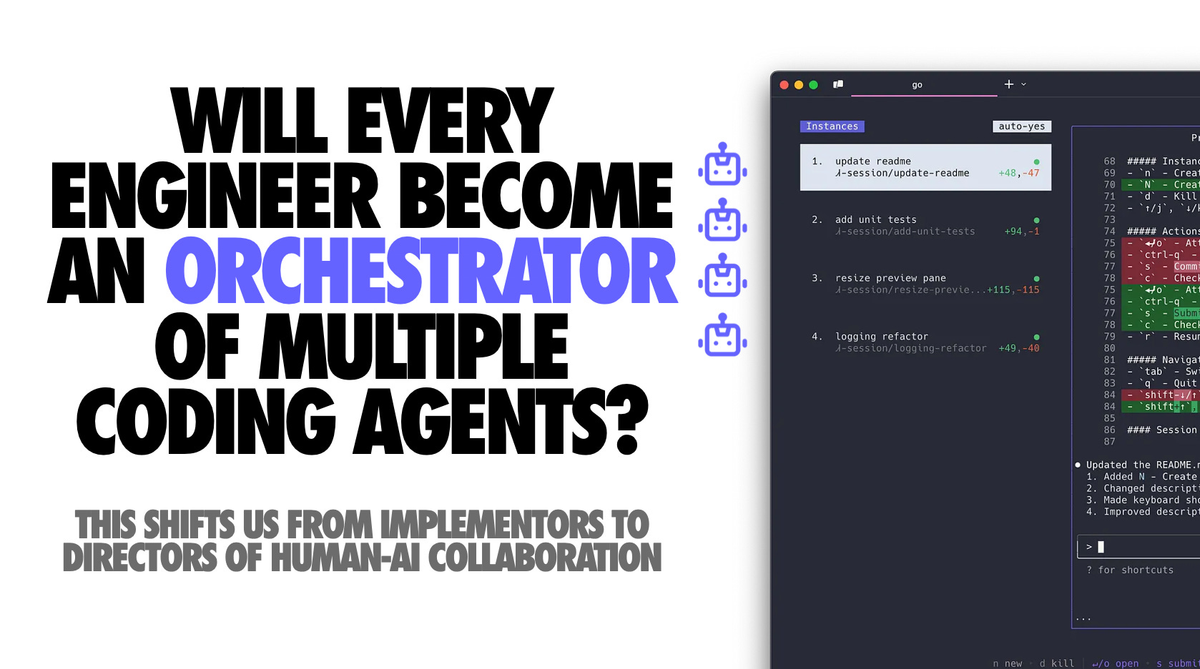
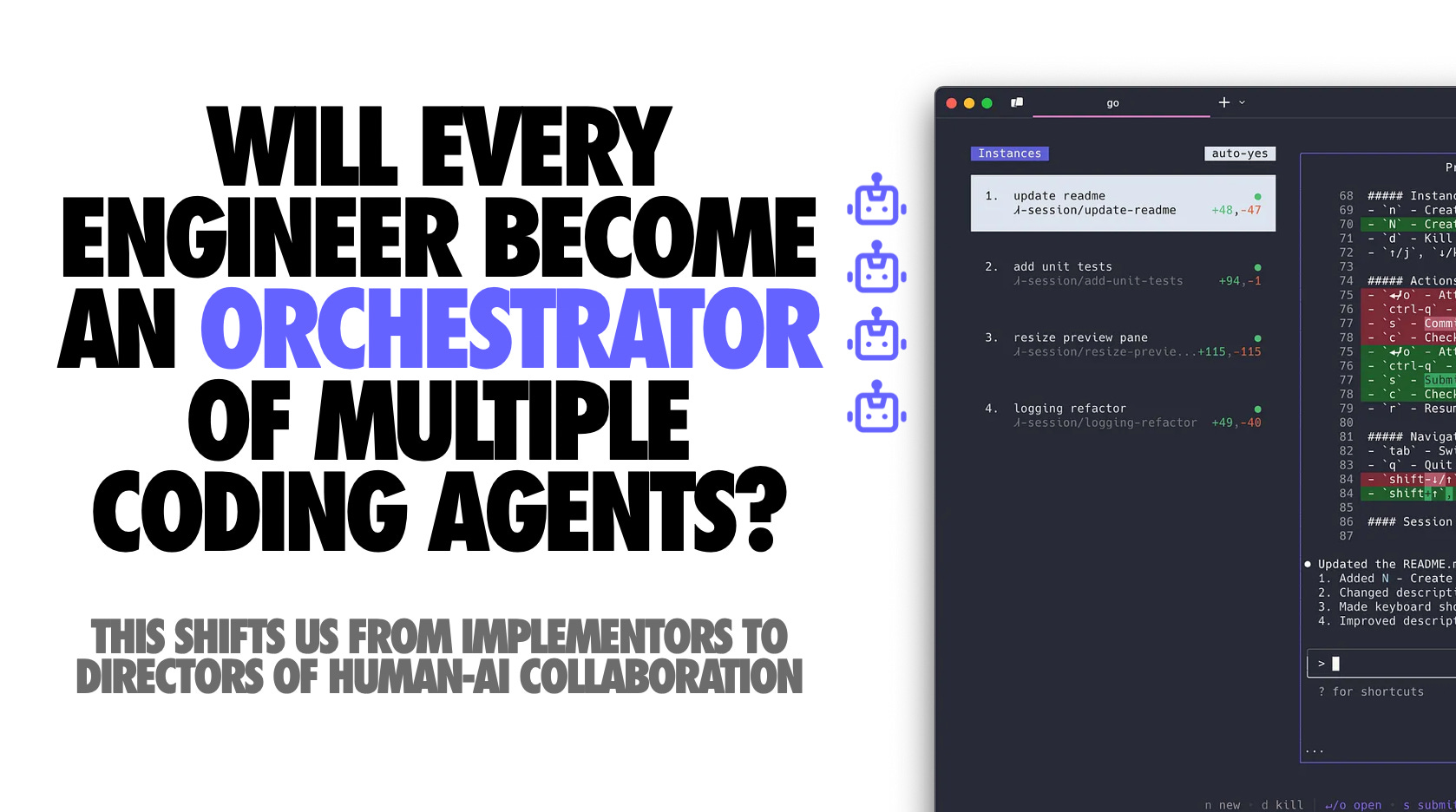
A new paradigm is emerging — engineers orchestrating **clusters of autonomous coding agents**.
In this future, the developer’s role shifts from **implementer** to **manager** — from *coder* to **conductor**, and ultimately to [**orchestrator**](https://www.youtube.com/watch?v=sQFIiB6xtIs).
Over time, developers will **guide AI agents to produce the right code**, coordinating multiple agents to collaborate effectively.
Seasoned engineers already feel this transition: moving from *“How do I code this?”* to *“How do I ensure the right code gets built?”*
---
## What Is an “Orchestrator” Tool?
An **orchestrator** enables **multi–AI agent workflows** — running many agents in parallel without interference.
Before diving deeper, let’s define our terminology.
---
## The Conductor Role
Playing the **conductor** means collaborating closely with a single AI agent on a specific task — like guiding a solo performer.
- **Human in the loop** at every step
- **Fine-tuning prompts** and steering AI behavior dynamically
- **Synchronous sessions** inside IDEs or CLIs
**Key characteristics:**
- Tight feedback loops
- Manual steps by developers: branches, tests, commit messages
- **Ephemeral interactions** — once the session ends, context can be lost
### Modern Conductor-Style Tools
- **Claude Code (Anthropic)** — CLI/editor integration for step-by-step, human-guided coding.
- **Gemini CLI (Google)** — Planning and coding assistance with an ultra-large context window.
- **Cursor IDE Assistant** — Inline or chat-mode edits with deep project indexing.
- **VSCode, Cline, Roo Code** — IDE chat assistants under continuous human guidance.
---
## Shift to the Orchestrator Role
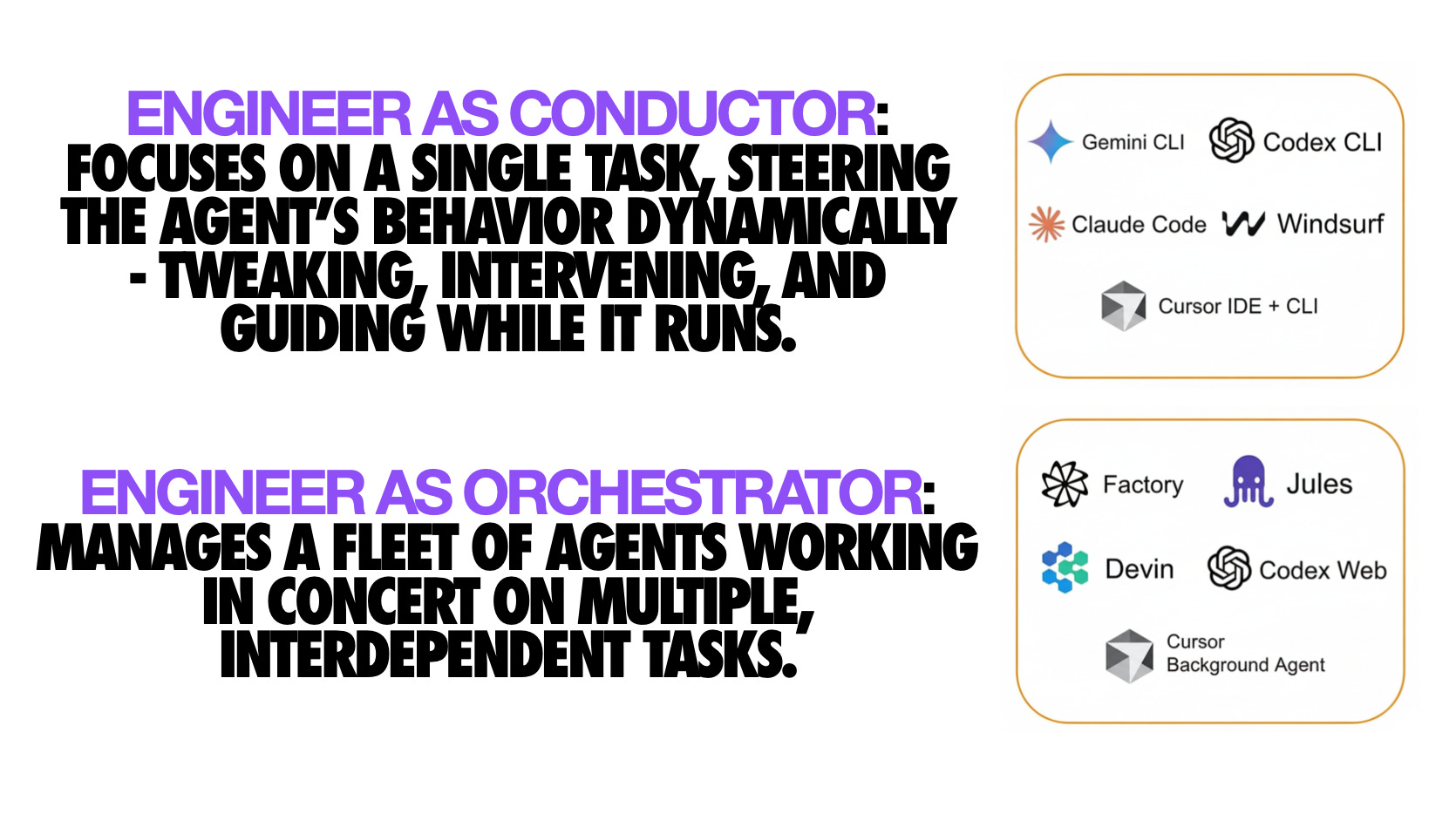
**Orchestrator = Managing a Fleet of AI Agents**
Where **conductors** work with one AI “musician,” **orchestrators** supervise an "orchestra" of multiple agents in parallel.
- **High-level goals**
- **Autonomous execution**
- Result review via **pull requests**
### Features of Orchestrator Tools
- **Autonomous AI agents**
- Minimal human intervention mid-task
- Persistent artifacts: branches, commits, PRs
- Massive parallelization with multiple agents
### Modern Orchestrator Tools
- **GitHub Copilot AI Agent (Microsoft)**
- **Jules – Google’s Autonomous Coding Agent**
- **OpenAI Codex (Cloud AI Agent)**
- **Anthropic Claude Code for Web**
- **Cursor Background Agents**
- **Conductor** & **Claude Squad** (Melty Labs / Open Source)
---
## Conductor vs. Coordinator
| Aspect | Conductor | Coordinator / Orchestrator |
|------------------------|-------------------------------------|---------------------------------------|
| **Scope** | Micro, single task/agent | Macro, multi-task/multi-agent |
| **Autonomy** | Low – step-by-step prompts | High – autonomous multi-step execution|
| **Sync vs Async** | Synchronous | Asynchronous |
| **Artifact Traceability** | Often ephemeral changes | Fully version-controlled PRs/branches |
---
## Human Effort Investment
- **Conductor:** Nearly 100% human engagement during AI’s work time
- **Coordinator:** Effort is **front-loaded** (specifying tasks) and **back-loaded** (reviewing results) — enabling parallel delegation
---
## Example Scenario
**Feature with frontend, backend, and tests**
- **Conductor mode:** Work sequentially, collaborating with AI at each step.
- **Coordinator mode:** Assign a backend agent, frontend agent, and test agent — review three PRs later.
---
## Fluid Roles
Roles are **fluid** — a developer might conduct one task and coordinate another simultaneously.
Tools increasingly allow **seamless switching** between modes.
---
## Why Coordinators Matter
Coordinator-mode AI could be **the biggest productivity leap in programming history**.
- Higher-level requirement definitions
- Delegation to multiple autonomous agents
- Human oversight for quality
---
## The Professional “AI Team” Vision
AI agents specialized for:
- Planning
- Coding
- Testing
- Code review
- Documentation
- Deployment/monitoring
Humans **oversee and integrate**, not micromanage each step.
---
## Challenges for Orchestrators
1. **Quality Control:** Review every PR before merge.
2. **Coordination/Conflict Avoidance:** Isolated workspaces & clear task separation.
3. **Context Sharing:** Avoid agent silos with unified orchestration layers.
4. **Prompting & Specs:** Clear specifications for predictable outputs.
5. **Debugging Agents:** Tools for rollback, monitoring dashboards, intervention.
6. **Ethics/Responsibility:** License compliance, vulnerability scanning, security audits.
---
## The Future of Coding
- Shift from manual coding to **oversight & strategy**
- Engineers become **AI managers**
- The keyboard remains, but creative/critical thinking leads AI teams
---
## Conclusion
By late 2020s, many engineers will **manage multiple AI coding agents**.
- Tasks delegated via issues/prompts
- AI produces the bulk of code
- Humans focus on architecture, design, review
This is **AI + Humans**, with humans **at the helm** — as **Conductor** and **Orchestrator**.
---
## Related Ecosystem: AiToEarn
Platforms like [**AiToEarn官网**](https://aitoearn.ai/) extend orchestration beyond coding:
- Open-source global AI content monetization
- Multi-platform publishing: Douyin, Kwai, WeChat, Bilibili, Facebook, Instagram, LinkedIn, Threads, YouTube, Pinterest, X
- Integration of AI generation tools, analytics, and model ranking
Similar orchestration principles: **parallel execution, efficient review, scalability**.
---
**Source:** [https://addyo.substack.com/p/conductors-to-orchestrators-the-future](https://addyo.substack.com/p/conductors-to-orchestrators-the-future)