From Game Factory to Spatial Intelligence Simulation: Why HunYuan 3D Is Tencent AI’s Flanking Breakthrough

Tencent’s Hunyuan 3D: Accelerating Global AI Expansion

China’s AI models are expanding rapidly abroad — and Tencent’s Hunyuan 3D has already brought the world into an immersive, three-dimensional universe.
On November 26, Tencent launched the international version of the Hunyuan 3D Creation Engine, with its API available on Tencent Cloud International. Concurrently, the open-source version surpassed 3 million global downloads, signaling a clear AI strategy: combining overseas deployment with open-source adoption to enter the global developer spotlight.
---
Why Tencent? Why Now? Why 3D?
Tencent differs from pure compute companies like NVIDIA or creative toolmakers like Adobe — it is a composite technology player with:
- Demand-side strength: Massive 3D needs in gaming, navigation, AR/VR, and cloud services.
- Technical maturity: Hunyuan’s multimodal capabilities are advancing as 3D generation technology hits a growth curve.
- Ecosystem reach: Distribution through WeChat, QQ, and Tencent Cloud to both consumers and enterprises.
This combination — Business + Technology + Ecosystem — gives Tencent strong leverage for commercial 3D generation at scale.
---
From the “Factory Workshop” to AI-Driven Creation
Tackling the Pain Points of 3D Game Production
Traditional 3D game asset creation is expensive, slow, and difficult:
- Art costs are typically 50–80% of game development budgets.
- One high-quality 3D character can cost tens of thousands to a million RMB and take weeks or months.
- Complex scenes require even longer production cycles.
This reality polarizes the industry:
- Large studios with big teams produce high-precision assets.
- Small studios/indies must compromise quality.
Tencent’s Two Technical Tracks
According to Guo Chunchao, Head of Hunyuan 3D, Tencent avoided “one-click generation” gimmicks and adopted two R&D tracks:
- 3D Asset Track — Batch production of high-quality components.
- World Model Track — Large-scale, scene-level environment generation.
---
Practical Deployment in Tencent Games
Examples:
- DreamStar UGC Editor: Users type a description (e.g., “pirate-themed wooden barrel”) and receive a fully editable 3D asset in seconds.
- Light Game Dream Workshop: A zero-code tool letting non-modelers complete entire games in about a week using prefab templates and AI-generated assets.
Competition data: In the 2025 Light Game Dream Workshop National Game Creation Competition, 40% of entrants had no prior game development experience yet produced playable games thanks to Hunyuan 3D.
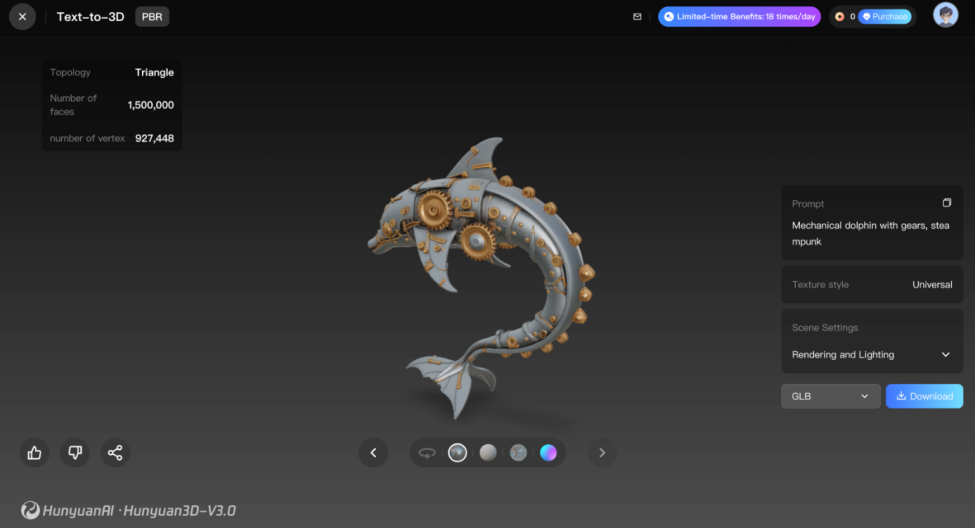
Mechanical dolphin with gears, steampunk style — generated by Hunyuan 3D
---
AI + Global Publishing Synergy
Platforms like the open-source AiToEarn complement tools like Hunyuan 3D by:
- Publishing assets to Douyin, Instagram, YouTube, Pinterest, and more.
- Ranking AI models via model ranking.
- Tracking analytics for engagement optimization.
This integration accelerates global adoption of AI-generated 3D content.
---
Overcoming Technical Bottlenecks
Key Challenges:
- Component-based generation: Breaking objects into usable, editable parts.
- Low-poly topology balance: Maintaining performance efficiency while preserving detail.
Tencent’s dual platform approach:
- Hunyuan 3D AI Creation Engine Platform — For mass creators.
- Hunyuan 3D Studio — For professional teams, controlling every stage from concept to animation.
---
Building Interactive Worlds
From Objects to Environments
Hunyuan 3D’s world model can generate interactive 3D spaces from a simple text prompt like “cyberpunk city alleys at dusk after rain”.
The global race for world modeling includes Google DeepMind, Meta, OpenAI, NVIDIA, Tesla, and others — each tackling physics, prediction, and interactivity differently.
Tencent’s approach focuses on real deployment first, starting with stable world generation before adding temporal consistency and basic physics.
---
The Vision
World Play — A hybrid model combining 2D stability with 3D spatial diversity, enabling AI to not just “see” but also act within environments.
Future World Model 2.0 aims for ultra-realistic geometry and materials to power exhibitions, tourism, and other high-fidelity scenarios.
---
Open Source as an Ecosystem Strategy
With over 3 million downloads since November 2024, Hunyuan 3D’s open-source release fuels rapid iteration via:
- Community feedback on textures, modularity, and geometry editing.
- Independent deployments for games, NPC generation, and VR prototyping worldwide.
---
Beyond Gaming: Industry Adoption
More than 150 enterprises use Hunyuan 3D via Tencent Cloud for:
- 3D printing — Easy consumer creation via natural language.
- Advertising & content — Turning product display into immersive experience.
- Design — Integration as the core engine for AI-based design assistants.
---
Autonomous Driving & Robotics
HunYuan 3D provides simulation assets for:
- Autonomous driving — Supplementing real-world training data.
- Robotics — Feeding 3D environments and objects into testing pipelines.
---
Tencent’s AI Strategy
Focus: Build ecosystem moats, not just scale.
Achievements:
- HunYuan Image 3.0 ranked #1 globally in LMArena’s blind tests for text-to-image.
- Integrated across WeChat, QQ, advertising, gaming, and cloud services.
Key priorities according to Guo Chunchao:
- Quality
- Controllability
- Speed & cost reduction
---
Breakthrough Directions for Mix Yuan 3D
- Data layer: Expand high-quality, multimodal datasets.
- Model architecture: Add richer conditions and “analysis–sculpting” capabilities.
- Interaction: Support for 3-view diagrams, multimodal inputs, drag-to-edit shapes.
---
The Data Bottleneck
3D data scarcity is now the sector’s limiting factor:
- Limited global volume (~tens of millions) vs. billions of text records.
- Complex preprocessing before models can use asset data.
Tencent’s answer:
- Acquire/open-source 3D assets to expand datasets.
- Embed additional modalities to reduce reliance on pure 3D volume.
---
Commercial Outlook
Guo Chunchao likens the current stage to the Midjourney era of images — early adoption but far from high-complexity, high-controllability futures.
Tencent’s restraint in capex and focus on Model as a Service position it for sustainable leadership.
---
Creator Ecosystem Linkages
Tools like AiToEarn官网 enable:
- AI generation integration.
- Cross-platform publishing (Douyin, WeChat, YouTube, Instagram, etc.).
- Analytics and AI model rankings via AI模型排名.
This synergy helps turn advanced AI outputs into measurable business value.
---
Would you like me to prepare English case studies of Hunyuan 3D adoption across industries? That would make the narrative even more actionable for international readers.