From Game Factory to Spatial Intelligence Simulation: Why Mix Yuan 3D Is Tencent AI’s Flanking Breakthrough

Tencent’s Hunyuan 3D: From Gaming to Global AI Ecosystem
When Chinese AI models are accelerating their push into global markets, Tencent’s Hunyuan 3D has already drawn the world into its three-dimensional universe.
---
Global Launch & Rapid Growth
On November 26, Tencent released the international version of the Hunyuan 3D creation engine, with its API going live on Tencent Cloud International. At the same time, downloads of its open-source version surpassed 3 million globally.
By advancing product globalization alongside model open-sourcing, Hunyuan 3D is quickly reaching developers worldwide—showing a clear path in Tencent’s broader AI strategy.
---
Why Tencent? Why Now? Why 3D?
Unlike compute powerhouses (e.g., NVIDIA) or pure tools providers (e.g., Adobe), Tencent is a composite technology company that has three synergistic strengths:
- Demand side:
- Massive 3D asset requirements across interactive games, mapping/navigation, AR/VR, and cloud services.
- Technology side:
- Mature multimodal capabilities in the Hunyuan large model, aligning with rapid growth in 3D generative tech.
- Ecosystem side:
- Distribution networks across consumer and enterprise markets via WeChat, QQ, and Tencent Cloud.
This business–technology–ecosystem triad gives Tencent deep scene penetration and network effects—making commercial deployment of 3D generation far more feasible.
---
1. Starting in the Game Factory: Deployment Inside Tencent Games
The Industry Challenge
In the traditional 3D game industry, “expensive, slow, difficult” is a near-universal consensus.
- Art costs: typically 50–80% of development budgets
- 3D production: the most costly stage
- Time: complex assets can take weeks or months
- Risk: imperfections can damage a game’s reputation
This creates a polarized landscape:
- Big studios invest heavily in pixel-perfect, high-precision assets
- Small indie teams can’t afford quality 3D production, leaving many ideas unrealized
Why 3D AI Matters
3D generation tech has become a necessity for game development pipelines—able to enhance efficiency without disrupting workflows.
---
Tencent’s Approach: Two Core Paths
Guo Chunchao, Head of Hunyuan 3D, describes the traditional pipeline: concept art → high-poly sculpt → retopology → UV unwrap → texture baking → rigging. Each step requires human expertise.
Rather than promise an unrealistic “one-click 3D,” Tencent split its R&D into two major lines:
- Batch asset generation – boost efficiency for individual 3D asset creation
- World model generation – create scene-level 3D environments
---
Asset Creation in Practice
Piloted in dozens of Tencent games, including:
- Yuan Meng Zhi Xing — players type prompts like “pirate-themed wooden barrel” and receive editable 3D assets in seconds.
- LightPlay Dream Workshop (no-code editor) — lets creators build playable games in about a week using prefab templates + Hunyuan 3D generation.
Results:
- Props that once took 2 days to model now take 0.2 days
- In contests, 40% of participants were newcomers but produced playable games
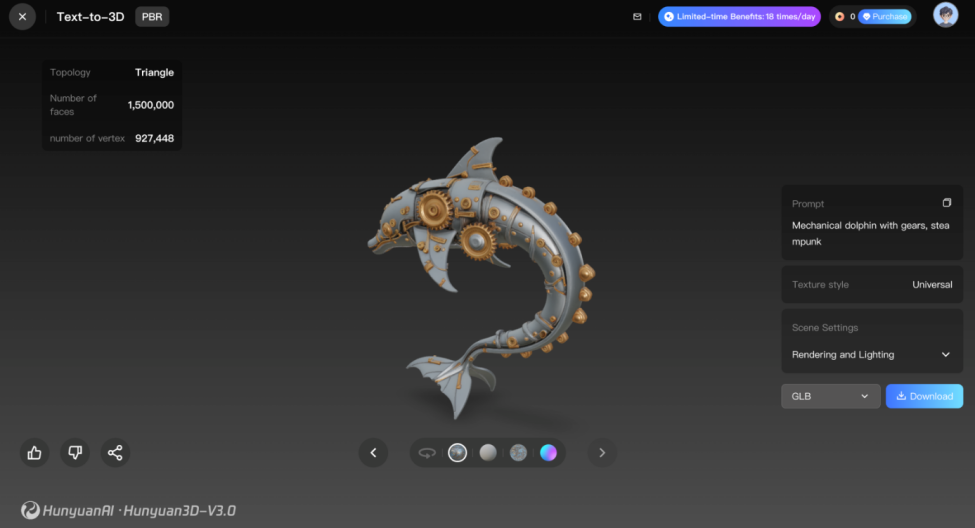
A steampunk mechanical dolphin created with Hunyuan 3D
---
Balancing Precision & Performance
Challenges in integrating AI into professional game pipelines include:
- Component-based generation: separate items into editable subparts (guns into stock/barrel/magazine)
- Low-polygon topology balance: look detailed but run smoothly in-game
---
Two Platform Layers
- HunYuan 3D AI Creation Engine — for mass creation, low skill barrier
- HunYuan 3D Studio — for professionals, covering concept → geometry → topology → texture → rigging → animation
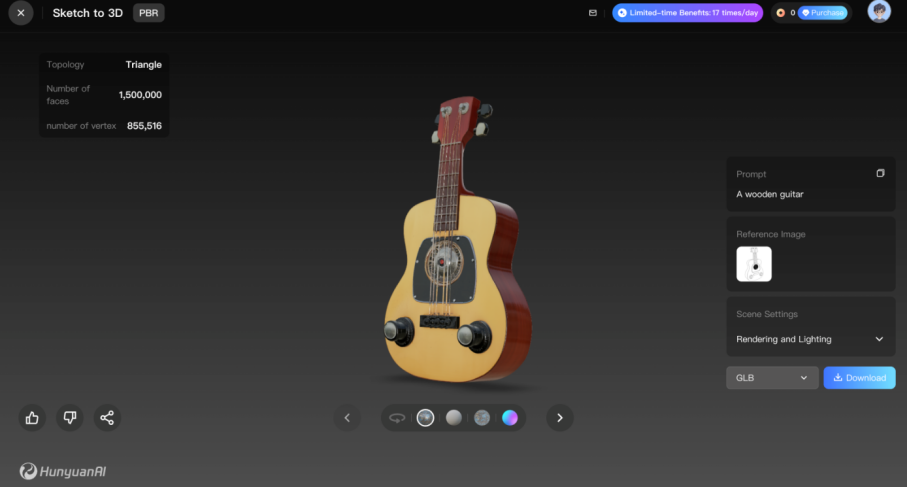
Hunyuan 3D sketch-to-3D conversion
---
World Models: Generating Entire Scenes
This second path focuses on turning text or images into navigable 3D worlds in minutes.
Example: “cyberpunk alley at dusk” → explorable 3D scene with accurate neon reflections.
Competition includes:
- Google DeepMind — long-horizon prediction for reinforcement learning
- Meta — immersive understanding via V-JEPA 2
- OpenAI — videos to model object physics
- NVIDIA — physics-based simulation
- Tesla — autonomous driving integration
Tencent flips the approach: start from internal 3D business needs, guiding tech direction toward scalable deployment.
---
Focus Areas in World Models
- Stable runtime performance
- Consistency over time (lighting, object states, physics)
Tencent’s World Play model aims to blend 2D stability with 3D spatial diversity.
Future goals: World Model 2.0 with higher realism for industries like online exhibitions.
---
Open-Source Strategy
Since open-sourcing in Nov 2024 and releasing World Model 1.0 in July 2025, downloads have topped 3 million.
Benefits: faster iteration via community, ecosystem growth, feedback guiding R&D.
---
2. Beyond Gaming: Industry Expansion
Hunyuan 3D is now used in B2B contexts—over 150 companies via Tencent Cloud—spanning:
- Game production
- E-commerce
- Film/VFX
- Advertising
- 3D printing
- Simulation & autonomous driving
---
3D Printing
First commercial success loop:
From natural language or images → printable models with built-in support structures.
Manufacturers like Bambu Lab and Creality report large growth in active model creation.
---
Advertising, Design, E-commerce
- Game ads gain direct 3D asset feeds
- Lovart uses Hunyuan 3D for AI-assisted design
- E-commerce click-through rates up ~35% after integrating 3D product views
---
Simulation & Robotics
Robotics labs feed back requirements to Tencent R&D.
Autonomous driving simulations adopt open-source 3D assets for faster iteration.
---
AI Strategy: Competing on Ecosystem Strength
Tencent’s AI investments focus on scenario fit and ecosystem advantage over sheer scale.
Key strengths:
- Internal data & scenarios
- External cloud/Open-source reach
- Technical depth in 3D geometry & rendering
---
Current Limitations
Challenges in:
- Quality (visual fidelity)
- Controllability (precise component generation)
- Speed & efficiency (GPU use, cost)
Roadmap:
- Improve quality & controllability
- Accelerate generation & reduce costs
---
Three-Pronged Breakthrough
- Data: richer multimodal datasets, pipeline optimization
- Architecture: conditional inputs, “analysis–sculpting” methods
- Interaction: three-view display, multimodal editing, drag-and-drop shape modification
---
3D Data Scarcity: The Bottleneck
Global 3D datasets are tens of millions in size vs. billions in text data.
Processing requires complex engineering (format conversion, preprocessing).
Tencent’s response:
- Acquire/collect open-source 3D assets
- Embed multimodal info to reduce reliance on pure 3D volume
---
Outlook: Early Stage of 3D AIGC
Guo Chunchao analogy: We’re in the “Midjourney era” for 3D—good enough for some uses but far from “complex scenes + extreme control + arbitrary combinations.”
Commercialization will come once technology leadership is secure.
---
Ecosystem Power Over Time
Technology evolves and scenarios shift—but ecosystem strength endures.
Platforms like AiToEarn官网 show how open ecosystems can empower creators across industries with:
- AI generation tools
- Cross-platform publishing
- Analytics & AI model ranking (AI模型排名)
---
In short: Tencent’s Hunyuan 3D is not just a technical tool—it's a strategic play to embed AI deeply into production across gaming, industry, and global creative ecosystems. While challenges remain in data, controllability, and high-precision outputs, the combination of internal demand, technical capability, and ecosystem reach puts Tencent in a strong position to lead the next phase of the 3D AI revolution.