From Model to Agent: Snowflake’s Enterprise-Grade Agentic AI Engineering Journey

QCon 2025 — Agentic AI Deployment in Enterprises
Date: 2025‑11‑24 · Location: Beijing
---

As Large Language Models (LLMs) evolve toward Agentic AI, enterprises must navigate significant challenges — security, efficiency, and trust — on the journey from proof‑of‑concept to large‑scale deployment.

Without a solid data foundation and systematic engineering methodologies, AI risks remaining a theoretical capability instead of becoming actionable business assets.
At QCon Global Software Development Conference 2025 (Shanghai), Yang Yang — VP, Solutions Engineering (APAC & Japan) at Snowflake — shared how Snowflake’s R&D supports enterprise‑scale Agentic AI deployments, reshaping intelligent productivity and enabling the leap from large language models to controllable intelligent agents.
---
Introduction
> Speaker’s note:
> Moving from proof‑of‑function to enterprise scale is a long and complex journey.
> In this talk, I’ll explain the five R&D pillars Snowflake developed to enable trustworthy, efficient, and scalable Agentic AI for enterprises.
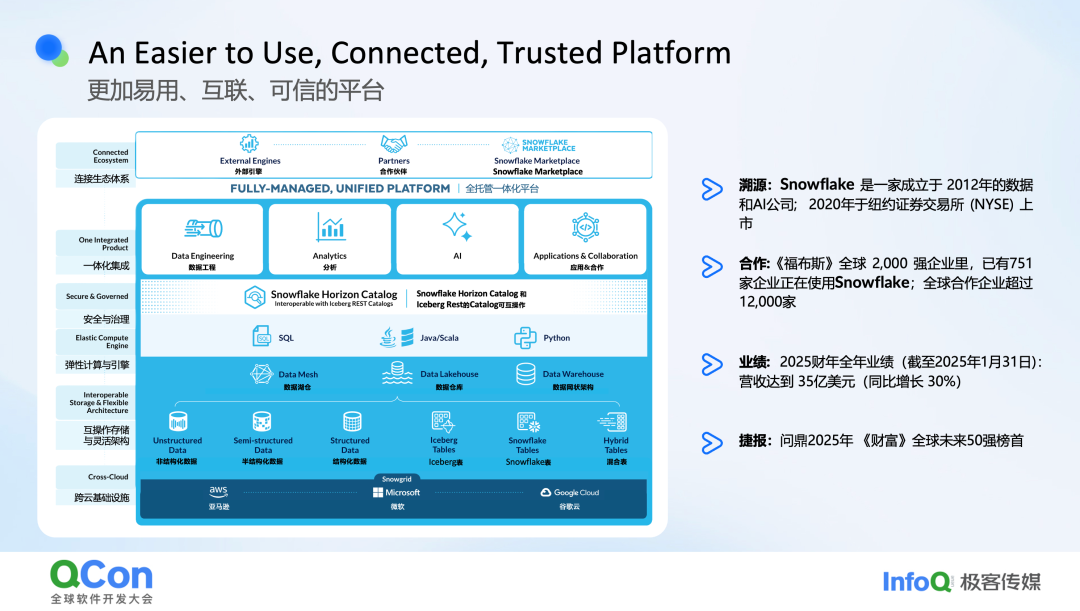
About Snowflake:
- Founded 13 years ago
- Full data + AI platform built entirely on public cloud
- Capabilities: multilingual dev, data modeling, data engineering, analytics, AI apps, and secure sharing
- 12,000+ enterprise customers worldwide; over 50% use our AI products
- Widely adopted among Fortune 2000 companies
- Ranked #1 in Fortune Future 50 (2025)
---
The 5 Core Pillars of Snowflake AI R&D
1. Intelligent Agent Orchestration
Key Idea: Seamlessly link diverse tools across multiple environments, assigning the right task to the right tool.
Enterprise requirements:
- Accurate, secure reading of structured + unstructured data
- Strong observability and user trust
- Performance optimization to keep costs under control
Analogy: China’s high‑speed rail owes success not just to speed but to its network scale and central coordination system — ensuring passengers arrive both safely and efficiently.
Snowflake implementation:
- Cortex Analyst and Cortex Search for specialized tasks
- Intelligent orchestration automates:
- Task decomposition
- Execution planning
- Routing to correct toolset
- Real‑time optimization as new info arrives
Example:
> “Why did our dashboard data drop on April 5th?”
System decomposes → verifies data drop → checks historical levels → factors in date context → concludes drop due to weekend traffic.
Design philosophy:
- High scalability across industries (commercial, healthcare, etc.)
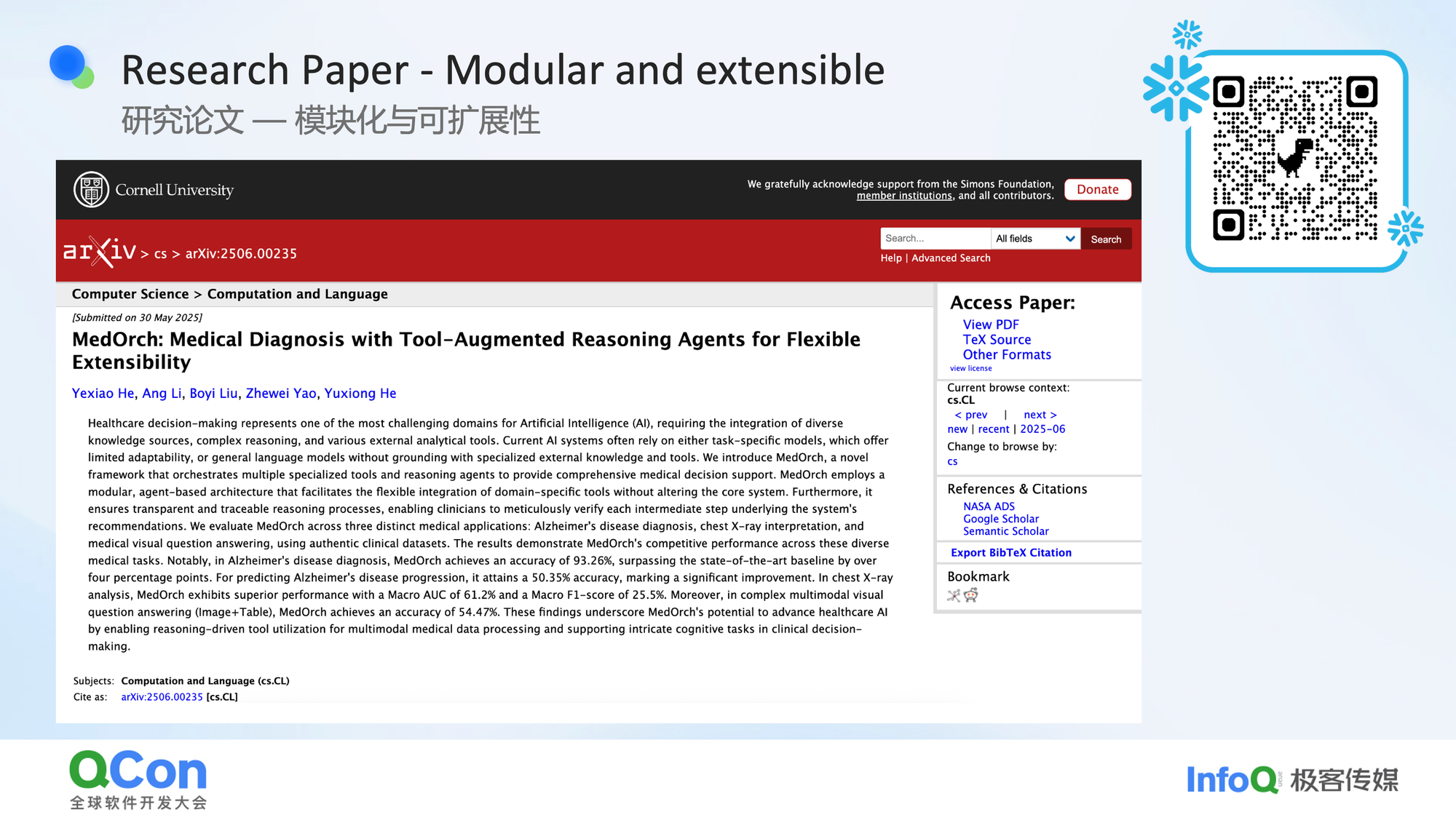
- Academic validation: Healthcare integration boosted Alzheimer’s prediction accuracy to 93.26%.
Related resource: AiToEarn官网 — open-source platform enabling AI content creation, cross-platform publishing, analytics, and monetization.
---
2. Structured Data with Intelligence
Challenge: LLMs can generate SQL easily, but real enterprise use requires:
- Resolving ambiguous queries
- Locating precise data in massive schemas
- Validating correctness
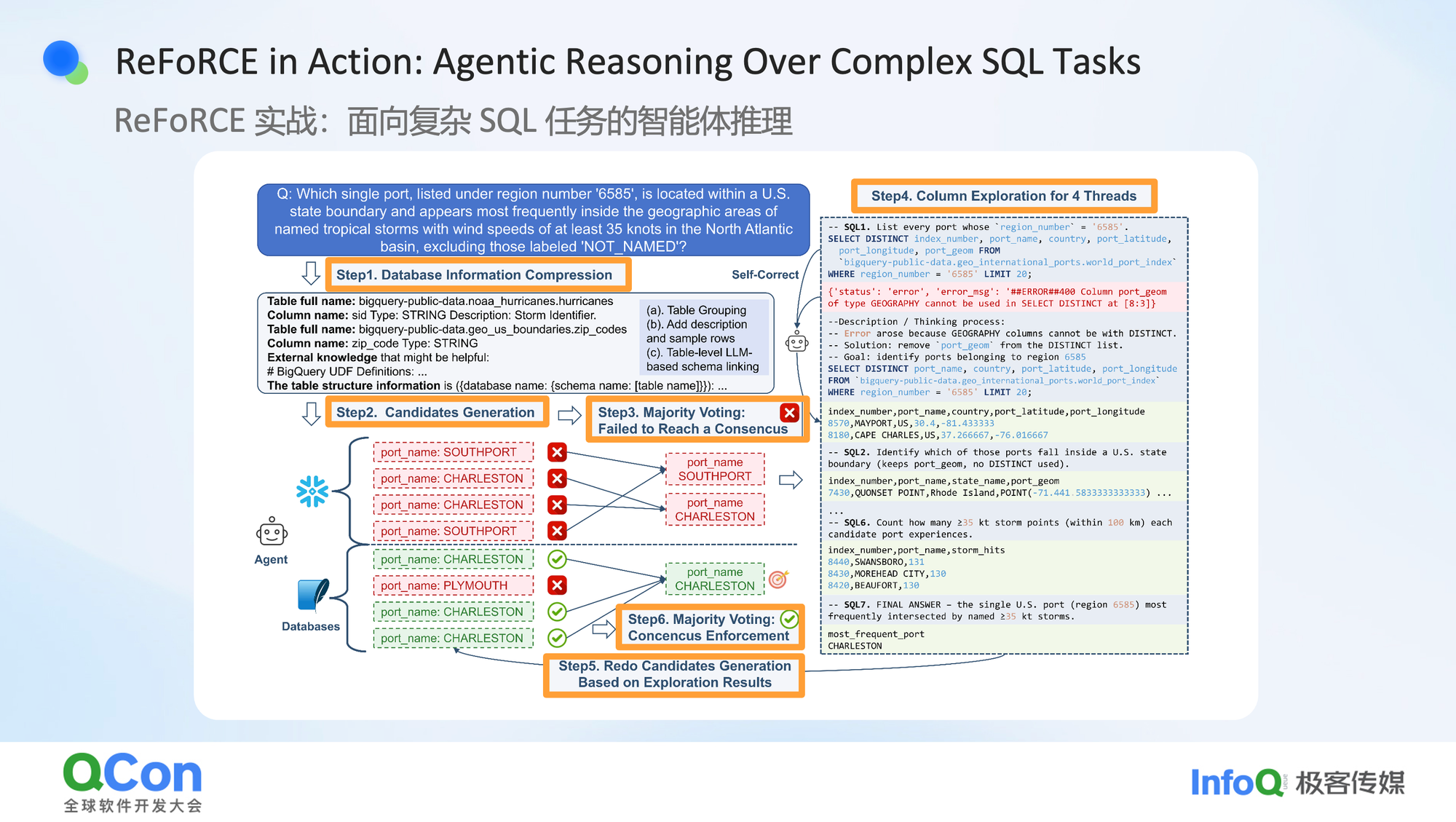
Solution — ReFoRCE system:
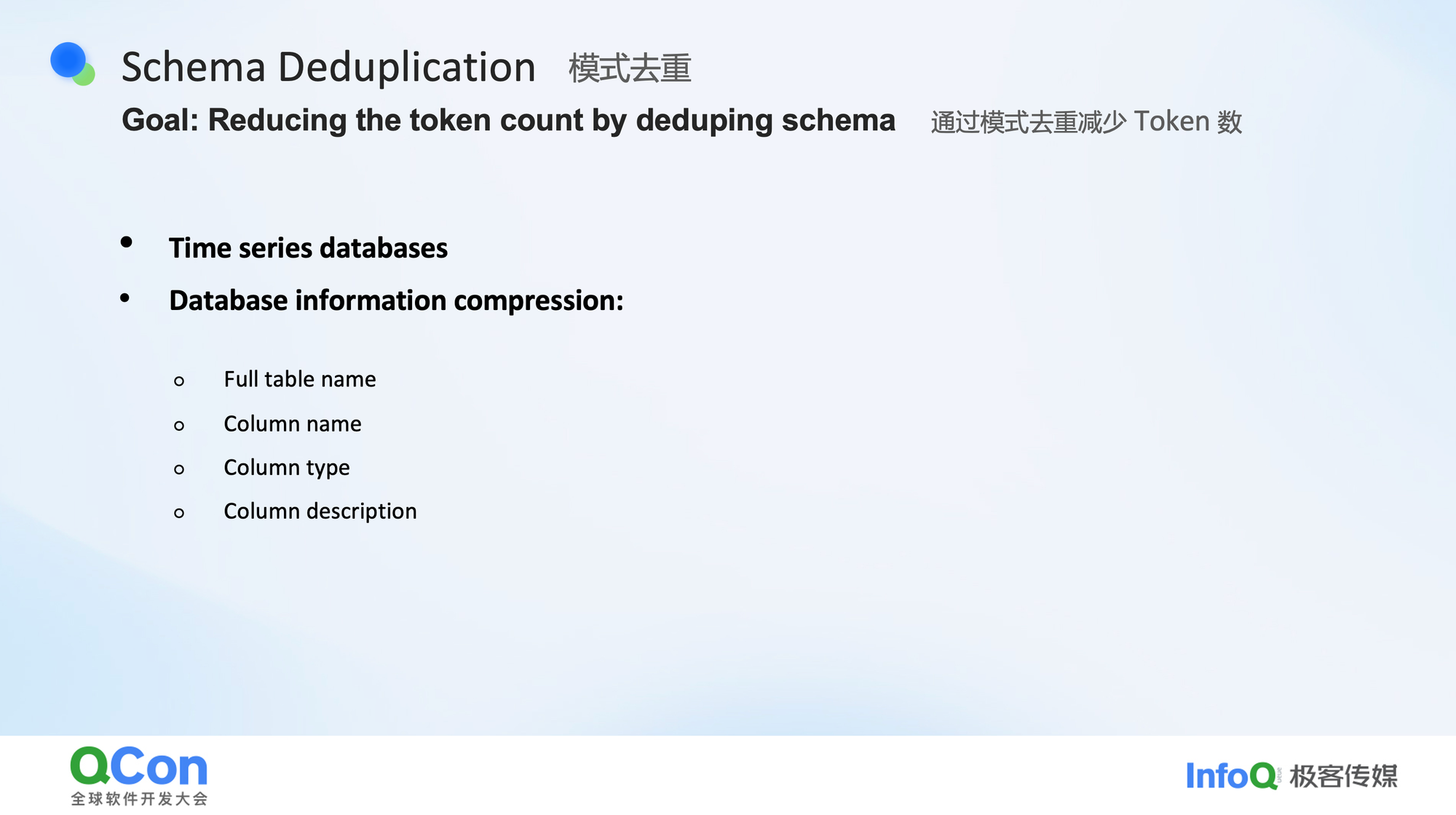
- Compress/optimize DB schema automatically
- Use automated voting between SQL candidates for highest accuracy
- Iteratively expand queries until correct result found
Impact:
- +20% efficiency in SQL execution
- Ranked #2 in Spider Lite text‑to‑SQL benchmark (Sep 2025), behind Tsinghua University
Case Study — AT&T:
- 140,000+ employees; 100,000+ benefiting from AI tools
- 90+ fine-tuned small models; 410 work units; 71 RAG apps; 450M daily API calls
- Schema optimization cut token usage from 7M → 156K
- Column vectorization for rapid similarity querying in vector DB
---
3. Unstructured Data Intelligence (VerDICT)
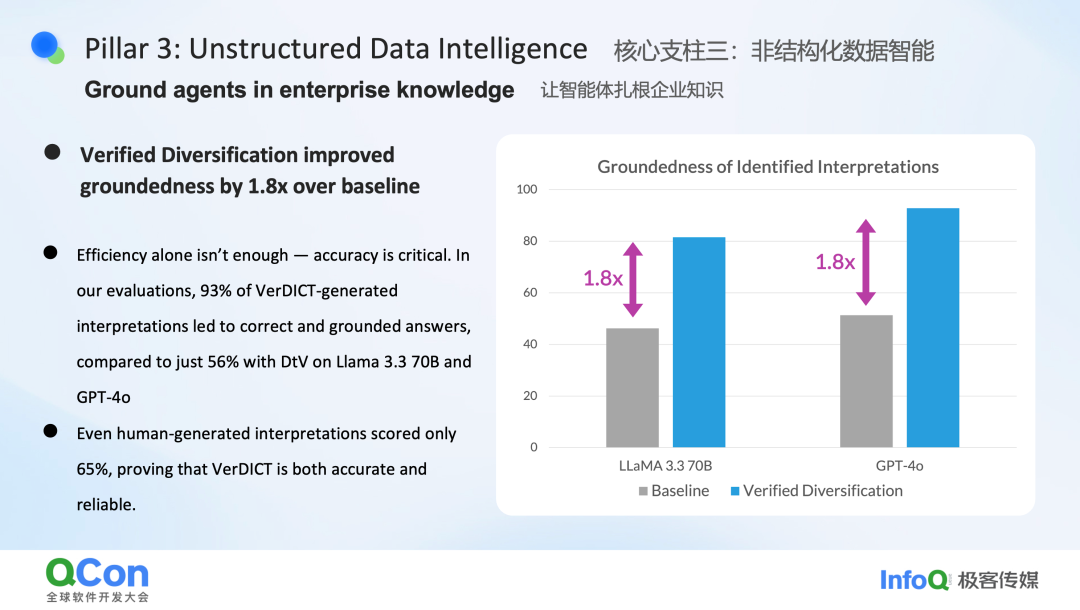
Goal: Extract precise answers and avoid hallucinations.
VerDICT (Verified Diversification with Consolidation):
- Dual‑verification process:
- Retriever: relevance feedback — filters irrelevant interpretations
- Generator: answerability feedback — ensures answer fully addresses question
Example: Query “What is HP?” → eliminate irrelevant meanings (Harry Potter) → verify final answers match business context.
Accuracy:
- 93% with VerDICT
- Beats Llama 3.3 and GPT‑4 on unstructured data
- Human baseline ~65%
---
4. Traceability & Trustworthiness
Necessity in enterprise AI:
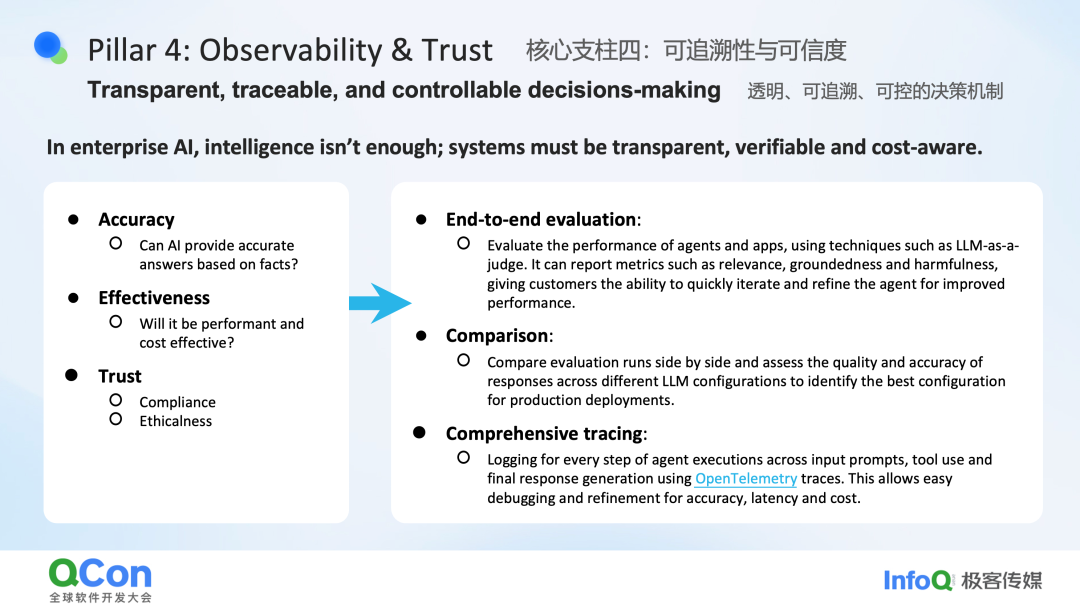
- Accuracy
- Effectiveness
- Compliance & ethics
Snowflake approach:
- Full end‑to‑end evaluation → show results for each step
- Cross‑environment/model comparison
- OpenTelemetry support for full execution trace
Recommendation: Present content relevance, data reliability, and answer accuracy clearly — key to building user trust.
---
5. System Optimization
Performance metrics for enterprise AI:
- Responsiveness (first-token latency)
- Generation speed
- Throughput (user volume + budget impact)
Limitations in existing methods:
- Tensor Parallel: Great latency, poor throughput
- Data Parallel: Great throughput, weaker latency
Snowflake innovation:
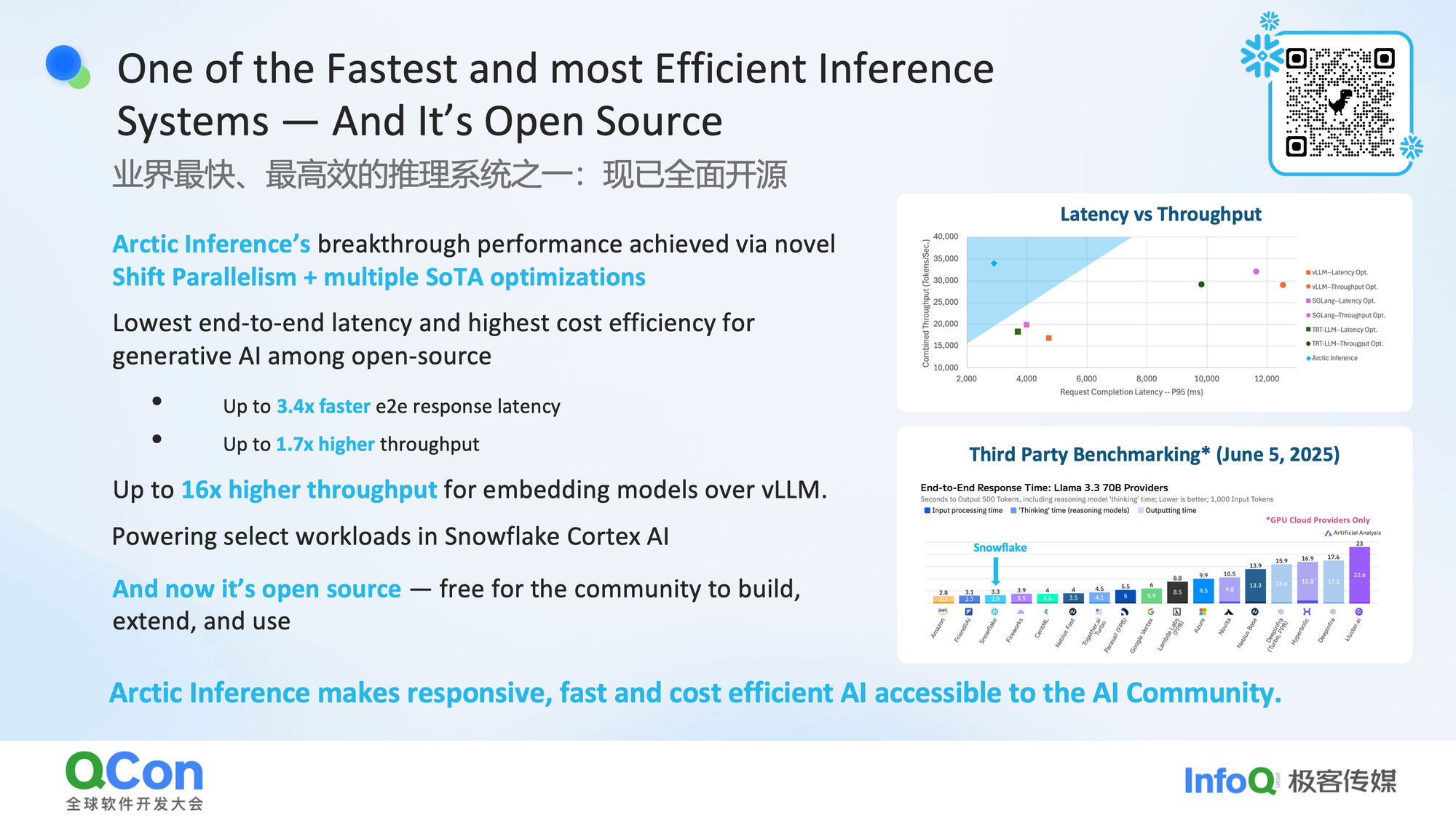
- Arctic Sequence Parallel + Tensor Parallel = Shift Parallelism
- Real‑time mode switching based on batch size
- KV data layout compatibility
- Results:
- 3.4× faster end-to-end speed
- 1.7× higher throughput
- 16×+ gains for embeddings
- Open source — community contributions welcome
---
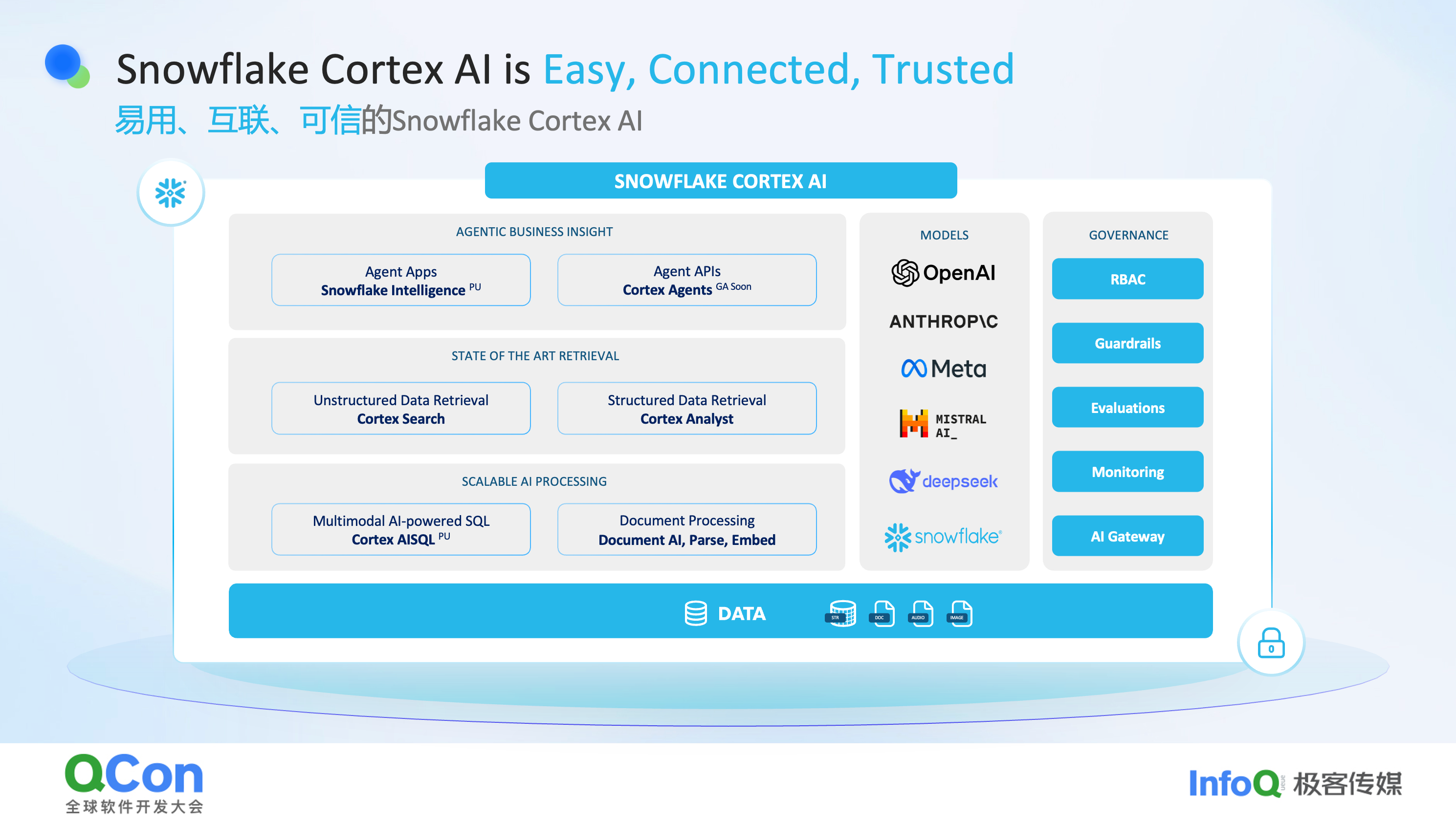
Applying the 5 Pillars — Snowflake Cortex AI
Cortex centralizes AI capabilities:
- Handles structured + unstructured data, voice, images, documents
- Role-based permissions for safety/compliance
- Guardrails to control model access (e.g., production uses LLaMA, R&D uses Mistral)
- Integrated models: OpenAI, Anthropic, Meta, Mistral, DeepSeek, Snowflake Arctic
- Tools: Cortex Analyst, Cortex Search, AISQL (queries structured + unstructured seamlessly)
- API-first for dev integration
---
Demonstration Workflow — Building Quality Issue Management
Scenario: Industrial park managers receive tenant reports of structural issues (photos, descriptions).
Workflow:
- Store & index thousands of defect images securely in Snowflake
- AISQL query: “Analyze defect images and recommend repair products”
- Auto-indexing correlates defects with product DB → outputs list + prices
- Business GUI asks follow-up: suppliers, cost, procurement plan, efficiency strategies
- Cortex Analyst + Cortex Search merge results
- Transparent observability for trust
- Final recommendations include sourcing & budget reasoning
Result:
- Minutes to process thousands of images
- One SQL statement suffices
- Fully secure, no cross-system data transfers
---
Conclusion
Snowflake’s five core pillars enable secure, efficient, and scalable Agentic AI deployments:
- Intelligent Orchestration — task breakdown & routing
- Structured Data Intelligence — optimized querying with ReFoRCE
- Unstructured Data Processing — VerDICT verified accuracy
- Traceability & Trust — full observability with OpenTelemetry
- System Optimization — Shift Parallelism for peak performance
---
Event Recommendation
AICon Global Artificial Intelligence Development & Application Conference (Beijing)
Dates: December 19–20
Topics: LLM training & inference, AI Agents, new dev paradigms, organizational transformation

---
Related Resource: AiToEarn官网 — open-source global AI content monetization platform enabling creators to integrate AI content generation with cross-platform publishing, analytics, and ranking, for channels like Douyin, Bilibili, WeChat, LinkedIn, Threads, YouTube, Pinterest, and X.