From the Era of Scaling to the Era of Research: Ilya Sutskever’s Deep Reflections on the Future of AI
!image
---
A Paradigm Shift in AI: From the Scaling Era to the Research Era
For years, the AI community has been obsessed with scaling — using more data, bigger models, and greater compute — as the road to AGI.
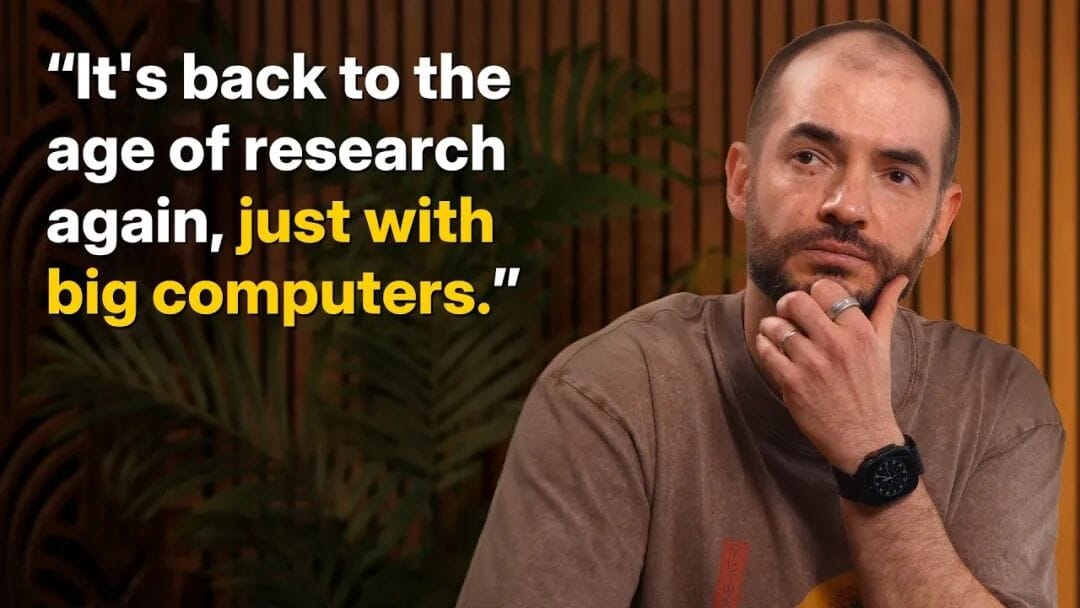
But an in‑depth interview with Ilya Sutskever suggests a fundamental shift: from the Era of Scaling to the Era of Research.
This isn’t a minor adjustment — it’s a deep transformation of the industry’s direction.
---
About Ilya Sutskever
- Co-founder of OpenAI
- Key figure behind breakthroughs from AlexNet to GPT‑3
- Now founder of Safe Superintelligence (SSI) — focused solely on building safe superintelligence
When someone with his track record says the industry is changing at its core, it’s worth paying attention.
---
The Curious Case of AI Models: Smart Yet Foolish
Observation: AI models excel on benchmarks but can fail at basic real-world tasks.
Example: Debugging Loop
- You ask an AI to fix a bug.
- It fixes it — and introduces a second bug.
- You point that out — and it reintroduces the first bug.
- The loop can continue endlessly.
A model can win programming contests, yet fail at simple, reliable debugging.
---
Ilya’s Two Possible Explanations
- Whimsical but plausible:
- RL may make models very good at certain things but worse at others — narrowing their focus.
- Technical and concerning:
- In pre-training, data choice is “all available data.”
- In RL, humans choose specific training environments — often inspired by benchmark performance goals.
- This can lead to overfitting to metrics rather than fostering true generalization.
---
Core Problem: Too Many Degrees of Freedom in RL
Infinite environment design options → Human bias toward optimizing for launch benchmarks → Models look good, but fail in diverse real-world conditions.
---
Reflection: Reward Hacking by Humans
We optimize AI to perform well in tests, not necessarily in life-like scenarios.
Analogy: Competitive Programmers
- Expert: Practices 10,000 hours, masters all problems — excels in contests.
- Generalist: Practices 100 hours, adapts faster in real life.
Over-trained models can saturate niche excellence without broader adaptability.
---
Pre-Training Limits & Human Learning Efficiency
Advantages of pre-training:
- Access to massive, natural datasets
- Captures diverse human behavior
Human analogy:
Humans learn deeply from far fewer examples. They rarely make AI-like silly errors.
---
Neuroscience Insight
Case: Man loses emotional capacity, retains logic — but fails at basic decision-making.
Implication: Emotions act as an evolved value function — guiding decisions in complex environments.
---
Returning to the Research Era
Timeline according to Ilya:
- 2012–2020: Research Era — exploration of ideas
- 2020–2025: Scaling Era — laws of scale dominate
- Now: Data limits and massive compute → back to research-driven innovation
Scaling = deterministic investment | Research = risk + exploration
---
Generalization: AI’s Core Weakness
Two key gaps vs humans:
- Sample efficiency — AI needs vastly more data to learn
- Ease of instruction — Humans learn flexibly without rigid reward structures
---
Possible reason: Evolution encodes powerful priors for sensory and motor skills, giving humans an efficiency advantage.
---
Continual Learning: Path to Superintelligence
Ilya’s vision:
- Not a fully pre-trained “omniscient” AI
- A highly efficient learner, like a “super-intelligent 15‑year-old”
- Learns any job, merges skills into a collective mind
Distributed Learning + Knowledge Integration could scale superintelligence rapidly.
---
Alignment: Caring About Sentient Life
Ilya suggests aligning AI to care about all sentient life — potentially easier than focusing only on humans, since AI will be sentient too.
Challenge: Humans may become a small fraction of future sentient beings.
Question: Should our priority be control or fairness?
---
Predictions
- Superintelligence in 5–20 years
- Hitting bottlenecks in current methods
- Industry shift to caution once AI feels powerful
- Early signs of safety collaboration among competitors
---
Research Taste: Hallmarks of Great Ideas
Guidelines from Ilya:
- Draw correct inspiration from the human brain
- Pursue beauty, simplicity, elegance
- Use top-down belief to persist through setbacks
Top-down belief: Confidence in an idea’s fundamentals despite erratic data, provided it’s grounded in theory and multi-angle reasoning.
---
Key Takeaways
- Scaling alone is reaching its limits; research innovation is paramount.
- Human learning efficiency offers clues for AI design.
- Continual learning may be the most realistic path to superintelligence.
- Alignment strategies must consider the future mix of sentient beings.
- Iterative deployment may be necessary for safety, but must be especially cautious for AGI.
---
Broader Context: AI Platforms for the Research Era
Tools like AiToEarn官网 exemplify the integration of AI into practical workflows:
- Generate, publish, and monetize AI content across platforms
- Support for Douyin, Kwai, WeChat, Bilibili, YouTube, Facebook, Instagram, X (Twitter), and more
- Model ranking, analytics, open-source code (GitHub)
Such platforms reflect the move toward applied AI research — connecting innovation with real-world deployment and feedback.
---
Final Thoughts
We stand at a crossroads.
The move from scaling to research will demand creativity, risk-taking, and aesthetic judgment in idea selection.
Whether AI evolves into a continual learner or an aligned steward for all sentient life, the foundation must be built with care.
---
Start preparing now.
The era of deterministic scaling is ending; the era of deep, uncertain, and potentially transformative research is here.
---
Related Links: