
Golang HTTP Request Timeout and Retry: Building Highly Reliable Network Requests | Dewu Tech
# Table of Contents

1. Foreword
2. Risks and Necessity of Timeout Control
3. Timeout Parameter Example
4. Context-Based Timeout Implementation
   1. Timeout Propagation via Context
   2. Timeout Control with Tracing
5. Retry Strategy
   1. Exponential Backoff with Jitter
   2. Error Type Determination
6. Idempotency Assurance
   1. Request ID + Redis Implementation
   2. Business-Level Idempotency Strategies
7. Performance Optimization
   1. Connection Pool Configuration
   2. `sync.Pool` Memory Reuse
8. Summary

---

## 1. Foreword

In **distributed systems**, the reliability of **network requests** directly impacts service quality.
Imagine a payment system suffering order status inconsistencies due to **timeouts** in third-party API calls, or user actions failing because of transient **network jitter**. These usually stem from **HTTP clients without robust timeout control or retry strategies**.

While Golang’s standard library offers a basic HTTP client, **high-concurrency and high-availability scenarios** demand more fine-tuned strategies for complex networking environments.

---

## 2. Risks and Necessity of Timeout Control

> **Key Insight**: Cloudflare’s 2024 report shows **78% of outages are linked to poor timeout settings**.

**Risks of improper timeout configuration:**
- **DoS Amplification**: No connection timeout → half-open connections under malicious slow-response attacks exhaust server file descriptors.
- **Resource Utilization Inversion**: Excessive or unlimited `ReadTimeout` keeps slow requests holding connection pool slots. Netflix data showed reducing timeout from 30s → 5s improved connection pool use by **400%** and boosted throughput 2.3×.

**Purpose**: Timeout control is a **resource protection mechanism** — preventing anomalies from spreading system-wide.

---

## 3. Timeout Parameter Example

Never rely on `http.DefaultClient` — its `Timeout` is **0** (no timeout).
In production, **always configure all timeout parameters explicitly**.
transport := &http.Transport{
DialContext: (&net.Dialer{
Timeout: 3 * time.Second, // TCP connection setup timeout
KeepAlive: 30 * time.Second, // Keep-alive duration
DualStack: true, // IPv4/IPv6 dual-stack support
}).DialContext,
ResponseHeaderTimeout: 5 * time.Second, // Response header wait timeout
MaxIdleConnsPerHost: 100, // Max idle connections per host
}
client := &http.Client{
Transport: transport,
Timeout: 10 * time.Second, // Total request timeout
}
---
## 4. Context-Based Timeout Implementation
`context.Context` enables **flexible, request-level timeout control** — useful in **distributed tracing and cancellation scenarios**.
Unlike `http.Client.Timeout`, **context timeouts propagate** through service call chains.
### 4.1 Timeout Propagation via Context
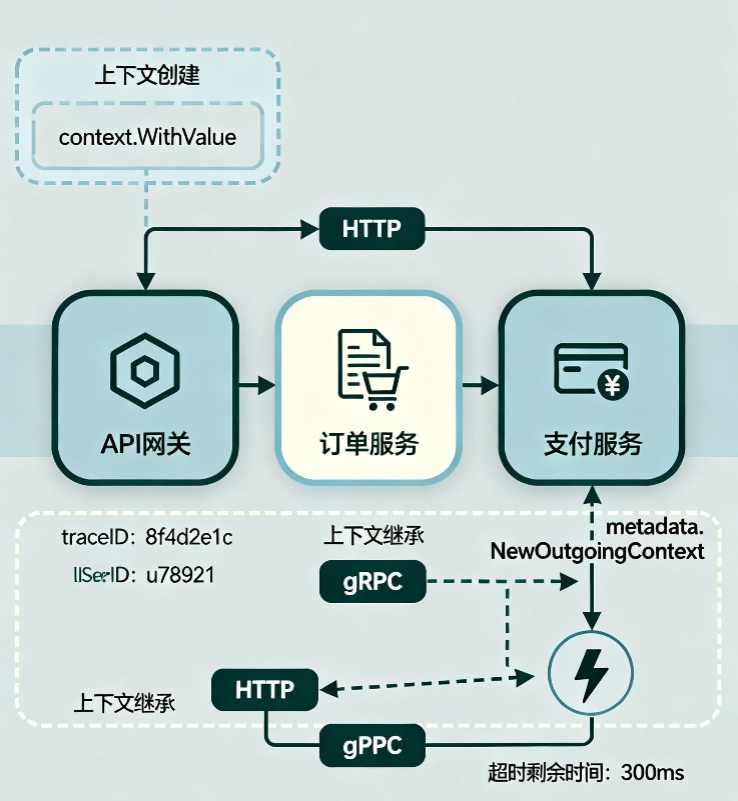
Using `context.WithTimeout` or `context.WithDeadline` produces a **timeout-aware context** passed through request lifecycles.
Cancellation of a parent context terminates all child contexts instantly.
---
### 4.2 Timeout Control with Tracing
func requestWithTracing(ctx context.Context) (*http.Response, error) {
ctx, cancel := context.WithTimeout(ctx, 5*time.Second)
defer cancel()
...
}
**Example:**
req, err := http.NewRequestWithContext(ctx, "GET", "https://api.example.com/data", nil)
if err != nil {
return nil, fmt.Errorf("Failed to create request: %v", err)
}
req.Header.Set("X-Request-ID", ctx.Value("request-id").(string))
client := &http.Client{
Transport: &http.Transport{
DialContext: (&net.Dialer{Timeout: 2 * time.Second}).DialContext,
},
}
resp, err := client.Do(req)
if err != nil {
if ctx.Err() == context.DeadlineExceeded {
return nil, fmt.Errorf("Request timed out: %w", ctx.Err())
}
return nil, fmt.Errorf("Request failed: %v", err)
}
return resp, nil
> **Note**: `context.WithTimeout` and `http.Client.Timeout` are cumulative — the shorter wins.

---

## 5. Retry Strategy

Retries must **avoid overload** and **prevent thundering herd** scenarios.
Effective strategies combine:
- Error type checks
- Backoff algorithms
- Idempotency guarantees

### 5.1 Exponential Backoff with Jitter

Exponential backoff increases retry intervals; jitter randomizes them to prevent synchronized bursts.
type RetryPolicy struct {
MaxRetries int
InitialBackoff time.Duration
MaxBackoff time.Duration
JitterFactor float64 // 0.1 to 0.5 recommended
}
func (rp *RetryPolicy) Backoff(attempt int) time.Duration {
if attempt <= 0 { return rp.InitialBackoff }
backoff := rp.InitialBackoff * (1 << (attempt - 1))
if backoff > rp.MaxBackoff { backoff = rp.MaxBackoff }
jitter := time.Duration(rand.Float64() float64(backoff) rp.JitterFactor)
return backoff - jitter + 2*jitter
}
func Retry(ctx context.Context, policy RetryPolicy, fn func() error) error {
var err error
for attempt := 0; attempt <= policy.MaxRetries; attempt++ {
if attempt > 0 {
select {
case <-ctx.Done():
return fmt.Errorf("retry canceled: %w", ctx.Err())
default:
}
backoff := policy.Backoff(attempt)
timer := time.NewTimer(backoff)
select {
case <-timer.C:
case <-ctx.Done():
timer.Stop()
return fmt.Errorf("retry canceled: %w", ctx.Err())
}
}
err = fn()
if err == nil { return nil }
if !shouldRetry(err) { return err }
}
return fmt.Errorf("max retries %d reached: %w", policy.MaxRetries, err)
}
---

### 5.2 Error Type Determination

Retry only on retry-worthy errors:
func shouldRetry(err error) bool {
var netErr net.Error
if errors.As(err, &netErr) {
return netErr.Timeout() || netErr.Temporary()
}
var respErr *url.Error
if errors.As(err, &respErr) {
if resp, ok := respErr.Response.(*http.Response); ok {
switch resp.StatusCode {
case 408, 429, 500, 502, 503, 504:
return true
}
}
}
return errors.Is(err, ErrRateLimited) ||
errors.Is(err, ErrServiceUnavailable)
}
**Netflix Best Practice**:
- Retry on 5xx up to 3 times
- Use `Retry-After` for 429
- Exponential backoff for network errors (start at 100ms, max 5s)

---

## 6. Idempotency Assurance

Retry safely only if **requests are idempotent**.

### 6.1 Request ID + Redis Implementation
type IdempotentClient struct {
redisClient *redis.Client
prefix string
ttl time.Duration
}
func (ic *IdempotentClient) NewRequestID() string {
return uuid.New().String()
}
func (ic IdempotentClient) Do(req http.Request, requestID string) (*http.Response, error) {
key := fmt.Sprintf("%s:%s", ic.prefix, requestID)
exists, err := ic.redisClient.Exists(req.Context(), key).Result()
if err != nil {
return nil, fmt.Errorf("Idempotency check failed: %v", err)
}
if exists == 1 {
return nil, fmt.Errorf("Request already processed: %s", requestID)
}
set, err := ic.redisClient.SetNX(req.Context(), key, "processing", ic.ttl).Result()
if err != nil || !set {
return nil, fmt.Errorf("Concurrent request conflict: %s", requestID)
}
client := &http.Client{}
resp, err := client.Do(req)
if err != nil {
ic.redisClient.Del(req.Context(), key)
return nil, err
}
ic.redisClient.Set(req.Context(), key, "completed", ic.ttl)
return resp, nil
}
> **Tip**: TTL > (max retry interval + processing time)

---

### 6.2 Business-Level Idempotency Strategies

- **Update**: Optimistic locking, e.g. `UPDATE ... WHERE version = ?`
- **Create**: Unique indexes to prevent duplicates
- **Delete**: Soft delete (mark status) instead of hard removal

---

## 7. Performance Optimization

High-throughput bottlenecks often come from **connection management** or **memory allocation**.

### 7.1 Connection Pool Configuration
func NewOptimizedTransport() *http.Transport {
return &http.Transport{
MaxIdleConns: 1000,
MaxIdleConnsPerHost: 100,
IdleConnTimeout: 90 * time.Second,
DialContext: (&net.Dialer{
Timeout: 2 * time.Second,
KeepAlive: 30 * time.Second,
}).DialContext,
TLSHandshakeTimeout: 5 * time.Second,
TLSClientConfig: &tls.Config{
MinVersion: tls.VersionTLS12,
},
ExpectContinueTimeout: 1 * time.Second,
}
}
**Example Impact**: Uber raised `MaxIdleConnsPerHost` from 2 → 100, latency dropped from **85ms to 12ms**, throughput ×6.

---

### 7.2 `sync.Pool` Memory Reuse
var requestPool = sync.Pool{
New: func() interface{} {
return &http.Request{Header: make(http.Header)}
},
}
func AcquireRequest() *http.Request {
req := requestPool.Get().(*http.Request)
req.Method = ""
req.URL = nil
req.Body = nil
req.ContentLength = 0
req.Header.Reset()
return req
}
func ReleaseRequest(req *http.Request) {
requestPool.Put(req)
}
---

## 8. Summary

HTTP requests are the **lifeblood** of a system — poor timeout/retry control is like a weak artery.
Under load, weaknesses cause breakdowns.

To achieve **reliable network requests**, balance:
- Timeout control
- Retry strategies
- Idempotency checks
- Performance tuning

**Essential rule**: In distributed systems, **timeouts and retries are survival mechanisms**.

---

**Further Reading**:
- [Golang HTTP Client Docs](https://pkg.go.dev/net/http)
- [Netflix Hystrix Timeout Pattern](https://github.com/Netflix/Hystrix/wiki/Configuration)

