Google Previews Code Wiki: Can You Trust AI to Document Your Codebase?
Google Previews Code Wiki — AI-Driven Codebase Documentation
Google has introduced a preview of Code Wiki, an AI-powered system that automatically generates documentation for code within a repository and keeps it updated after each code change.
Currently, the preview includes documentation for hundreds of open-source projects, with plans for a Gemini CLI extension to run on internal company codebases. Pricing details for the commercial version are not yet disclosed.
---
Overview & Background
Google’s official announcement provides minimal technical details, urging developers to explore the preview themselves to understand its full capabilities.
On Hacker News, Omar Shams (founder of Mutable.ai) noted that Code Wiki is a refactored version of Auto Wiki, a project built before Google acquired his company.
Unlike tools that document program output, Code Wiki focuses on the code itself — its structures, APIs, and internal logic.
---
Example: Microsoft ASP.NET Core
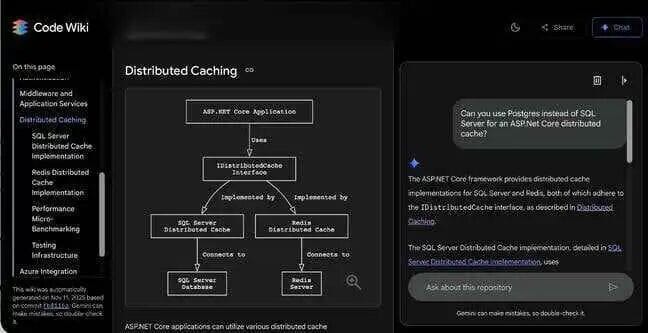
We reviewed Code Wiki’s generated documentation for Microsoft’s ASP.NET Core web framework:
- Strength: Microsoft’s general documentation is extensive for end-users, but less complete for contributors — a gap Code Wiki aims to fill.
- Feature: Chat-based UI for codebase queries.
Sample Query:
> Could PostgreSQL replace SQL Server for ASP.NET Core’s distributed cache?
Gemini’s response:
> “There’s no mention of direct support or out-of-the-box implementation for PostgreSQL.”
Reality check:
- Microsoft’s official docs confirm Azure PostgreSQL can be used via `IDistributedCache`.
- Gemini was partly right: the codebase only implements SQL Server and Redis.
- Verdict: Human verification remains essential.
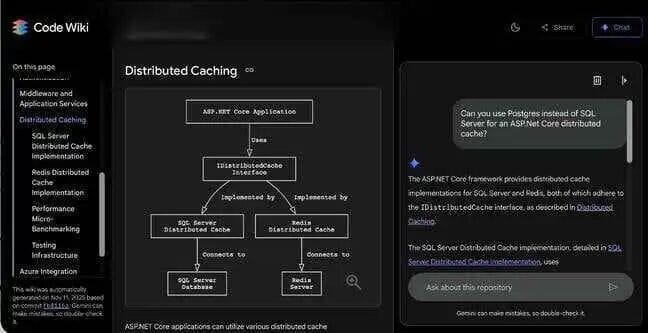
Code Wiki explaining ASP.NET distributed cache code
---
Developer Feedback & Criticism
Key Concerns
- Context Limitations — AI may lack sufficient architectural understanding.
- Accuracy Risks — Output can oscillate between overly vague and overly specific.
- Maintenance Awareness — Missed important status updates (e.g., vuejs/vue deprecation).
Quotes from Developers:
- “Whole-codebase documentation should not rely solely on AI — architectural context can’t be solved with tool calls.”
- “Generated text is verbose, often an ‘educated guess’ — sometimes 1/5th the length of the actual code.”
---
Not a True Wiki
While called “Code Wiki,” the platform is not collaborative in the traditional sense:
- Traditional wiki: Editable by multiple contributors; knowledge refined by community.
- Code Wiki: Primarily auto-generated text & diagrams; minimal human editing.
Disclaimer in UI:
> “Gemini may be wrong, please always verify.”
---
Pros & Cons of Auto-Updating Documentation
Advantages:
- Always in sync with latest code changes.
- Reduces onboarding overhead for new developers.
Drawbacks:
- Frequent revisions may disrupt readers.
- Potential loss of persistent references.
---
Competitors & Similar Concepts
- DeepWiki (by Devin) — similar approach, covers open-source repos and supports private codebases.
---
Related AI Platform Trends
Beyond code documentation, AI is transforming content creation and publishing:
Platforms like AiToEarn官网 enable:
- AI Content Monetization — across Douyin, Kwai, WeChat, Bilibili, Xiaohongshu, Facebook, Instagram, LinkedIn, Threads, YouTube, Pinterest, and X (Twitter).
- Model Rankings via AI模型排名.
- Cross-platform publishing and analytics to optimize reach.
This integrated setup illustrates that AI-driven documentation could be part of a larger ecosystem of creation, distribution, and monetization tools.
---
Google’s Collaborative Code Wiki Concept
Separate from the AI-driven Code Wiki preview, Google has floated a vision for a collaborative, editable programming knowledge base.
Key Features
- Editable Pages — for programming topics, code snippets, API references.
- Version History & Moderation — revert edits when needed.
- Google Search Integration — surface Code Wiki entries in coding queries.
- API Friendly — runnable snippets, integration with code hosting platforms.
Why It Matters
Structured wiki formats can reduce fragmentation in developer knowledge compared to scattered Q&A threads (e.g., on Stack Overflow).
Collaboration & Incentives
- Relies heavily on developer contributions.
- Incentive system planned for active editors.
- Preview access currently limited, with public launch expected later.
---
Conclusion & Next Steps
Key takeaway:
Code Wiki represents both the promise and limitations of AI-generated, auto-updating technical documentation — useful for quick onboarding, but requiring human oversight for accuracy and context.
---
Question for You:
Do you want me to prepare a comparative analysis of Code Wiki vs. MDN, Stack Overflow, and GitHub Docs?
That could highlight where Google’s approach stands out — and where it falls short.