# Unconventional AI Learning Journey — How Gabriel Petersson Joined OpenAI’s Sora Team Without a Degree

Reading code line-by-line, refusing “vibe coding,” and reverse-learning math and diffusion models through ChatGPT — this **OpenAI research scientist** worked on **Sora** using one of the most unconventional methods to master video generation architecture.
Compiled by | Tina
---
## Overview
Within OpenAI's Sora team is a research scientist unlike the typical Silicon Valley stereotype:
- **No academic degree**, no formal competition background.
- **High school dropout** from Sweden.
- Not a “vibe coder” — prefers disciplined, line-by-line code reading.
- Learned advanced math and ML concepts by **filling knowledge gaps recursively with AI**.
His approach: **Project-driven learning + AI-assisted gap-filling + disciplined code reading**.
> **Note:** This article is *not* promoting dropout culture. University offers valuable networks and resources. Gabriel himself notes not having a diploma **still limits opportunities**.
---
## 1. First Startup — Cold Calling With Recommendation Systems
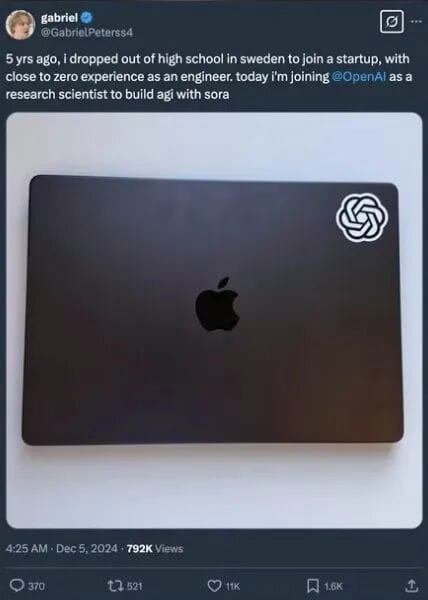
**The Beginning:**
- Inspired by books _Superintelligence_ and _Life 3.0_.
- Initially knew no coding, failed Andrew Ng’s ML course.
- Partnered with cousin to build **AI product recommendations**.
**Tactics Used:**
1. Crawled client sites → built a new recommendation model.
2. Printed A3 visual comparisons (current vs. improved system).
3. Walked into businesses, asked for e-commerce leads.
4. Offered **instant deployment** using console-pasted scripts.
5. Integrated **A/B testing** for immediate ROI measurement.
**Lessons:**
- Immediate value demo leads to instant adoption.
- Scalability ignored early — focus was on customer acquisition.
---
## 2. Fastest Learning: Real Project Over Theory
**Key Insights:**
- Coding learned out of necessity:
- Java (bad Pokémon clone).
- Python games.
- Web crawlers, recommendation engines.
- Stack Overflow + friends for quick fixes.
- Real projects accelerate mastery far more than abstract study.
**Gabriel’s Advice:**
- Enter the market **ASAP**.
- Let ChatGPT handle unknowns.
- Knowledge is no longer scarce — execution matters most.
---
## 3. AI for Self-Learning: Math & Diffusion Models
**Process:**
1. Ask ChatGPT “What are the core concepts in image/video models?”
2. Request full **diffusion model code**.
3. Debug with ChatGPT until code runs.
4. Drill into each module’s purpose & math intuition.
5. Reverse-teach the AI, validate understanding.
**Techniques:**
- Ask AI to explain “as if you were 12 years old.”
- Use analogies (bookstore for vector embeddings).
- Demand **extremely specific** and visual explanations.
---
## 4. **Recursive Gap Filling** — Repeat Until Complete Understanding
**Core Practice:**
- Constantly ask: “Do I really understand this?”
- Recognize the “click moment” → mark comprehension.
- Improve questions to speed up “Aha!” breakthroughs.
**Prompt Tricks:**
- “List different approaches, pros/cons, who tried them.”
- “Include all intermediate steps.”
- Build intuition — explain **why** something works.
---
## 5. No PhD — Doing PhD-Level Work
**Reality Today:**
- AI reduces the barrier for high-level research.
- Example: Sora video model improvements involve:
- Watching outputs,
- Adjusting architecture/data,
- Retraining,
- Iterating visually.
**Workflow With AI:**
- Provide codebase + specific problem.
- Request idea lists, relevant papers.
- Integrate new methods — always reading code line-by-line.
**Belief:**
- The right shortcut is to **deeply understand fundamentals faster**.
---
## 6. From Stockholm to San Francisco
**Strategy:**
- Seek **best teams** — best people.
- Prefer contracting to stay mobile.
- Request heavy feedback: “Review all my PRs.”
- Treat code reviews as mentorship opportunities.
---
## 7. Breaking Into OpenAI Without a Degree
**Critical Moves:**
- Dataland project: mentorship from an exceptional engineer.
- Temporary visas → networking in San Francisco.
- Joined **MidJourney** — gained credibility.
- Leveraged GitHub & Stack Overflow contributions as proof of skill.
**Advice for Proving Value:**
1. **Build a very good demo** — clear in 3 seconds.
2. Make coding skill obvious.
3. Show projects that directly link to company value (“make money”).
---
## 8. Core Hiring Truths
- **Companies care:** Can you help them make money?
- Diplomas = fallback **proxy signals** if proof of capability is missing.
- Bypass recruiters → speak directly to technical decision-makers.
- Offer short trials (even unpaid) with actionable ideas.
---
## 9. Guidance for 18-Year-Olds Uncertain About Career
**Options Suggested:**
- Try becoming a software engineer — build simple games via ChatGPT.
- Showcase **learning speed** & initiative.
- Marketing route: send improved content samples to companies.
---
## 10. “Learning ML with AI” Isn’t Shameful
- Top-down learning dramatically shortens timelines:
- Traditional = ~6 years before touching diffusion models.
- AI-assisted = **3 days to top-level concept**, then decide depth.
- Universities no longer hold a monopoly on foundational knowledge.
- Agency > credentials.
---
## 11. Avoid “Fake Effort” — Only Real Projects Count
- Good habits without advancing output = decoration.
- Move into **real money, real users** environments.
- Target → get first real job quickly.
---
## 12. Chronic Mild Suffering — The Cost of Avoidance
- The “do nothing” option breeds **decision allergy**.
- Uncomfortable steps (quit job, move cities, apply abroad) bring big leaps.
- Example: Convincing a friend to interview → **income ×10**.
---
## 13. Final Note — Letter to Past Self
- Feeling “not smart enough” is common; most underestimate capability.
- Listening to this kind of content signals top-1% agency.
- Keep following the path — opportunity is abundant.
---
## Key Takeaways
- **Project-Driven Learning** beats theory-first.
- **Recursive Gap Filling** ensures deep understanding.
- **Fundamentals can be mastered faster** with AI.
- **Proof of value** > credentials.
- Avoid “fake effort” → maximize **real-world output**.
---
**Reference:** [YouTube Interview](https://www.youtube.com/watch?v=vq5WhoPCWQ8)
Statement: This summary is based on InfoQ’s content and does not represent platform views. Reproduction without permission is prohibited.
---