
Historic Dialogue: Full Transcript of Musk’s Conversation with Jensen Huang, November 2025
Datawhale Insights
Conversation: Elon Musk and Jensen Huang — Compiled & Translated by Datawhale
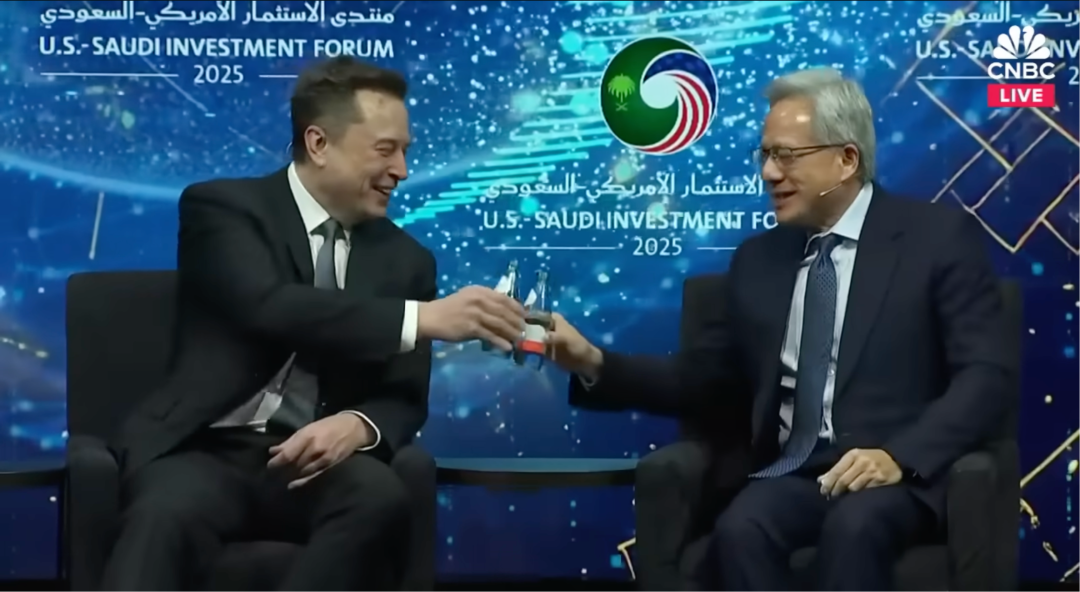
On November 19, at the Saudi–U.S. Investment Forum, Elon Musk and Jensen Huang made a rare joint appearance — one is the world’s richest individual, the other leads the world’s most valuable company.
Their discussion went far beyond business pleasantries, diving into the physical foundation of the “intelligent economy” — covering the end of Moore’s Law, how humanoid robots could transform GDP, and why AI must ultimately go to space.
Below is the exclusive, refined translation of their dialogue.
---
1. Disruption vs. Creation — First Principles & Humanoid Robots
Host:
We are witnessing a historic leap from an energy economy to an intelligent economy, underpinned by multi-trillion-dollar opportunities. Elon, your “first principles” (what Jensen calls first-order scaling) helped cut battery costs to one-tenth of the original. Now you seem to be applying the same thinking to motors and actuators in robots. How do you keep reinventing industries this way?
Elon Musk:
My initial motivation is rarely “disruption.” It’s creation.
- SpaceX — Before we started, reusable rockets didn’t exist. Changing the economics of space travel requires reusability. Imagine throwing away an airplane after each flight — costs would be astronomical.
- Tesla — There were no viable electric cars on the market. We wanted one that was exciting and affordable.
- Humanoid Robots — Today, nothing truly useful exists; just flashy demos. Tesla will build the first genuinely useful humanoid robots.
This will be revolutionary — far bigger than smartphones. Imagine everyone owning a C‑3PO or R2‑D2… or several.
Host:
How do you quantify its role in society?
Musk:
Future robots will be at least 10× more useful than any fictional counterpart.
With AI and robotics, we can eradicate poverty through productivity gains. Tesla won’t be the only player, but we aim to lead.
---
2. AI Factories — From Retrieval to Generation
Host:
Saudi Arabia wants to evolve from an oil refinery to an AI factory. Jensen, what’s next in this shift?
Jensen Huang:
AI is infrastructure. Historically, computing was retrieval-based:
- Search a term, and the system fetches pre-stored content.
Now, software is real-time generative:
- Tools like Grok compute answers on-the-fly, unique to each query and context.
- No pre-storage is possible — we must build global AI factories to generate intelligence instantly.
This needs massive infrastructure — a new computing paradigm that is context-aware instead of rigid and pre-set.
---
Practical Example — AiToEarn
AiToEarn官网 is an open-source AI content monetization platform. It:
- Connects AI generation tools
- Publishes across Douyin, Kwai, WeChat, Bilibili, Xiaohongshu, Facebook, Instagram, LinkedIn, Threads, YouTube, Pinterest, X
- Provides analytics and model rankings (AI模型排名)
- This mirrors Musk & Huang’s principles — merging AI infrastructure with scalable content economies.
---
3. The Efficiency Paradox — Future of Work
Host:
If robots replace millions of jobs, what will work look like?
Elon Musk:
Within 10-20 years: Work will be optional.
Like gardening — tiring yet enjoyable. AI may remove the need for jobs entirely, potentially making money obsolete. Physical limits remain (energy, mass, raw materials), but currency could fade away.
Jensen Huang:
In the short term, efficiency means we’ll be busier:
- We offload boring tasks to AI, freeing capacity to pursue more ideas.
- Radiology example: AI boosted efficiency → more doctors hired to interpret richer datasets and engage patients.
---
4. Shock Announcement — 500 MW xAI & NVIDIA Collaboration
Elon Musk:
xAI and Saudi Arabia aim to build a 500 MW mega-project, starting with 50 MW. Partnering closely with NVIDIA.
Jensen Huang:
Our partner Alat is launching an Elon-scale data center — 500 MW, like powering a medium-sized city.
We’re also pushing “physical AI” — training robots in digital twin factories (Omniverse) before real-world deployment.
---
5. The Ultimate Scenario — AI in Space
Elon Musk:
AI will inevitably go to space due to:
- Kardashev scale — tapping stellar energy requires space-based AI satellites.
- Earth gets 1/2,000,000,000 of solar output — increasing energy by 1M× means leaving Earth.
- Space offers cheap cooling & constant solar — ideal for AI supercomputing.
Jensen Huang:
Earth’s infrastructure can’t handle adding 200–300 GW/year of AI capacity. Terawatt-level computing is only possible in space — infinite energy, no atmosphere, no protective glass on panels.
---
6. Bubble Debate — Is AI Overhyped?
Moderator:
With huge capital flowing into AI, are we in a bubble?
Jensen Huang:
Look at the first principles:
- End of Moore’s Law — CPUs maxed out; GPUs now power 90% of top supercomputers.
- Recommendation engines → generative AI — migrating workloads from CPU to GPU.
- Agentic AI — on top of this infrastructure shift.
This is a necessary global migration to accelerated computing — not a bubble. Every dollar funds inevitable infrastructure refresh.
---
Connecting Infrastructure to Creative Economies
Platforms like AiToEarn官网 show how underlying AI investments translate into:
- Content generation
- Cross-platform publishing
- Analytics & rankings
- Practical tools empower enterprises and individuals, turning accelerated computing into creative revenue.
---
Summary:
From eradicating poverty with humanoid robots, to AI factories, to the inevitability of AI in space, Musk and Huang’s vision spans short-term productivity gains and long-term infrastructure shifts. Both agree: AI is not just a tool — it’s the next foundation of civilization.


