How Shopify Handles 30TB of Data per Minute with a Monolithic Architecture
Shopify’s Billion-User Monolith: How Simplicity Scales
If you’ve ever worked on a web application that slows down with just a few thousand users, imagine handling billions—and doing it with a single, elegantly designed monolith, not hundreds of microservices or annual rewrites.
This is the real story of Shopify:
Processing 20+ TB of data every minute, powering one of the world’s largest e-commerce platforms, and keeping its architecture simple, scalable, and human-friendly.
---
Black Friday at Shopify
For most companies, Black Friday means chaos.
For Shopify, it’s a well-oiled machine in overdrive.
When midnight strikes, traffic floods in from all over the globe. Millions shop at stores like Gymshark, Kylie Cosmetics, and Allbirds.
2021 Black Friday Weekend Stats
- 30 TB of data processed per minute
- 32M+ requests per minute
- 11M MySQL queries per second
- $3.9M sales per minute
- Zero downtime, zero crashes
---
The Modular Monolith Approach
Shopify’s architecture is a modular monolith—one codebase, mainly Ruby on Rails, split into clear logical domains.
Think of it as one city with distinct districts:
- Checkout
- Payments
- Orders
- Admin Backend
- Inventory
- Analytics
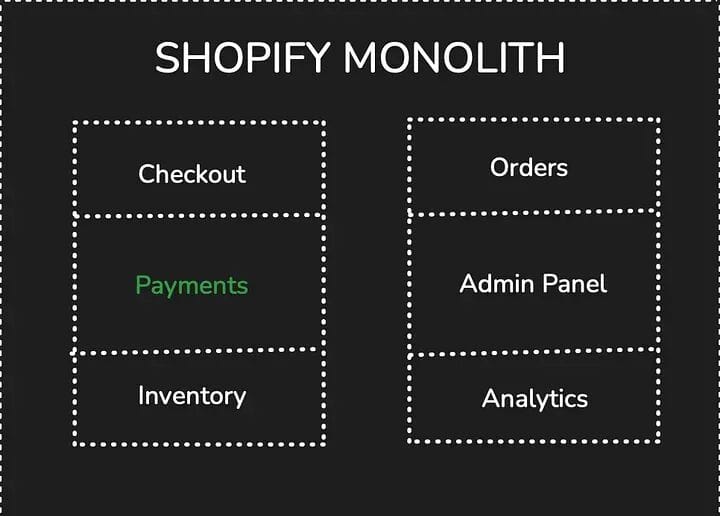
Each module has:
- Exclusive data ownership
- Public API for interaction
- Dedicated maintenance team
---
Enforcing Boundaries with Packwerk
Modules live in the same codebase but are strictly isolated.
- Shopify uses Packwerk, an internal tool, to detect forbidden module access.
- This discipline keeps the 10+ year-old monolith clean and maintainable for thousands of engineers.
---
Hexagonal Architecture (Ports & Adapters)
Why?
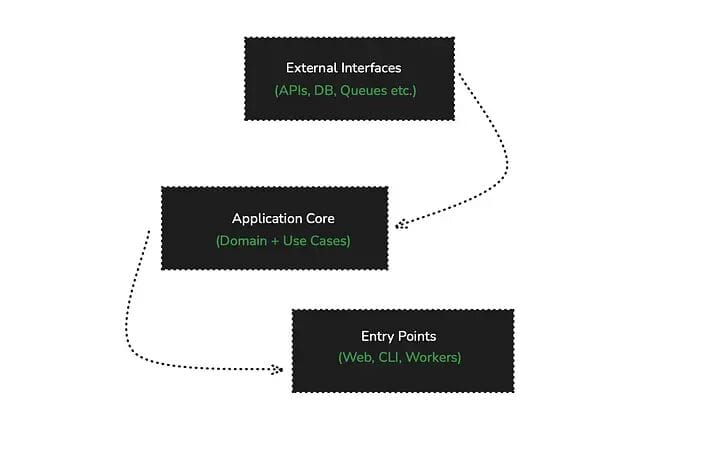
Modular boundaries decide where features live.
Hexagonal architecture decides how they talk to the outside world.
Core principles:
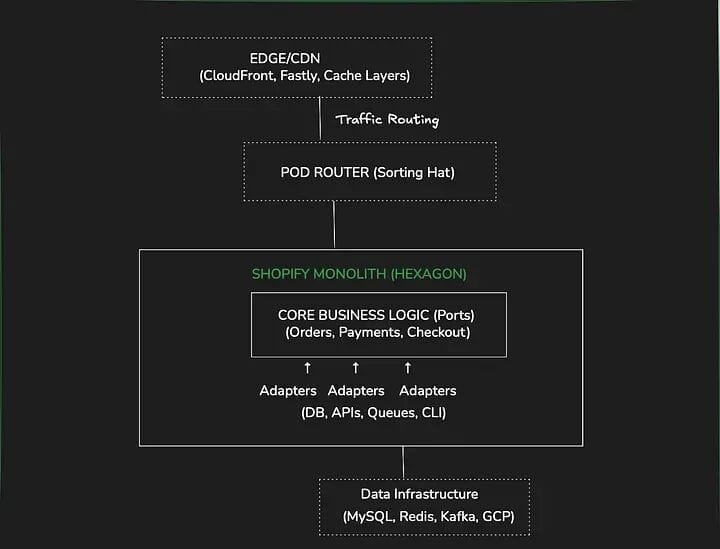
- Core business logic sits at the center (unchanging)
- Adapters at the edge handle external communication (API, DB, queues)
Example: Creating an Order
Tight‑Coupling (Traditional)
- Controller directly calls DB
- Business logic lives in controllers
- API changes risk breaking everything
Hexagonal Method (Shopify Way)
────────────────────────┐
│    Web Layer           │
│ (GraphQL, REST, etc.)  │
└───────────┬────────────┘
            ▼
 ┌──────────────────────┐
 │ Application Service  │
 │ (CreateOrderUseCase) │
 └───────────┬──────────┘
      (via Interface)
            │
 ┌──────────────────────┐
 │ Adapters             │
 │ (MySQL, Kafka, Redis)│
 └──────────────────────┘
Workflow:
- API adapter receives request
- Passes to `CreateOrderUseCase`
- Core logic runs (inventory check, payment validation, discounts)
- Adapter persists data to MySQL or sends event to Kafka
Key Benefit: Core logic is agnostic to the input/output source.
Shopify can swap tech without touching business logic.
---
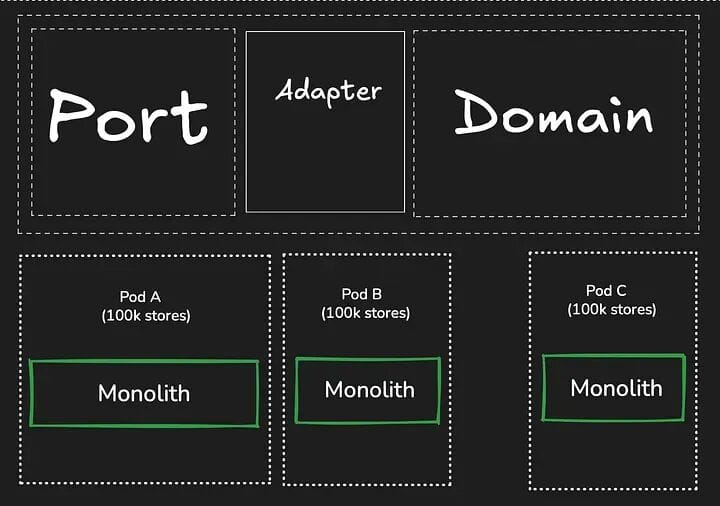
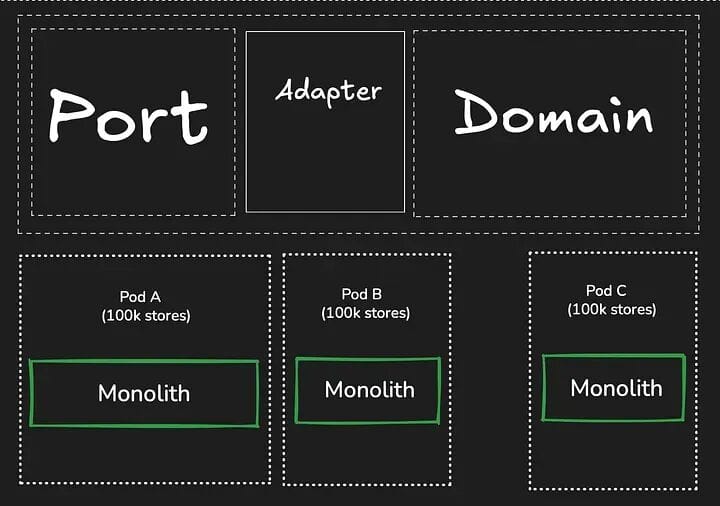
Pods: Horizontal Scaling for Monoliths
When a viral launch threatens to overload the platform, Pods isolate the impact.
Each Pod is a mini-Shopify:
- Separate DB shard
- Separate cache
- Separate queues
- Separate workers
Routing is handled by the Sorting Hat service, sending requests to the right Pod.
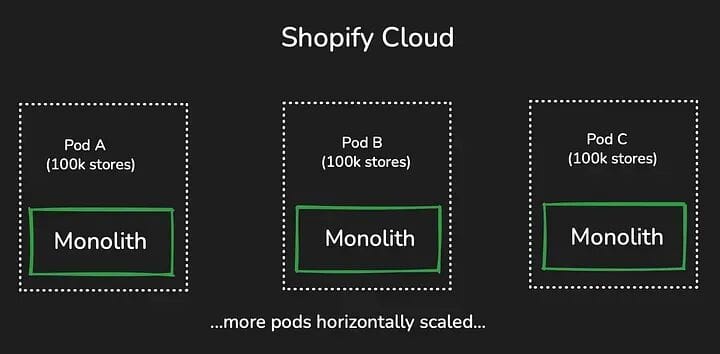
If Pod A crashes due to a mega-launch, Pod B handles other 100K stores unaffected.
---
Data Flow Evolution
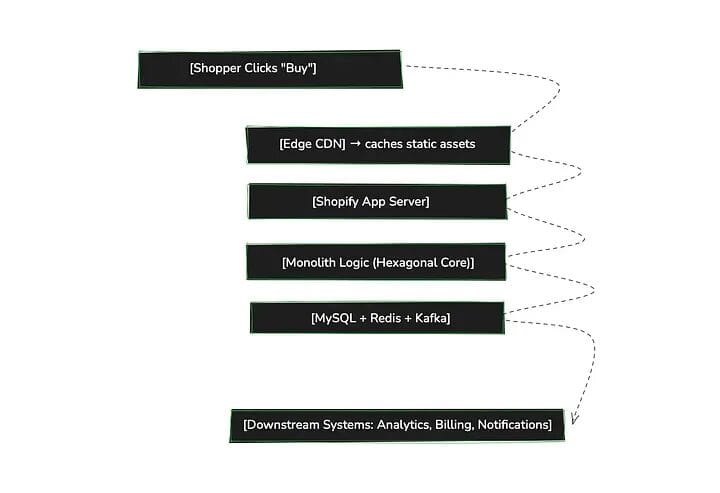
Every click (e.g., "add to cart") generates massive data streams.
From Batch to Real-Time:
- Old: Longboat (hourly batch queries)
- New: Debezium + Kafka (real-time CDC)
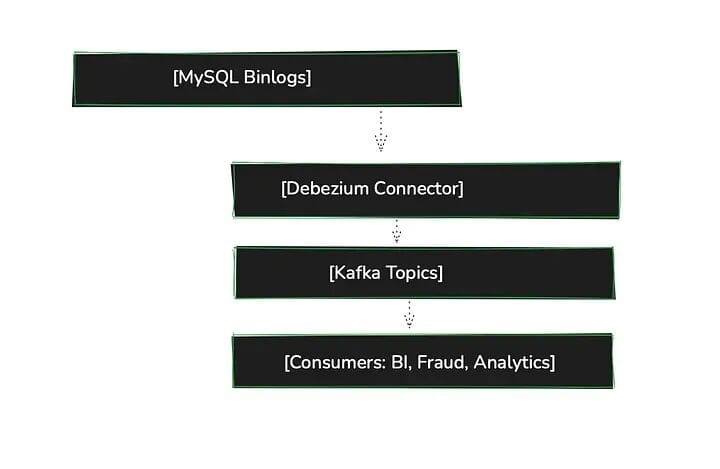
Result: Real-time dashboards, instant fraud detection, and fast analytics at PB scale.
---
Handling Traffic Spikes Gracefully
When 1M people click “add to cart” in the same second, brute force won’t work.
Shopify relies on:
- Edge caching via CDN for static pages/media
- Redis/Memcached for sessions, precomputed data, fast reads
- Background queues for heavy tasks
- Graceful degradation of non-core features during spikes
Example: Pause recommendations during traffic surges—but keep checkout running flawlessly.
---
MySQL at Massive Scale
Despite trend shifts, Shopify stays with MySQL—at extreme scale:
- Hundreds of shards across Pods
- 10M+ queries/sec
- Automatic replica balancing
- Snapshot backups with 30‑minute restore window
- Online schema changes (zero downtime)
- Dynamic re‑sharding to avoid hotspots
This is boring excellence—and it works.
---
Black Friday On‑Call: Calm Under Pressure
> “You prepare for battle. Expect alarms. Imagine chaos.
> But as traffic surges—charts spike, Pods hum, caches hold—nothing breaks.
> You sip coffee. You smile.”
The magic of robust architecture is serenity even on the busiest day of the year.
---
Lessons We Can All Apply
- Start Monolithic, Modularize Over Time
- Avoid splitting systems unless necessary—complexity is expensive.
- Follow Hexagonal Architecture Principles
- Keep business logic clean and decoupled from I/O.
- Isolate Failures
- Use Pods, shards, or domains to limit blast radius.
- Prefer Stream Processing Over Batch
- Real-time data = faster feedback loops.
- Plan Graceful Degradation
- Protect core features during failures.
- Make “Boring” Beautiful
- Great architecture feels uneventful.
---
Final Thoughts
Shopify’s success is about clarity, craftsmanship, and composure at global scale.
They prove a disciplined hexagonal monolith can outperform an unruly mess of microservices—even at internet-scale.
When you’re processing 20 TB every minute, simplicity is not a weakness—it’s the mark of true excellence.
Architecture Summary
---
Related: AI Content Platforms
In today’s AI-powered content ecosystem, tools like AiToEarn官网 enable creators to:
- Produce AI-generated content
- Publish across platforms (Douyin, Kwai, WeChat, YouTube, Instagram, X, etc.)
- Integrate analytics
- Monetize at scale
Just as Shopify scales commerce, AiToEarn scales content—keeping processes unified yet flexible.
---
Source: Medium Article