> **"Every wonderful thing in our lives once began as a thought in someone's mind."**
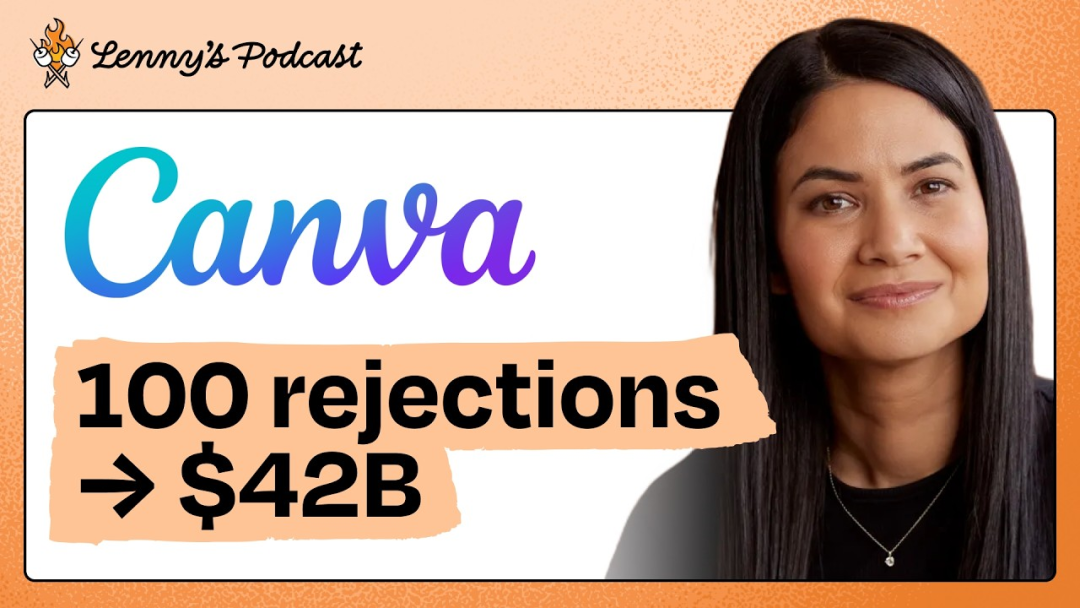
*Image source: Lenny's Podcast*
---
## ✨ Key Highlights
- **Two-Step Plan:**
1. Build one of the most valuable companies in the world.
2. Do as much good as possible with that success.
- **Mindset Shift:** Treat rejections as opportunities to improve, not personal failures.
- **Authentic Growth:** Build your own structure instead of copying others’ frameworks.
- **Focused Excellence:** Solve a small group’s problems exceptionally well rather than solve the majority’s poorly.
---
### About Melanie Perkins
Melanie Perkins, co-founder and CEO of **Canva**, aims to *"empower everyone to design with ease"* through one of the most influential visual design platforms. As one of the youngest unicorn founders, she has dedicated her career to lowering barriers to creativity via technology. Hundreds of millions now use Canva to express ideas effortlessly.
This interview (Oct 2025) explores Canva’s growth, product philosophy, and Melanie’s future vision.
---
## From Ideals to Achievements
### Column B Thinking
**Definition:** Start not from what’s possible today (“Column A”), but from an ideal future (“Column B”), then work backwards.
**Melanie Perkins:**
Rather than just stacking bricks you already have into something viable, Column B thinking means envisioning the “castle on the hill” — the magical, beautiful future worth decades of effort — and then building toward it.
**Example:** Without Column B thinking, Canva wouldn’t exist. Melanie started in university with **no business experience**, imagined a radically simpler, collaborative, online design future, and first applied it to a niche yearbook market with Fusion Books — eventually scaling that idea into Canva.
---
## How to Build a Column B Company
### Step 1 — Envision the Ideal Future
1. Ask: *What world do you want to live in in 10+ years?*
2. Define both wild success and absolute failure scenarios.
3. Extend the horizon to inspire long-term thinking.
### Step 2 — Build the Ladder to the Moon
- Don’t just dream — map a series of **small steps** (“rungs”) toward that big vision.
- Even tiny incremental progress matters if it leads toward the goal.
> Tip: Create a **vision board** for constant reinforcement.
---
## Chaos to Clarity
Melanie’s process moves ideas from vague concepts (“chaos”) to tangible outcomes (“clarity”):
1. Write down the idea.
2. Build a pitch deck.
3. Refine into designs or prototypes.
4. Keep iterating until the concept is clear enough for others to *see*.
**Why:**
An idea in your head is invisible to others — visual communication makes it real.
---
## Crazy Big Goals
**Definition:** Goals so ambitious they feel absurd — but worth pursuing.
**Canva’s Example:**
- Empower everyone in the world to design.
- Make design *affordable and accessible* everywhere.
- Two-step plan as above.
**Why They Work:**
- Inspire max effort.
- Demand persistence despite obstacles.
- Are important enough to fuel years of commitment.
---
## Handling Tough Periods
Growth brings breaking points:
- Doubling in size often collapses previous systems.
- Example: A front-end rebuild estimated at 6 months took **2 years** — no new features shipped during that time.
- Solution: Add fun micro-celebrations (yellow rubber ducks on a progress board) to keep morale.
---
## Turning Rejection Into Strength
- Melanie pitched to **100+ investors** and was rejected each time.
- Each rejection led to pitch deck improvements.
- Focus feedback into controllable elements (clarity of vision, problem framing).
- **Lesson:** Rejection is data — iterate until message resonates.
---
## Community-Led Product Features
- Canva receives over **1 million** feature requests/year.
- Tracks and closes loops — >200 delivered this year.
- Example: Teachers requesting Magic Write in classrooms led to AI safety adaptations.
**Principle:** Balance “shaping the future” with listening to what the community truly needs.
---
## The Two-Step Plan
1. **Build one of the most valuable companies in the world.**
2. **Do the most good possible with that position.**
- Canva pledged 1% of time, profits, equity to social good.
- **$50M** already donated to *GiveDirectly* in Malawi; $100M planned.
- Aim: Ensure **everyone meets basic survival needs**.
---
## Product Expansion
Mission: *Design anything, publish anywhere.*
- Supports over **100 languages**; localized experiences.
- Available on web, iOS, Android.
- Expanded formats: social graphics → presentations → docs → whiteboards → video → websites.
- Now adding: email design, forms, deep AI integration.
---
## Melanie’s Product Philosophy
- Focus on **real market gaps**, not competitors.
- Start small: solve a niche very well, then expand.
- **Better to serve a small group exceptionally than a large group poorly.**
---
## AI Integration
- Embedded AI into Canva’s editor for contextual assistance.
- Personal routine: “AI walks” — voice-dump ideas to phone, then have AI summarize.
---
## Vision 2050
Melanie’s long-term vision includes:
- Basic survival needs met for all.
- Universal access to quality education.
- Vibrant communities with shared purpose.
- Combat loneliness via collective big goals.
---
## Rapid-Fire Round
**Books:**
- *The Power of Moments*
- *Designing the Obvious*
**Favorite Tool (non-Canva):** Karma (meditation/music)
**Life Guiding Quotes:**
- “Happiness is when your thoughts, words, and actions are in harmony.”
- “Every great thing was once just imagined.”
---
## Closing Thoughts
- Every decision shapes the world — ask if it’s leading to your desired future.
- *Imagination is the starting point of creation.*
- Persistence, clarity of vision, and purpose-driven growth underpin Canva’s journey.
---
**Source:**
[She Turned 100+ Rejections into a $42B Company | Melanie Perkins](https://www.youtube.com/watch?v=-LywX3T5Scc)
---
> Platforms like **[AiToEarn](https://aitoearn.ai/)** echo this vision-focused approach, enabling creators to:
> - Generate content with AI.
> - Publish simultaneously across major platforms (Douyin, Kwai, WeChat, Bilibili, Rednote, Facebook, Instagram, LinkedIn, Threads, YouTube, Pinterest, X).
> - Track performance with integrated analytics and AI model ranking.
> As Melanie’s journey shows, the right tools help turn imagination into lasting impact.