Investor Shaun In-Depth: Why Musk Always Beats His Rivals | [Matrix Low-Key Share]
![Investor Shaun In-Depth: Why Musk Always Beats His Rivals | [Matrix Low-Key Share]](/content/images/size/w1200/2025/11/img_001-599.jpg)
Elon Musk, Jensen Huang, and Shaun Maguire: Decoding Elite Operating Systems

Elon Musk runs multiple disruptive enterprises (SpaceX, Tesla, etc.), while Jensen Huang has steered NVIDIA to dominate AI hardware. Both are seen as having “extraordinary ability,” yet the operating logic behind these successes is rarely understood.
Investor Shaun Maguire — with experience as a PhD in mathematical physics, DARPA field operative, and professional esports player — offers a rare inside view of how top innovators and organizations actually function. His insights span elite talent evaluation, organizational management, and investment decision‑making.
Shaun personally witnessed Musk’s “20‑person collective intelligence” at SpaceX during its controversial 2019 investment round — and candidly admits his mistake in selling NVIDIA stock at a $60 B valuation. He explains his 15‑level intelligence ladder, Musk’s “give them rope” talent mechanism, the underestimated difficulty of The Boring Company’s work, and the persuasion battle behind the SpaceX investment.
From war‑zone cognition shifts to esports teamwork, and from surviving bullying to working with Nobel laureates, Shaun’s journey reveals how top performance depends on multi‑dimensional resonance between talent selection, capital allocation, cognitive frameworks, and organizational culture.
---
Interview Context
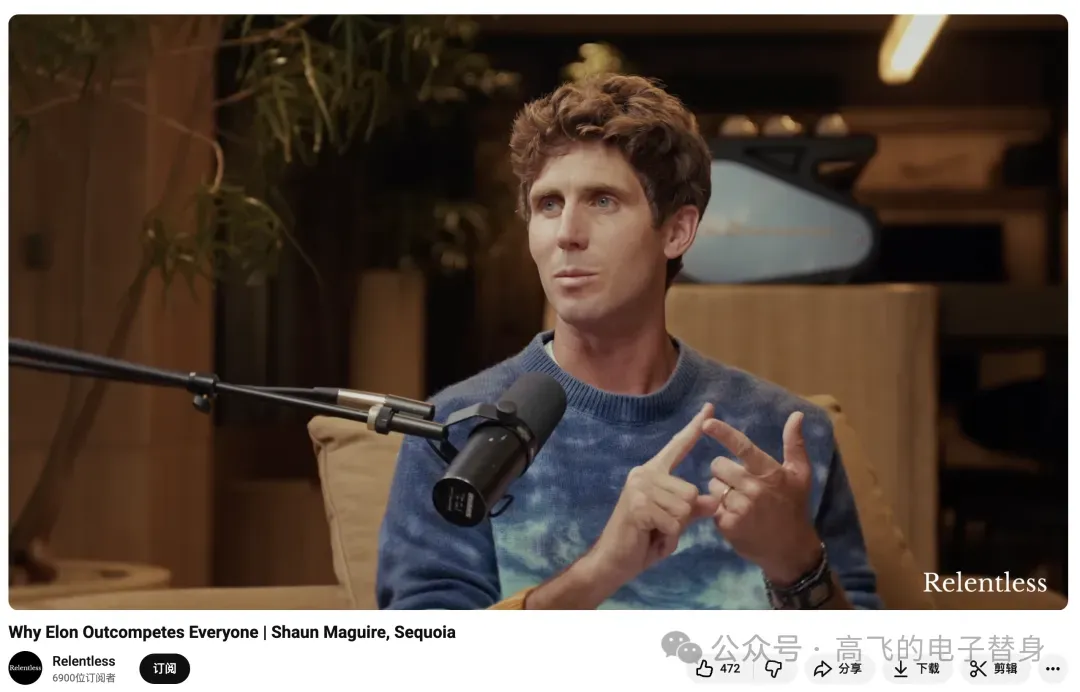
This Relentless podcast episode is dense with insight and unique, asymmetrical information. Maguire’s uncommon career trajectory allows him to dissect Musk’s organizational DNA and talent systems — far beyond typical media angles.
He admits investment mistakes and recalls formative adversities, then unpacks logic frameworks like:
- Judging math ability within 30 minutes, from Fields Medal level to average professor
- The Boring Company’s technical difficulty ranking between Falcon 9 and reusable Falcon 9
---
01 — Musk’s “Collective Intelligence”
How 20 People Execute One Vision
Shaun emphasizes “Elon the Collective” — a core team of ~20 who have worked with Musk for over a decade, bonded by deep trust.
Key traits:
- Autonomous Execution: Act on Musk’s thinking without explicit instruction.
- Clear Decision Boundaries: Know exactly when to escalate vs. act independently.
- Long‑Cycle Trust: Takes ~10 years to build this synergy.
> “These 20 people can directly translate his vision into reality — at scale and with precision — unmatched in Silicon Valley.”
Extreme Talent Filtering: “Give Them Rope”
Two extremes in Musk’s talent system:
- Rapid Promotion: For proven top performers.
- Zero Tolerance: One major failure = out.
Result: Top 1% talent remains, driving the organization forward.
---
Side Insight: Coordination principles like Musk’s apply in other domains. Platforms such as AiToEarn官网 orchestrate AI content creation, publishing, analytics, and model ranking (AI模型排名) across channels — enabling creator teams to align vision and execution efficiently.
---
Talent Intuition: Spotting Engineering Mindsets at Interview
Example: Musk redirecting an economics graduate into mechanical engineering — correctly identifying hidden potential from minimal signals.
---
02 — The “15‑Level Ladder” in Talent Assessment
Why Most People Can’t See the Gap
Shaun’s framework: intellectual fields have ~15 levels. Higher‑level individuals can gauge others within 1–2 levels in minutes. Those 3+ levels lower cannot distinguish upper‑tier differences.
Analogy: Chess Elo
- 2800 vs 2700: elite distinction obvious to masters
- 1000-rated players: see no difference between the two
---
Calibration Through Exposure
Shaun’s ability comes from close interaction with extreme talent:
- Fields Medalists in mathematics summer programs
- IMO champions in trading internships
- Nobel laureates in physics
Once you’ve seen the top 0.001%, your benchmarks change forever.
---
03 — Investment Decision Methodology
Step 1: Identify Essential Capabilities
- Some companies require high intellect (e.g., robotics)
- Others succeed via sales, resilience, or other traits
- Then rank the founder in the key trait
---
Cold Email Case Study — Reading High‑Level Signals
AI code‑generation startup Factory impressed Shaun when its founder mentioned co‑authoring a paper with Juan Maldacena during undergrad — a marker of 2600‑level ability in his chess analogy.
Most VCs lack the calibration to spot such signals.
---
04 — The 2019 SpaceX Investment Battle
Risk Context
In 2019:
- Tesla valued at ~$4–5 B
- Starlink not yet proven
- Rockets just becoming reusable
Persuasion Strategy
Shaun secured a $20 M probe investment, then sent updates every 3 weeks for 6 months — building longitudinal evidence to shift opinions.
---
05 — Why We Underestimate Musk’s Companies
Technical Misjudgment: The Boring Company
Continuous, zero‑person tunneling exceeds Falcon 9 complexity — but outsiders think linearly (drill vs drill) and miss generational leaps.
---
Precedent vs Extreme
Musk engineers moments of extreme impact (e.g., rocket landing, Optimus robot demo) for intuitive public recognition.
---
06 — Capital Allocation Mastery
Bet Sizing Strategy
Starlink evolved from:
- Small bet during research phase
- Medium bet post‑Falcon 9 reusability
- Large bet after unit economics validated
Similar to hedge funds scaling positions as understanding deepens.
---
07 — Cognitive Leaps from Extreme Environments
War‑Zone Learning
DARPA deployment in Afghanistan sharpened Shaun’s rapid feedback loops under pressure.
---
08 — From Bullying to World Champion
Seventh Grade Humiliation
Endured an enforced nickname (“Joel”) through high school, shaping resilience.
Esports Career
Pro Counter‑Strike taught him:
- Networking optimization
- Extreme teamwork
- Spatial geometry strategy
---
09 — Working With Musk
Key Traits
- Willingness to work intensely (e.g., sleeping on factory floors)
- Discretion to preserve strategic surprise
- Constant availability
“AlphaGo‑Style” Moves
Counterintuitive decisions reveal their brilliance months later — requiring deep trust.
---
10 — Investment Misjudgments
Selling NVIDIA at $600 B Market Cap
Mistakes:
- Underestimating Jensen Huang’s leadership
- Underestimating self‑fulfilling market irrationality
- Frustration with uninformed speculative capital
---
Core Insights Recap
Q1: How can Musk run multiple companies?
A: A decade‑built collective intelligence core team with extreme talent filtering.
Q2: How to assess talent under information asymmetry?
A: Develop calibration through exposure to the elite.
Q3: Why are Musk’s companies underestimated?
A: Humans need visible precedent or extreme moments to grasp nonlinear progress; many miss “AlphaGo‑style” strategic moves.
---
Final Thought: Whether in frontier tech or creative industries, combining calibration ability, long‑term trust systems, and strategic bet sizing leads to outsized impact.
Platforms like AiToEarn官网 mirror parts of this operating logic — integrating AI-powered creation, distribution, analytics, and ranking to help creators capture opportunity and amplify results across global channels.