JavaScript Closures Explained: A Developer’s Guide
# JavaScript Closures — The Complete Step-by-Step Guide

Closures are one of the most **powerful** and sometimes intimidating concepts in JavaScript.
This handbook breaks them down into **clear, practical examples** so that by the end you can confidently say:

> *"I’m no longer afraid of closures!"*

---

## 📚 Table of Contents
- [Prerequisites](#prerequisites)
- [Project Setup](#project-setup)
  - [Create Folder Structure](#create-folder-structure)
  - [Create HTML File](#create-html-file)
  - [Create Script Files](#create-script-files)
  - [Script Tag Management](#script-tag-management)
  - [Run the Project](#run-the-project)
- [Functions & Parameters](#functions--parameters)
- [Accessing Variables Without Parameters](#accessing-variables-without-parameters)
- [Scope & Lexical Scoping](#scope--lexical-scoping)
- [What is a Closure?](#what-is-a-closure)
- [Functions as Objects](#functions-as-objects)
- [Parent–Child Function Relationship](#parentchild-function-relationship)
- [Nested Functions](#nested-functions)
- [Creating Private Properties](#creating-private-properties)
- [Closure Mechanics & Decisions](#closure-mechanics--decisions)
- [Closures in Asynchronous Code](#closures-in-asynchronous-code)
- [API Requests with Closures](#api-requests-with-closures)
- [Closures in Loops](#closures-in-loops)
- [var Loop Problem & Fix](#var-loop-problem--fix)
- [Summary & Interview Tips](#summary--interview-tips)

---

## Prerequisites

You should already be comfortable with:
- Basic JavaScript (ES6 syntax)
- Browser DevTools
- Asynchronous concepts (Promises, callbacks)
- Terminal basics
- A text editor such as VS Code (with **Live Server**)

---

## Project Setup

Before diving into closures, we’ll set up a small test project to keep examples organized.

### Create Folder Structure
mkdir closure
cd closure
### Create HTML Filetouch index.html
Add:Closure Tutorial
**Why multiple script tags?**
Keeps each example isolated, avoiding mixed console output.

### Create Script Files
mkdir script
cd script
touch example-1.js example-2.js example-3.js example-4.js example-5.js example-6.js example-7.js
### Script Tag Management
Uncomment **only** the `` tag for the file you want to test.

Example:</code></pre><p><script src="./script/example-3.js">
### Run the Project
Start **Live Server** in VS Code → [http://127.0.0.1:5500/closure/index.html](http://127.0.0.1:5500/closure/index.html)

---

## Functions & Parameters

`example-1.js`:function sum(num1, num2) {  return num1 + num2;}console.log(sum(2, 3)); // 5
**Key idea:** Passing variables through parameters.

---

## Accessing Variables Without Parameters

You can remove parameters and still access variables from outer scope:
var num1 = 2;var num2 = 3;function sum() {  return num1 + num2;}console.log(sum()); // 5
This works because **functions can read from their parent scope**.

---

## Scope & Lexical Scoping

- **Scope:** Where variables are accessible.
- **Lexical Scoping:** Determined by *where* code is written — inner functions access outer variables.

---

## What is a Closure?

A **closure** = `function` + `lexical environment` (surrounding variables it remembers).

It allows a function to keep **references** to outer variables long after the outer scope finishes executing.

---

## Functions as Objects

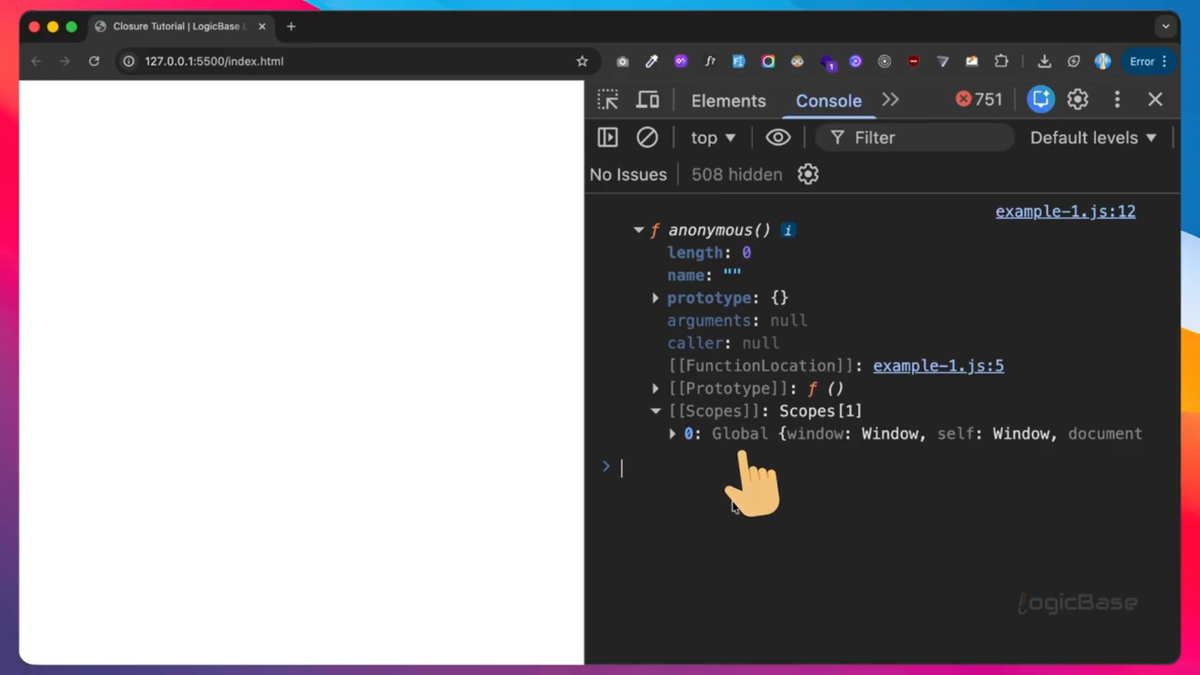
Functions in JavaScript are **first-class objects** — they can be stored in variables, passed around, and inspected.
console.dir(sum); // shows [[Scopes]] in DevTools
---

## Parent–Child Function Relationship

An inner function automatically inherits variables from the outer function.

---

## Nested Functions
function outer() {  let count = 0;  function inner() {    count++;    console.log(count);  }  return inner;}const increment = outer();increment(); // 1increment(); // 2
Here, `inner` *closes over* `count`.

---

## Creating Private Properties
function bankAccount(initialBalance) {  let balance = initialBalance;  return {    getBalance: () => balance,    deposit: (amt) => balance += amt  };}const account = bankAccount(100);account.deposit(50);console.log(account.getBalance()); // 150
---

## Closure Mechanics & Decisions

JavaScript includes **only** the outer variables that are actually used inside a function in its closure.

Global variables are **not** included in closures.

---

## Closures in Asynchronous Code

Even with delays, closures remember state:
function asyncExample() {  let a = 20;  setTimeout(() => console.log(a), 3000);}asyncExample();
---

## API Requests with Closures
function apiFunction(url) {  fetch(url).then(res => {    console.log(res);    console.log(url); // preserved by closure  });}apiFunction("https://jsonplaceholder.typicode.com/todos/1");
---

## Closures in Loops
for (let i = 0; i < 3; i++) {  setTimeout(() => console.log(i), 1000 * i);}// 0, 1, 2
Using `var` here would print `3` three times — because all callbacks share the same `i`.

---

## var Loop Problem & Fix

**Fix:** Use an IIFE to capture a copy:for (var i = 0; i < 3; i++) {  (function(i) {    setTimeout(() => console.log(i), 1000 * i);  })(i);}
---

## Summary & Interview Tips

**Closure definition:**
> A closure is a function that retains access to variables from its outer scope after that scope has finished executing.

### Key Points:
- Functions retain **references**, not copies, of outer variables.
- Closures can be synchronous or asynchronous.
- Useful for private state, currying, factory functions.
- Beware `var` vs `let` differences inside loops.

---

**Pro Tip for Content Creators:**
If you plan to turn coding tutorials like this into multi-platform educational content, consider using [AiToEarn](https://aitoearn.ai/) — an open-source platform that enables AI-assisted generation, publishing, and monetization across **Douyin, Kwai, WeChat, Bilibili, Facebook, Instagram, LinkedIn, YouTube, Pinterest, X**, and more, all from one workflow.