Just Now: Yann LeCun Announces Departure to Launch Startup Focused on Advanced Machine Intelligence (AMI)
Yann LeCun Embarks on a New Chapter: Founding an AMI Startup
Machine Heart Editorial Team
Meta’s soon-to-depart Turing Award winner Yann LeCun has announced via Threads, LinkedIn, and other channels that he is transitioning into his next professional stage: founding a startup.
The new company will focus its R&D on Advanced Machine Intelligence (AMI). According to LeCun:
> "The goal of the new company is to drive the next major revolution in AI: enabling systems to understand the physical world, have persistent memory, possess reasoning ability, and plan complex sequences of actions."
In short, this venture will carry forward his long-standing commitment to world model research.
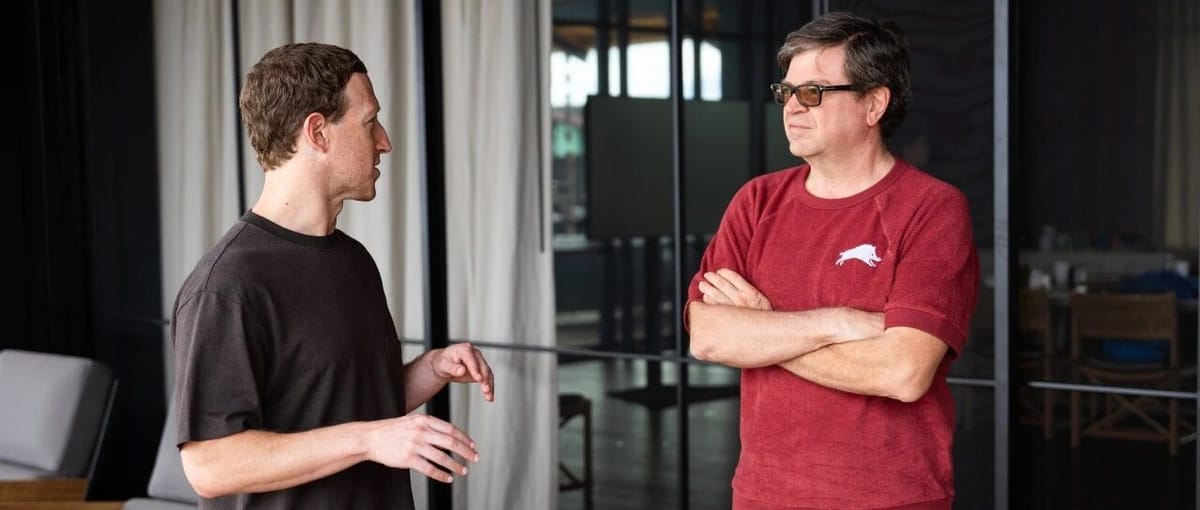
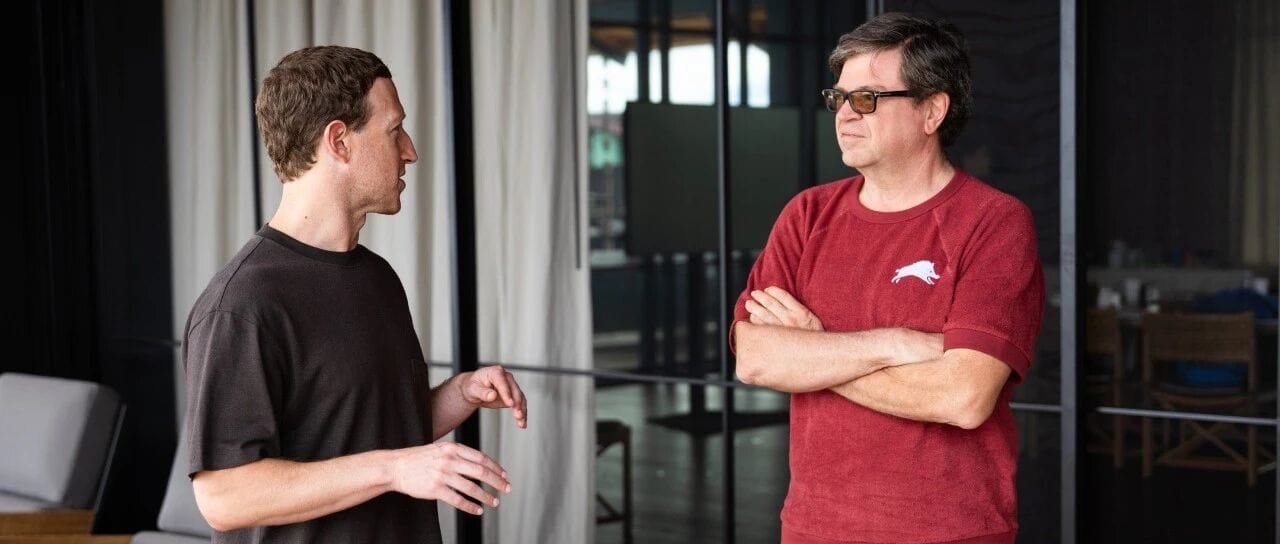
Interestingly, his post included a photo with Mark Zuckerberg:
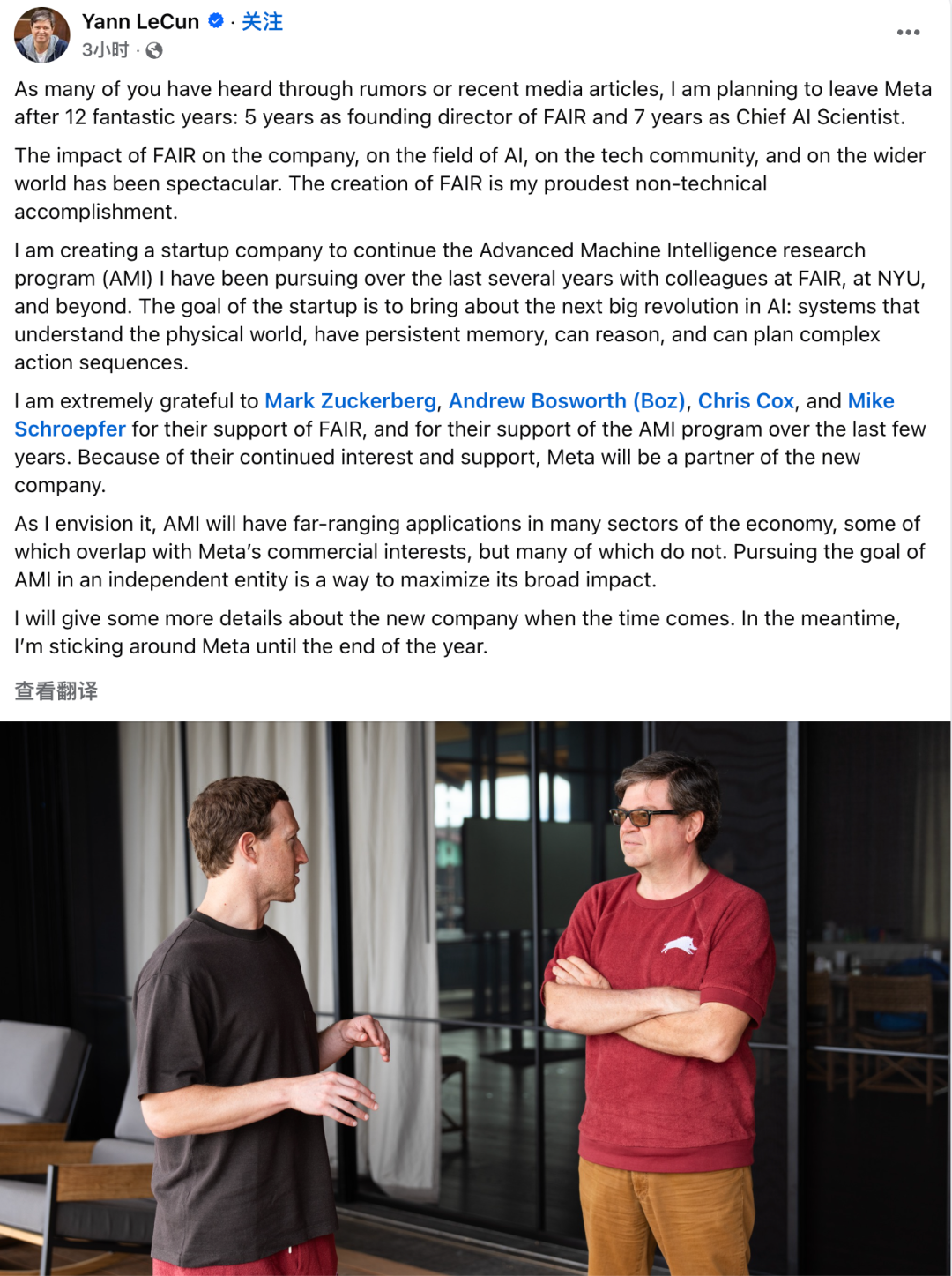
Image source: LinkedIn
---
Full Statement: Yann LeCun on Leaving Meta
> As many have heard through rumors or recent media coverage, I plan to leave Meta after an exciting 12 years — including 5 years as the founding director of FAIR, and 7 years as Chief AI Scientist.
>
> FAIR’s impact on Meta, the field, the tech community, and the world at large has been profound. Founding FAIR is my proudest non-technical achievement.
>
> I am now creating a startup to advance the Advanced Machine Intelligence (AMI) program I’ve been pursuing these past years with colleagues at FAIR, NYU, and across the broader field.
>
> The goal of the new company is to drive the next major AI revolution: systems that understand the physical world, have persistent memory, reason, and plan complex sequences of actions.
>
> I am deeply grateful to Mark Zuckerberg, Andrew Bosworth (CTO), Chris Cox (CPO), and Mike Schroepfer (First Senior Fellow) for their support of FAIR, and for backing the AMI program in recent years. Because of their continued interest and support, Meta will be a partner of the new company.
>
> In my vision, AMI will find applications across many economic sectors. Some will overlap with Meta’s business interests, but many will not. Pursuing AMI as an independent entity is the best way to maximize its broad impact.
>
> I’ll share more details about the new company when the time is right. In the meantime, I’ll remain at Meta until the end of the year.
---
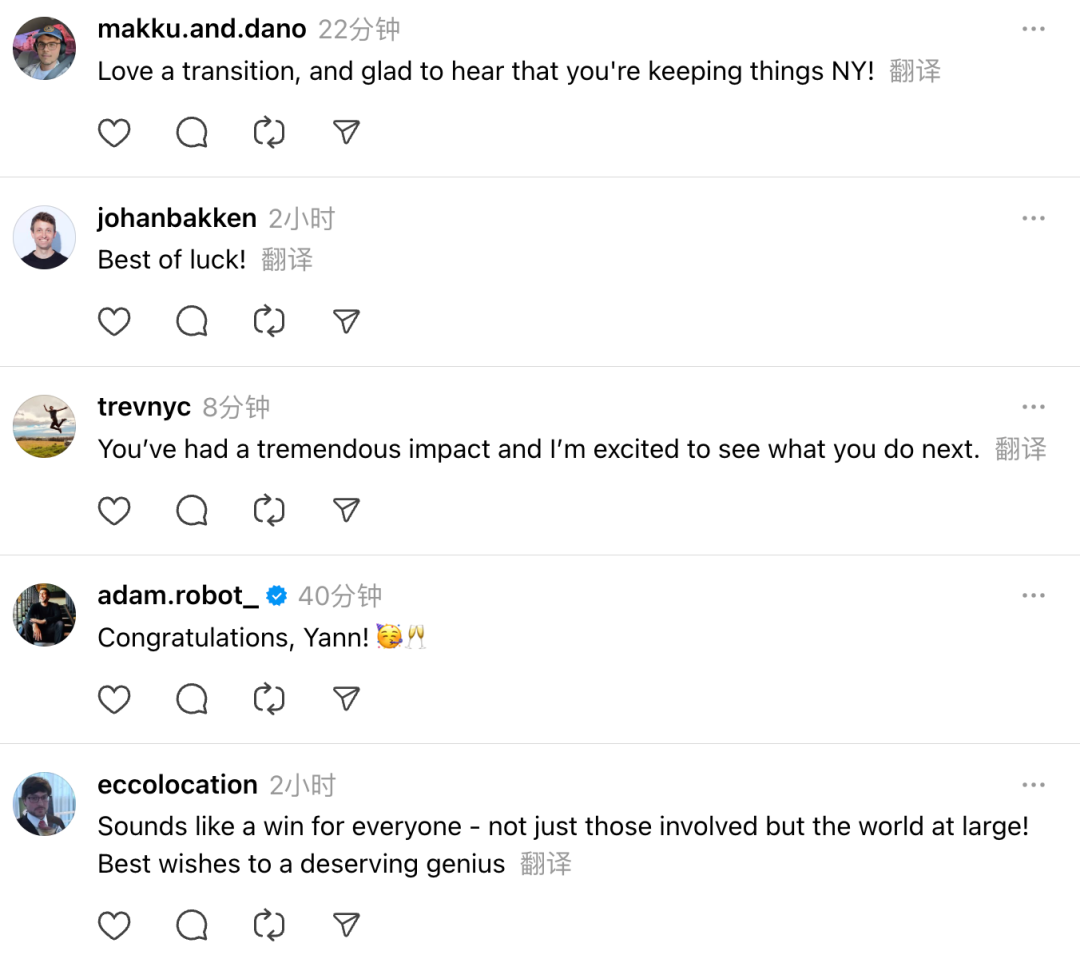
In the comments, people sent warm wishes and expressed high hopes for LeCun’s future:
---
Yann LeCun: Entrepreneur at 65
Yann LeCun (Chinese name: 杨立昆), born July 8, 1960, is a French-American computer scientist and one of the “Godfathers of Deep Learning.”
- Awards: Turing Award (2018, shared with Geoffrey Hinton and Yoshua Bengio)
- Recent recognition: Received the Queen Elizabeth Prize for Engineering alongside Yoshua Bengio, Bill Dally, Geoffrey Hinton, John Hopfield, Jensen Huang, and Fei-Fei Li.
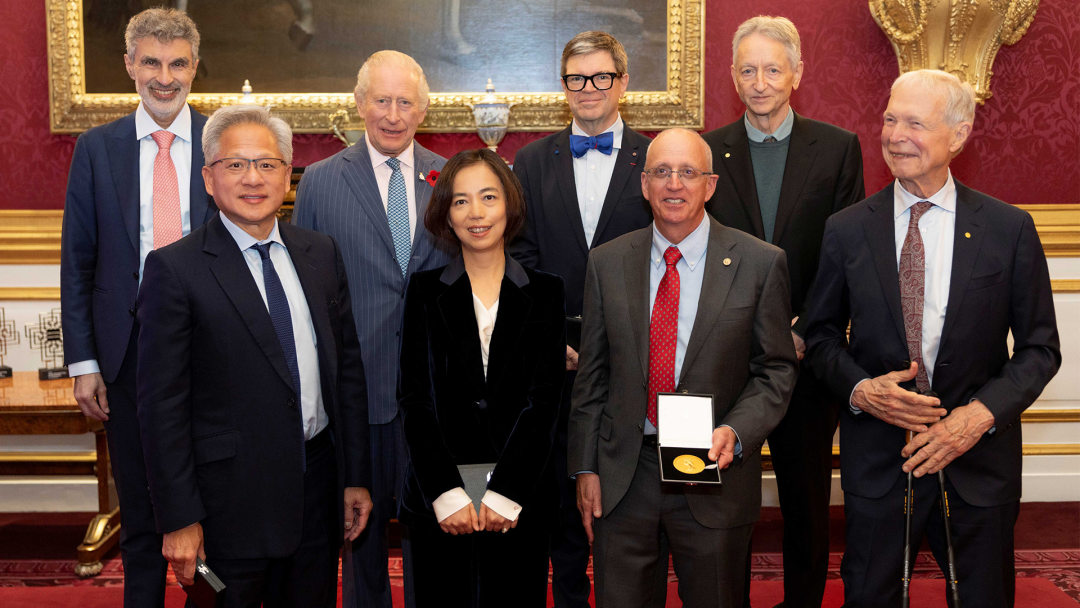
At age 65, LeCun is launching a new venture aimed at propelling the next revolution in AMI — one of the most closely watched developments in AI.
---
From Bell Labs to CNN: Building AI Foundations
Before Meta, most of LeCun’s foundational work was completed at AT&T Bell Labs, where he:
- Developed CNNs:
- Created LeNet, biologically inspired image recognition models foundational to modern computer vision, OCR, and image classification.
- Practical real-world deployment:
- The bank check recognition system he worked on was widely deployed by companies like NCR, processing over 10% of U.S. checks at its peak.
- Image compression innovation:
- Co-created the DjVu image compression technology.
---
The FAIR Era: “Outsider” Becomes “Challenger”
In 2013, invited by Mark Zuckerberg, LeCun joined Facebook (Meta) as the founding director of Facebook AI Research (FAIR), with notable conditions:
- Academic Freedom:
- Insisted on an open research model akin to academia — publishing openly to attract top scholars.
- Core Contributions to Meta:
- Built key open-source tools like PyTorch, and advanced large model development via Llama.
Challenges Emerged:
- Meta’s acquisition of Scale AI and appointment of Alexandr Wang to lead a new superintelligence lab created internal turbulence.
- Tightening of FAIR’s paper publication policy and cuts to ~600 AI positions further strained culture.
These pressures, alongside diminishing idealism inside FAIR, led LeCun to announce his departure.
---
LeCun’s Vision for World Models
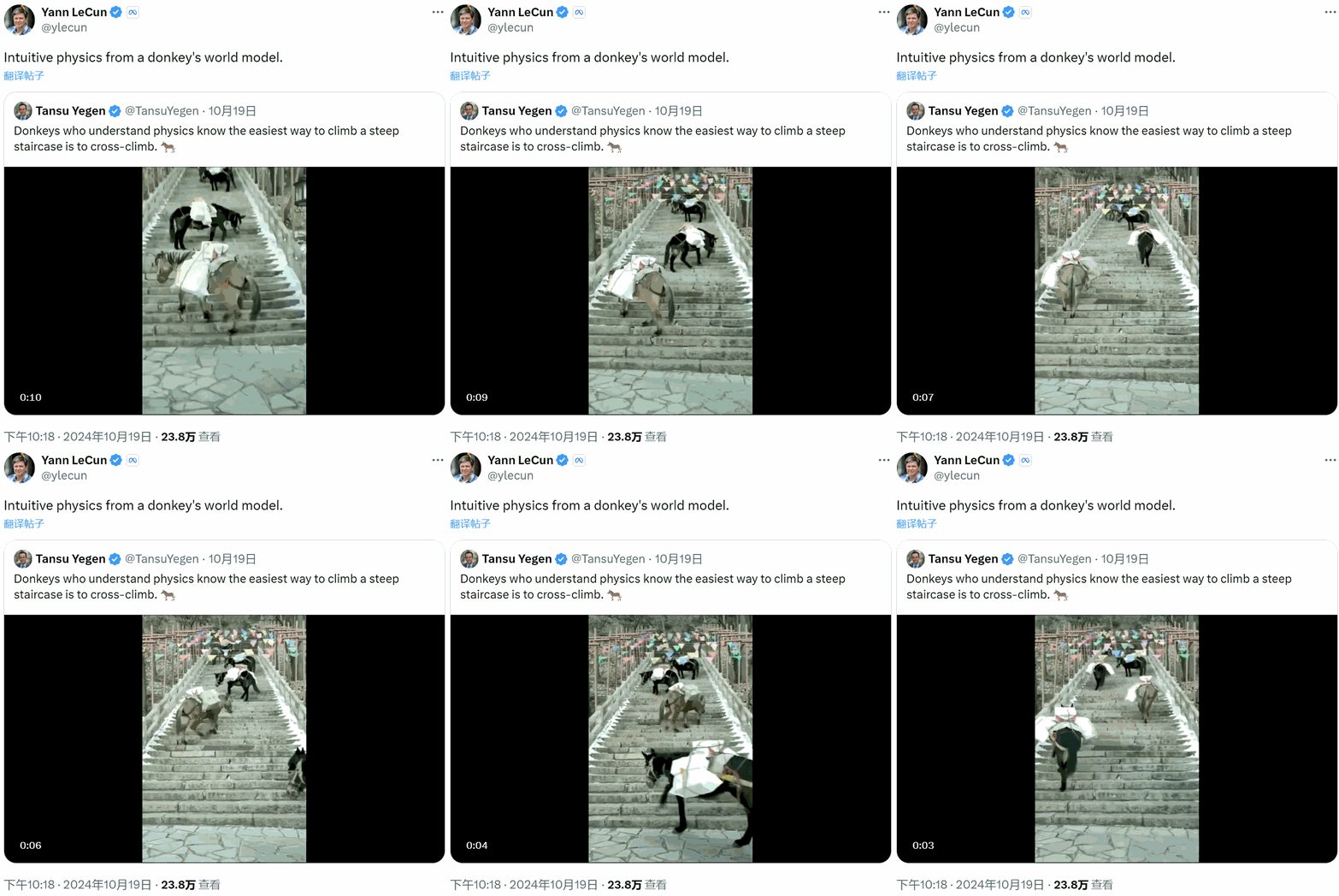
LeCun is a vocal critic of Large Language Models (LLMs), joking that
“modern LLMs’ physical intuition is still worse than that of a donkey.”
Key Research Directions:
Core Concept:
A world model is an abstract digital twin of reality, enabling AI to:
- Understand the physical world
- Predict consequences of actions
- Plan without needing millions of trials
Applications include assistive tech for the visually impaired, mixed reality guidance, personalized education, and program state analysis.
Before leaving Meta, LeCun co-authored the LeJEPA paper, outlining JEPA — an approach to learn actionable high-dimensional embedding spaces by maximizing consistency between semantically related views.
---
The Significance of His Departure
LeCun’s exit and entrepreneurial leap mark:
- End of an era inside Meta AI — alongside departures like PyTorch creator Soumith Chintala
- Start of an ambitious push towards AMI and world models — carrying implications for scientific, industrial, and societal impact.
---
Related Links

---
AI Tools and Creator Ecosystems
In parallel, platforms like AiToEarn官网 provide open-source tools that enable creators to:
- Generate AI-driven content
- Publish across multiple global platforms (Douyin, WeChat, YouTube, X)
- Monetize efficiently
Such ecosystems align with LeCun’s vision of democratizing access to advanced AI capabilities.