Multiple Posts in a Row! Lei Jun Got Angry — But Only a Little
Context and Background
There are always people online who take words out of context, twist them, and smear reputations.
Recently, Lei Jun posted several consecutive updates on Weibo — unusually emotional in tone.
> “I’ve rarely seen Lei Jun’s posts with visible emotion,”
> remarked a colleague at ifanr.
The “Good Looks First” Controversy
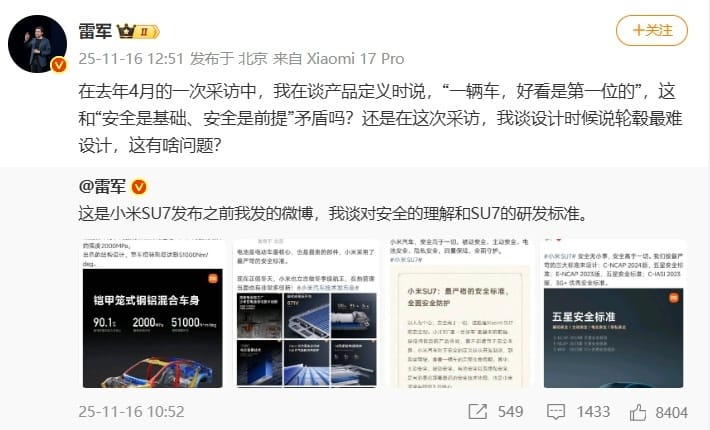
Lei Jun revisited a statement he made in an April 2023 interview:
"For a car, good looks come first."
Certain individuals have long twisted this to mean:
"Xiaomi cars don’t value safety."
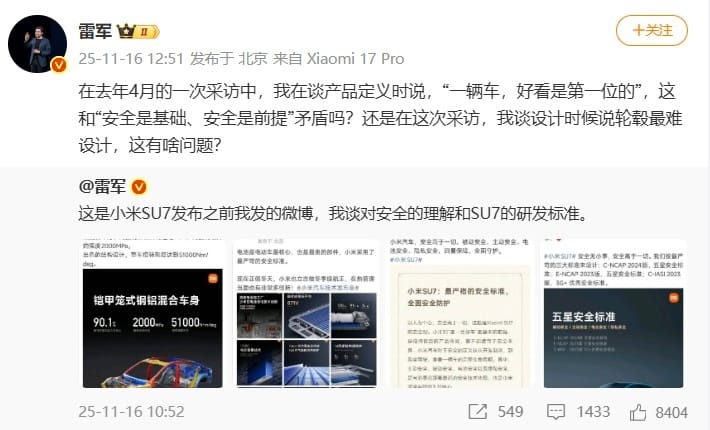
He asked rhetorically: does this actually conflict with his prior stance —
"Safety is the foundation, safety is the premise"?
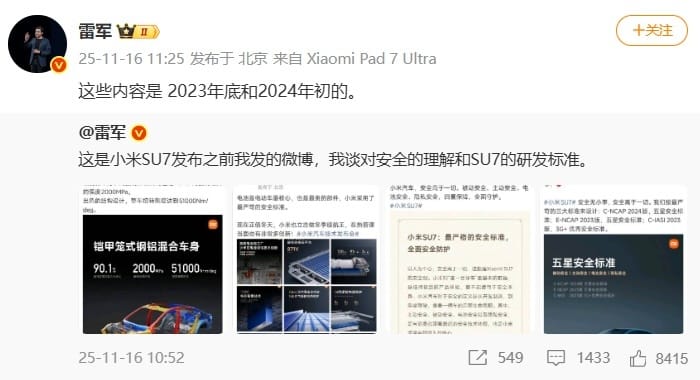
To support his view, he posted screenshots of older Weibo entries (before the Xiaomi SU7 launch) discussing body rigidity, battery safety, and technical standards.
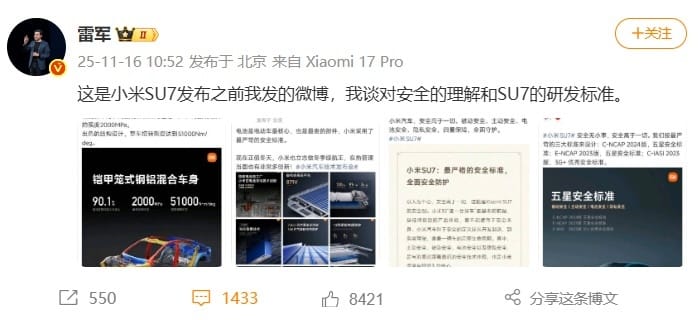
Lei Jun’s Position
- Condemns intentional misinterpretation of words.
- Believes “good looks” and “safety” are not contradictory.
- Calls out online groups pitting the two ideas against each other.
This tactic — reframing product disputes into broader public-opinion battles — has become a signature approach in Lei Jun’s responses.
---
Response After the Chengdu Accident
Following the serious SU7 incident in Chengdu, Lei Jun’s first public appearance was
on November 6, at the World Intelligent Connected Vehicle Conference.
His approach:
- Avoided direct discussion of specific safety concerns.
- Shifted focus to industry challenges.
- Urged resistance to paid smear campaigns (“black PR”).
Later that same day, he reposted a video comparing the Xiaomi YU7 to the Tesla Model Y. When a commenter mocked the choice of comparison, Lei Jun’s reply was essentially:
"What other product would you suggest we compare against?"

---
From Frustration to Polarization
Lei Jun’s frustration is understandable:
- He feels his design philosophy is misrepresented.
- Competitive products are dismissed even when compared fairly.
But when emotion starts driving public replies, debates shift from technical discussion into supporters vs detractors polarization.

---
The Fading Effectiveness of Consumer Electronics PR Tactics
Many believe Xiaomi’s consumer electronics PR style was carried into automotive.
Here’s why it doesn’t translate well:
Key Differences in Consumer Expectations
- Smartphones: Issues = overheating, crashes — tolerable and replaceable.
- Cars: Issues = loss of control, fires, rescue difficulty — life-or-death.
The trust threshold is much higher for vehicles.

Market Signals
- Lei Jun’s account lost 300,000 followers in two weeks post-accidents.
- Xiaomi Auto livestream comment sections were overwhelmed with negativity.
Paid trolls exist, but mass-scale sentiment can’t be entirely blamed on “black PR.”
---
Door Safety Concerns
Accidents from Tongling to Chengdu show a troubling pattern:
After severe collisions, doors reportedly couldn’t be opened, hampering rescue.
The public’s demand:
- Technical explanation of hidden door handle functionality.
- Analysis of why it failed in actual accidents.
- Plans for remedies/upgrades for owners.
Instead, responses centered on smear accusations.
---
Erosion of Trust via Marketing Hype
Some SU7 details raised eyebrows:
- “Front hood vent” on SU7 Ultra — purely decorative.
- “1.68 billion driving modes” — permutations of a few core settings.
Similar tactics appeared in other Xiaomi products:
- Laptop “thinner than a coin” — based on coin height, not thickness.
- “King of backlight photography” — relegated to “design goal” in fine print.

Takeaway: Number-focused marketing + disclaimers may be fine in electronics, but in cars they trigger skepticism about safety transparency.
---
Beyond Anger — A Call for Responsibility
Public fears won’t vanish through explanation alone. Anger should be channeled toward real risks:
Priority: Door Mechanism Transparency
- Extreme scenarios: collision, power failure, submersion.
- How does SU7/YU7 door system guarantee opening?
- Why did it fail in some accidents?
- Is the cause design flaw or operational limitation?
- Will there be retrofits or updates?
A clear public statement would rebuild trust far better than repeated posts.

---
Support Safety Standards Publicly
The Ministry of Public Security’s draft Safety Technical Conditions for Motor Vehicle Operation calls for:
> After each startup, passenger vehicles must have a 0–100 km/h acceleration time ≥ 5 seconds.
This limits high-performance EV risks.
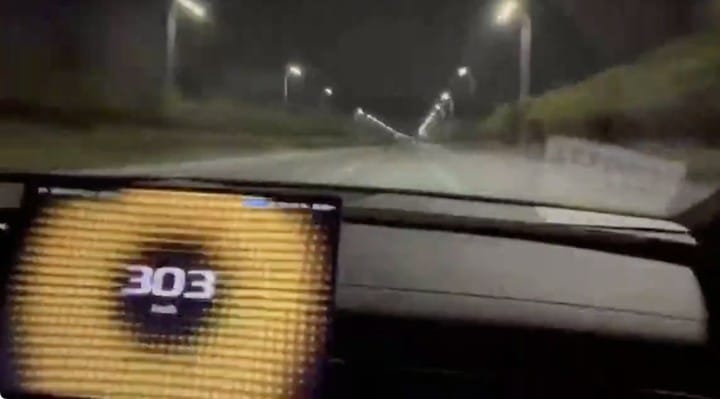
Instead of reiterating “Safety is the foundation” online, Lei Jun can act by:
- Publicly supporting this draft standard.
- Positioning Xiaomi Auto as an industry safety advocate.
---
The Driver Readiness Gap
High-performance cars are outpacing driver capabilities:
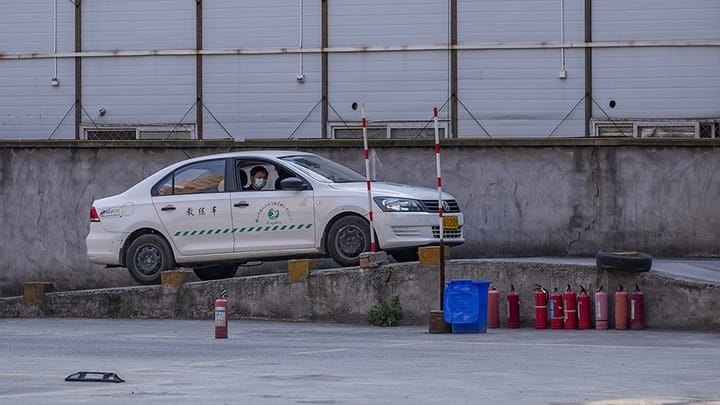
- C1 license holders can drive anything from a 90 hp Wuling Hongguang to a 1,548 hp SU7 Ultra.
- Typical training doesn’t prepare drivers for extreme acceleration and maneuvering.
Suggested Responsibility
Xiaomi, as a promoter of EV performance democratization, could:
- Push for graded driver licensing.
- Use Lei Jun’s influence to advance policy change.
This tackles root-level safety beyond vehicle mechanisms.

---
Conclusion: Anger Isn’t Enough
Lei Jun’s real threat isn’t smear campaigns — it’s eroding public trust.
The path forward:
- Address door safety issues transparently.
- Support acceleration regulation.
- Lead on driver licensing reform.
Industry leaders must move beyond emotion into responsibility.
---
Role of Tech Platforms in Transparent Communication
In this climate, consistent, factual communication is key.
Tools like AiToEarn官网 allow brands to:
- Generate, publish, and monetize content across Douyin, Kwai, YouTube, and X.
- Track analytics and AI model rankings.
- Keep public messaging accurate and aligned.
For documentation, see AiToEarn文档.
---
By integrating AI-powered content ecosystems with clear safety commitments, companies in sensitive sectors like automotive can maintain trust while driving innovation.