PPIO Releases Agent Runtime: Enabling Faster, Low-Cost Agent Deployment for Enterprises

PPIO Agent Runtime — Lightweight Framework for AI-Native Agents
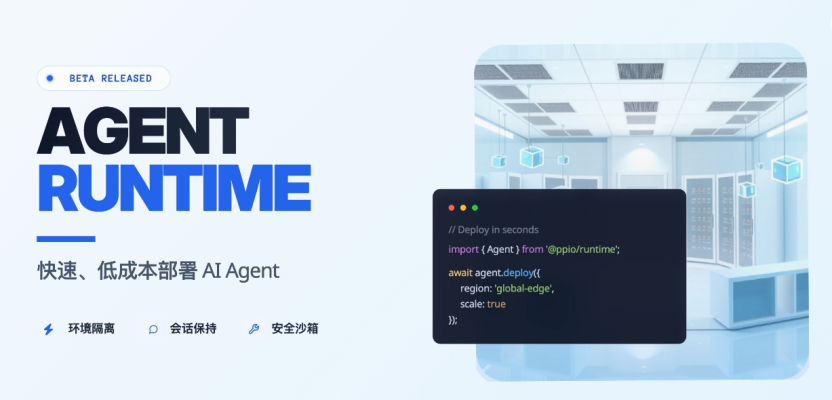
PPIO has introduced Agent Runtime, a lightweight agent runtime framework built upon its self-developed Agent Sandbox.
This solution is designed to meet the specific runtime needs of intelligent agents — similar in concept to AWS AgentCore Runtime — and significantly simplifies deployment through an easy-to-use SDK and secure sandbox execution environment.
With Agent Runtime, developers can focus entirely on business logic without worrying about:
- Infrastructure configuration
- Container orchestration
- Service exposure
- Operational complexity
---
From Cloud-Native to AI-Native
PPIO Agent Runtime leverages PPIO Sandbox for hardware-level security isolation and resource management. It then adds:
- Session management
- State persistence
- Rapid deployment capabilities
This represents a shift in cloud computing infrastructure — moving from general cloud-native approaches to AI-native environments built specifically for agents.
---
Why the Market Needs Agent Runtime
Strong Commercial Potential
The Agentic AI market is projected to grow from USD 5.25 billion in 2024 to USD 96.18 billion in 2032.
Deployment Challenges
Analysts predict that by end of 2027, up to 40% of agent projects may fail due to:
- Complex deployments
- Uncontrolled costs
- Unclear ROI
The underlying issue: current cloud infrastructure isn’t designed for agent workloads.
---
Limitations of Existing Architectures
1. Serverless vs. Agent Needs
- Short lifecycles vs. long runtimes
- Serverless environments (e.g., AWS Lambda’s 15-minute limit) suit short, event-driven jobs, but agents handling multi-step reasoning or data processing often need hours.
- Stateless vs. stateful requirements
- Agents must maintain context, session state, and task history — not compatible with stateless execution that discards all runtime state after each task.
---
2. Containers as an Alternative — Not Without Problems
- Idle cost overhead
- Containers consume CPU, memory, and GPU resources even when idle — wasting capacity for workload patterns typical to agents.
- Operational complexity
- Lifecycle management, logging, monitoring, scaling, networking, and security all increase deployment difficulty, especially for small teams.
---
PPIO Agent Runtime — Purpose-Built for Agents
Agent Runtime enables long-duration, stateful sessions in a secure, serverless-like environment tailored to agents.
Key Capabilities
1. Session-Level Isolation
- Each user session runs in a dedicated sandbox with isolated CPU, memory, and filesystem.
- All context data is erased after session ends.
- No implicit data exchange between sessions; all communication uses explicit external services (e.g., DBs, message queues).
---
2. Millisecond Cold Start
- Lightweight virtualization delivers cold start times ≤ 200 ms (including initialization).
- Supports high-concurrency scenarios with sub-second first-request responses.
---
3. Long-Running Stateful Sessions — Stateful Serverless
- Sessions can run continuously for hours.
- In-memory state, files, and connections are preserved throughout the session.
- Ideal for multi-turn, interactive agent applications like:
- Data analysis assistants
- Code debugging tools
- Document processing systems
---
4. Framework-Agnostic Integration
- Works with major frameworks:
- LangGraph
- OpenAI Agents SDK
- Google ADK
- CrewAI
- AutoGen
- Also supports custom implementations with minimal code changes.
---
5. Deployment in Minutes
- PPIO Sandbox CLI enables one-click configuration and deployment.
- Two commands get you from code to production.
- Integrate the PPIO SDK and invoke your agent with a single method.
---
6. Production-Grade Features
- Health checks via `/ping` endpoint
- Streaming responses using Server-Sent Events (SSE)
- Return data via `Generator` or `AsyncGenerator` to enable real-time streaming.
---
7. Cost Efficiency
- Pay only for actual usage time — no idle costs
- Fully managed and automatically scaled infrastructure
- Lower dev and ops burdens compared to container-based deployments
---
Ecosystem Synergy — AiToEarn as a Monetization Partner
For teams deploying agents with PPIO Runtime, platforms like AiToEarn官网 can extend value by monetizing AI creativity.
AiToEarn is an open-source, global AI content monetization platform featuring:
- Simultaneous publishing to Douyin, Kwai, WeChat, Bilibili, Rednote (Xiaohongshu), Facebook, Instagram, LinkedIn, Threads, YouTube, Pinterest, and X (Twitter)
- AI model ranking and analytics
- Integrated tools for efficient multi-platform content generation & monetization
Combining PPIO Agent Runtime’s deployment speed and scalability with AiToEarn’s content reach and monetization capabilities equips creators with a comprehensive AI-native infrastructure + revenue generation solution.
---
In summary:
PPIO Agent Runtime addresses the key limitations of current serverless and container-based deployments by delivering secure, fast-starting, long-running, framework-agnostic, cost-efficient environments purpose-built for intelligent agents — enabling faster time-to-market, operational simplicity, and better alignment with emerging AI-native workloads.