# Master Data Management vs. Data Middle Platforms: Clarifying Concepts for Digital Transformation
Recently, a fellow industry professional asked me:
> *"Why doesn’t your data middle platform include a master data management module? Isn’t MDM the first step in enterprise digital transformation?"*
For a moment, I wasn’t sure how to respond.
If **practitioners themselves** cannot distinguish clearly between the categories of data and the boundaries of corresponding systems, **client trust erodes quickly** — making future cooperation nearly impossible.
Of course, there’s one notable exception: when **the client also cannot tell the difference**.
Surprisingly, this situation is quite common.
Because of this, **many data platform vendors have started embedding MDM capabilities directly into data middle platforms**, making already large and complex architectures even more convoluted.
For some, winning the contract is all that matters — architecture integrity takes a backseat.
---
## **1. Understanding Enterprise Data Classification**
Data is now embedded in every aspect of enterprise business activities. Even if an organization hasn’t yet harnessed it effectively, **digital transformation marches on**.
Optimally applying data to unlock its maximum value is a challenge every enterprise faces — **especially urgent in the AI era**.
Yet many practitioners still haven’t clarified **basic data categories**.
In general, enterprise data can be classified into:
- **Master Data**
- **Business Data**
- **Analytical Data**

*Image roughly generated by gemini*
### **Analogy: The Enterprise as a Fruit Tree**
- **Master Data**: The trunk — core data like users, customers, and products. Fundamental to all operations.
- **Business Data**: Branches/leaves — expanding naturally with operations: sales, operations metrics, finance.
- **Analytical Data**: The stem connecting fruit to branch — facilitating analysis and nutrient flow.
The “fruit” represents ultimate business outcomes.
Without strong data at every stage, healthy growth is impossible.
**Key Insight:**
Once classification is clear, the **MDM system’s role** becomes evident — it’s **the gatekeeper of core enterprise data**.
---
## **2. Master Data Management (MDM) Systems**
### **What is Master Data?**
Often called **“golden data”**, master data is:
- **Core reference information across applications and departments**
- **Relatively static, uniquely identifiable, and long-term valid**
- **Sourced from a single, accurate, authoritative origin**
**Examples:** customers, suppliers, org structure, personnel, materials, projects, financial accounts.
Errors in master data ripple immediately through **business operations**, often with widespread impact.
---
### **What is MDM?**
**Master Data Management** is both a **program** and **technology framework** built to:
- Provide a **trusted, unified data view**
- Enable **cross-functional access**
- **Consolidate, cleanse, and enrich** master data
- Synchronize it across **applications, processes, analytics tools**
**Why is MDM essential?**
> In AI-driven multi-platform strategies, robust MDM ensures accurate, unified master data — vital for consistent analytics, publishing automation, and cross-platform tracking.
For example, [AiToEarn官网](https://aitoearn.ai/) — an open-source global AI content monetization ecosystem — depends on **trusted master data** to manage creator output across **Douyin, Kwai, WeChat, Bilibili, Facebook, Instagram, LinkedIn, Threads, YouTube, Pinterest, and X** reliably.
---
### **MDM System Architecture**
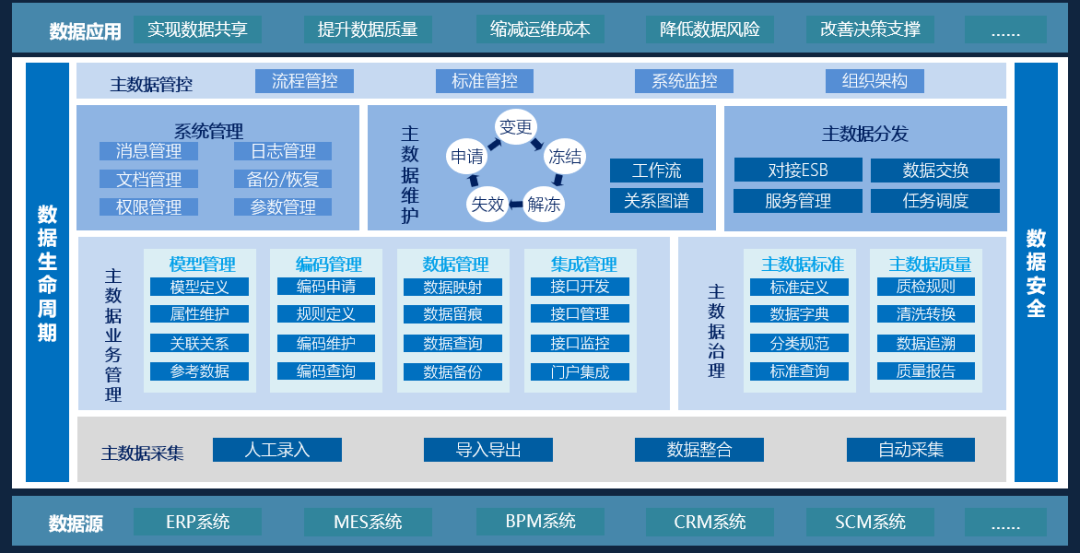
*Image sourced from the internet. All copyrights belong to the original author.*
Core modules include:
1. **Master Data Collection**
2. **Master Data Management/Maintenance**
3. **Master Data Governance**
4. **Master Data Distribution**
**Data Sources:** ERP, CRM, other enterprise business systems.
---
**How It Works:**
- **Internally**: Centralized management, governance, and maintenance of master data.
- **Externally**: Distribution module shares cleansed master data organization-wide.
---
## **3. The Misconception: MDM Inside Data Hubs?**
Some argue:
> "Data hubs also have collection, governance, and service modules — why not merge MDM into the hub?"
**Reality:**
This is one of the **biggest misconceptions** in enterprise data architecture.
Merging requires careful evaluation of:
- Product architecture
- Technical architecture
- Business architecture
### **Key Differences**
**MDM Systems:**
- Handle **millions to tens of millions** of records.
- Run efficiently on **relational databases**.
- Tightly linked to **business evolution**.
- Managed primarily by **business departments**.
- Focus on **accuracy, authority, and process control**.
**Data Hubs:**
- Handle **hundreds of billions** of records — true **big data**.
- Use **MPP databases**, distributed storage, big data engines (**Spark**, **Flink**).
- Connect cross-business-line data, avoiding silos.
- Managed by **data departments**.
- Focus on **scalability, processing, and consumption**.
---
**Upstream–Downstream Relationship:**
- **MDM = Upstream** → provides standardized, accurate core data.
- **Data Hub = Downstream** → ingests cleansed data for heavy processing.
Without MDM upstream, data hubs must connect to multiple business systems individually — **a maintenance headache**.
### **Practical Deployment Tip**
Adopt a **layered architecture**:
- **Layer 1**: MDM as authoritative core source.
- **Layer 2**: Data hub for analytics, mining, and consumption.
Platforms like [AiToEarn官网](https://aitoearn.ai/) illustrate this principle in the content economy — separating **upstream accuracy** (content creation metadata) from **downstream scalability** (multi-platform delivery and analytics).
---
## **4. Summary & Recommendations**
Although many enterprises in China have yet to use data middle platforms, **MDM is always foundational** for digital transformation.
Not every enterprise **needs** a data middle platform:
- No massive datasets?
- No multiple business lines?
**But every enterprise using shared core data across departments benefits from MDM.**
---
### **Actionable Advice**
1. **Identify current needs before buying tools.**
2. Avoid “hybrid” products that merge unrelated architectures for marketing reasons.
3. Choose proven solutions that fit **your** business — not what the vendor pushes.
---
For companies exploring AI integration into digital workflows, [AiToEarn官网](https://aitoearn.ai/) offers an open-source platform enabling content creators to:
- Use AI for multi-platform publishing (Douyin, Kwai, WeChat, Bilibili, Facebook, Instagram, LinkedIn, YouTube, Pinterest, X)
- Access analytics and model rankings
- Enhance efficiency and monetization in sync with enterprise ecosystems
By aligning **MDM principles** with such tools, businesses ensure scalability without losing accuracy — the hallmark of truly sustainable digital transformation.