Refactoring a Class Saves 2.9G Memory in the JVM?

Data Structure Refactoring That Saved Nearly 3 GB JVM Heap Memory in Production
This article explains how we refactored a core class’s data structure from
`HashMap>` → FastUtil `Long2ObjectOpenHashMap`.
By leveraging business data characteristics—tags as small integers, sparsely distributed—we replaced `HashSet` with sorted `int[]` arrays plus binary search lookups.
Key Results
- Heap drop: ~3.2 GB → 211 MB (↓ 94% memory usage)
- Validated in production with dual-write checks before rollout
- No performance trade-off in lookups; in many cases, lookups improved
---

Optimization in Numbers
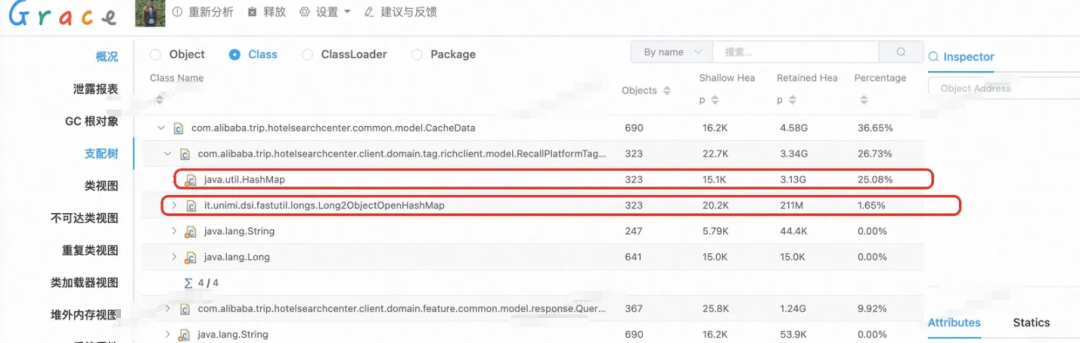
Refactoring one class dropped JVM heap by ~3 GB. This was measured in production, not a test lab:
Verification steps:
- Dual-write the old and new data structure
- Compare memory metrics in real-time
- Switch fully to new model after validation
Takeaway: General-purpose containers (`HashMap`, `HashSet`) and boxing can be surprisingly costly at scale.
---
1. Background

In our business pipeline, an interface filters product tags per city with complex logic:
- Multi-condition `AND`/`OR` nesting
- Multi-level expression trees
- Runtime-only computations for some rules
Because these filters couldn’t be expressed efficiently in our search backend, we cached full product-tag data in memory keyed by city ID for real-time filtering.
⚠️ Without this cache, each request rebuilt the structure → massive temporary memory spikes.
---
2. Legacy Structure
public class RecallPlatformTagsResp extends BasePageResponse {
    private static final long serialVersionUID = 8030307250681300454L;
    private Map> resultMap;
}
Example:
[
    {1:["2246","2288","3388","1022"]},
    {2:["12246","12288"]}
]
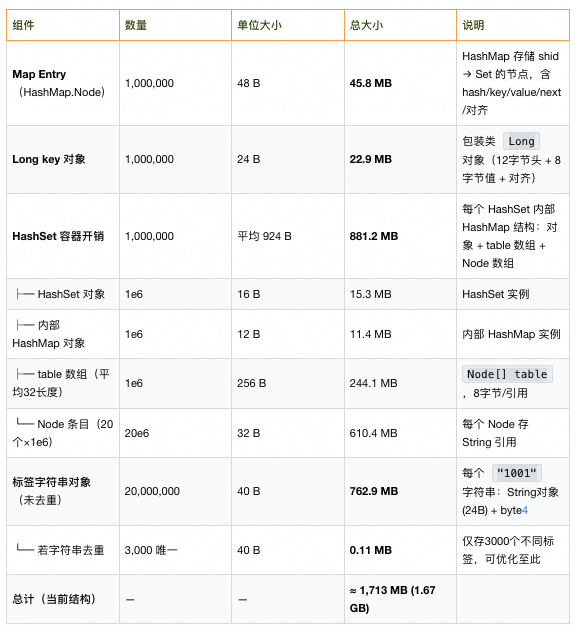
Problem: At scale, nested `HashMap` + `HashSet` → huge overhead from:
- Object headers
- Boxing/unboxing
- Hash table arrays
- Node pointers
---
3. Tag Distribution Analysis

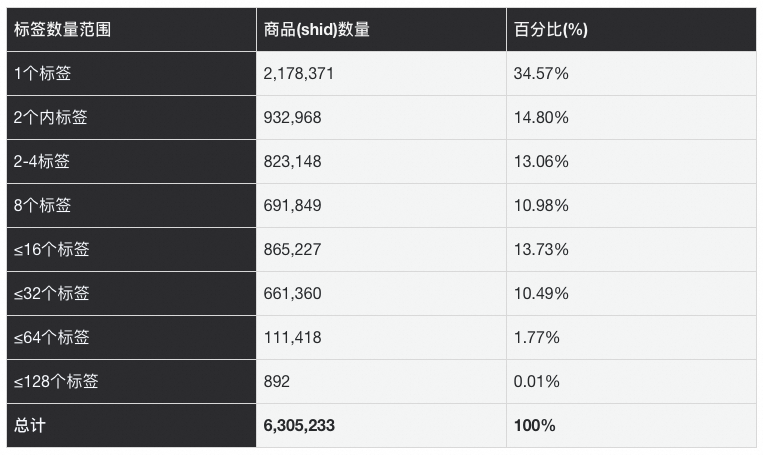
From 1 million sample items:
- 80% ≤ 16 tags
- 90% ≤ 32 tags
- 99% ≤ 64 tags
- Max tags < 128
Implications:
- Tags are bounded and small → arrays suffice
- Data is immutable after init → binary search works
- Tags are integers → `int[]` avoids `String` + object overhead
---
Visual Memory Impact:
---
4. New Structure Choices

Alternatives tried:
- FastUtil primitive maps (`Long2ObjectOpenHashMap`)
- Sorted `int[]` + binary search
- RoaringBitmap
- Custom compact object pool
Test metrics: memory footprint, lookup speed, init cost, code complexity
---
Best Combo:
- Key: FastUtil `Long2ObjectOpenHashMap` → no boxing, tighter layout
- Value: sorted `int[]` → tiny footprint, fast binary search
Memory Effect:
- Replace value (`HashSet` → `int[]`) in JDK `HashMap` → 1.3 GB → 64 MB
- Then replace JDK map with FastUtil → 25 MB
---
Why `int[]` over `HashSet`:
| Approach | Complexity | Memory | Notes |
|------------------------|------------|--------|-------|
| HashSet.contains() | O(1) avg | High | Hash collisions possible |
| int[] + binary search | O(log k) | Low | Cache-friendly; predictable |
With k ≤ 128:
- ≤ 7 comparisons worst-case
- 90% of lookups ≤ 5 comparisons
- Negligible latency impact; massive memory savings
---
5. Test Harness
JProfiler memory dumps compared:
- `Map>`
- `HashMap`
- FastUtil `Long2ObjectOpenHashMap`
- `BitSet`
- RoaringBitmap
import it.unimi.dsi.fastutil.longs.Long2ObjectOpenHashMap;
...(full Java test code above)
---
Result: Long2ObjectOpenHashMap is optimal
public class RecallPlatformTagsResp extends BasePageResponse {
    ...
    private Map> resultMap; // legacy dual-write
    private Long2ObjectOpenHashMap itemTags = new Long2ObjectOpenHashMap<>(1_600_000);
}
---
6. Why FastUtil `Long2ObjectOpenHashMap`

Advantages
- Primitive keys — no boxing (`long` direct)
- Open addressing — faster, cache-friendly
- Compact arrays — no linked lists or tree nodes
Internals:
long[] key;    // primitive keys
Object[] value;
mask = capacity - 1; // power of two
Hash: `(int)(key ^ (key >>> 32)) & mask`
---
Collision Handling
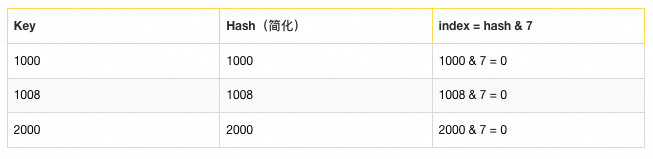
Linear probing: place colliding keys in next free slot
get(): probe until match or empty slot
remove(): use Backward Shift algorithm — slide items back to fill gaps, avoid breaking probe chains
---
Performance Notes
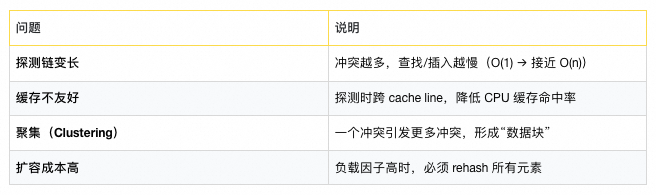
- Load factor ≤ 0.7 recommended
- Avoid sequential keys causing clustering
- Initialize with estimated capacity
new Long2ObjectOpenHashMap<>(16384);---
Suitable Use Cases
✅ High-frequency `long → Object` lookups, GC-sensitive systems
❌ Concurrent writes without external sync; highly skewed keys
---

Final Summary
Before:
HashMap>After:
FastUtil Long2ObjectOpenHashMapOutcome:
- Memory ↓ 94%
- Speed maintained
- GC pressure reduced
---
Key Takeaways:
- Generic containers can hide massive overhead at scale
- Let data characteristics drive structure choice
- Simple primitives + targeted algorithms beat general-purpose designs for bounded, read-mostly datasets