Six Years of Burn Rate, Dojo Sentenced to Death: How Musk’s Homegrown Supercomputer Dream Hit a Dead End

November 30, 2025 – Zhejiang

---
Introduction
For many years, Elon Musk was deeply committed to the prospects of the Dojo project — Tesla’s ambitious AI supercomputer initiative.

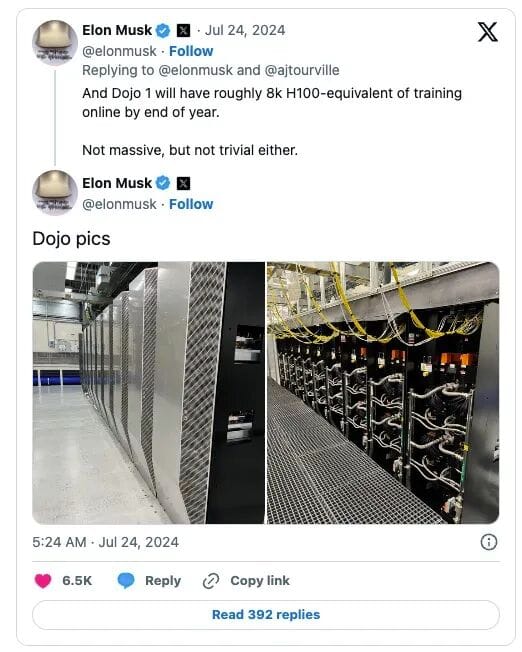
Originally envisioned as the cornerstone of Tesla’s AI ambitions, Dojo was announced with high expectations. In July 2024, Musk declared that before launching Tesla’s autonomous taxi service later that October, the company’s AI team would execute a “doubling” effort to accelerate Dojo’s capabilities.
However, after six years of hype, Tesla shut Dojo down in August 2025, dissolving the dedicated supercomputer team. Just weeks earlier, Musk had been optimistic about Dojo 2 — designed around Tesla’s in-house D2 chip — potentially reaching large-scale deployment by 2026. He later reversed course, calling it a “dead end.”
This article explores:
- What Dojo was designed to do
- Its role in Tesla’s FSD, robotics, and chip strategy
- The reasons behind its closure
- Industry implications and future directions
---
What Was Dojo?
Purpose
Dojo was Tesla’s custom-built supercomputer, purpose-designed to train the company’s Full Self-Driving (FSD) neural networks.
- Intended to support autonomous taxi rollouts.
- Processed massive quantities of driving video data from Tesla vehicles worldwide.
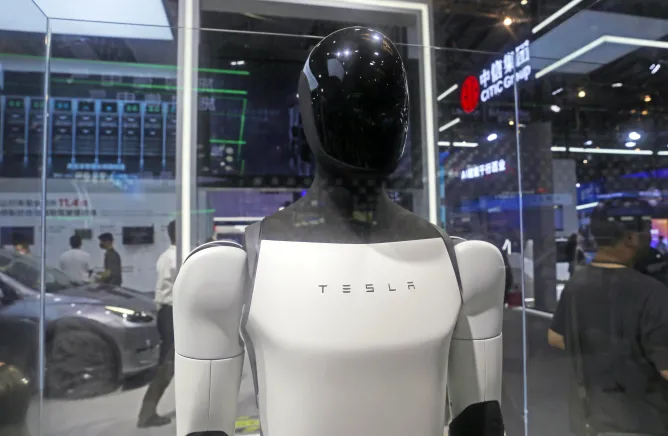
- Operated alongside other AI projects such as Optimus (Tesla’s humanoid robot).
Relation to Other Tesla Initiatives
- June 2025: Tesla launched a limited autonomous taxi service in Austin using Model Y SUVs.
- August 2024: Tesla revealed Cortex — a separate large-scale AI cluster for both FSD and Optimus video training.
- Cortex increasingly became the focal point of Tesla’s compute strategy as Dojo was mentioned less.
---
Industry Reaction
Opinions are divided:
- Negative view: Closure was expected due to slowing EV sales and limited autonomous taxi adoption.
- Positive view: Signals a shift to a partner-supported chip development model instead of high-risk in-house hardware R&D.
---
Timeline of Closure
Key events:
- Mid-August 2025 – Dojo project terminated.
- ~20 team members departed to form DensityAI, an AI chip startup.
- Project lead Peter Bannon resigned.
- Weeks prior – Tesla signed a $16.5 billion Samsung deal for the next-gen AI6 chip.
- Musk stated on X:
- > “Given that all paths clearly point to AI6, I had to choose to close Dojo… Dojo 2’s development has hit a dead end. Dojo 3 continues… as a single-board system-on-chip packing numerous AI6 chips.”
---
Origins of Dojo
Musk positioned Tesla not just as a carmaker, but as an AI company — striving to mimic human perception to solve autonomous driving.
Dojo was envisioned as the computational backbone for that vision, enabling rapid training of vision-based AI models without relying solely on third-party GPU vendors.
---
Tesla’s Data-First Approach
Most competitors use LiDAR + radar + HD maps, while Tesla relies solely on camera-based vision, processed by neural networks to make driving decisions.
- Data pipeline: Billions of miles of video → AI training → Over-the-air software updates.
- Goal: Achieve true full autonomy via continuous model improvement.
- Caution: Experts warn of possible training bottlenecks when valuable data sources are exhausted.
---
Supercomputing 101
What Is a Supercomputer?
- Composed of thousands of computing nodes.
- CPU: Manages node operations.
- GPU: Handles complex, parallel computing tasks.
- GPUs are essential for:
- FSD simulation training
- Large language model operations
Tesla has purchased NVIDIA GPUs while also developing proprietary solutions.
---
Why Tesla Built Dojo
Tesla’s pure vision-based AI route demands:
- Massive video data storage and processing.
- Millions of driving simulations.
- Hardware tuned specifically for AI workloads — leading to the D1 chip.
---
The D1 Chip
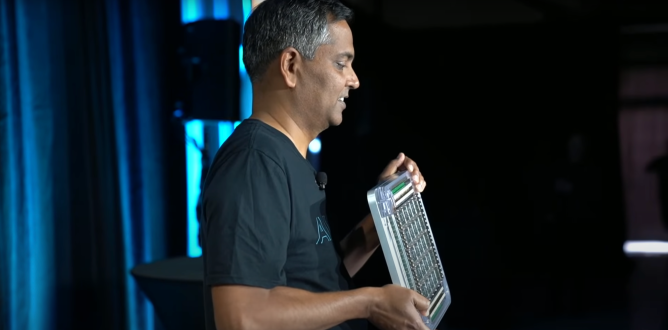
- Revealed: 2021 AI Day
- Specs:
- 7nm TSMC fabrication
- 50 billion transistors
- 645 mm² die size
- Goal: Reduce reliance on NVIDIA, increase bandwidth, lower latency.
- Challenge: Still behind NVIDIA’s A100 in raw performance.
Tesla began work on the D2 chip to address data flow bottlenecks.
---
Strategic Importance of Dojo
Dojo aimed to:
- Give Tesla chip production autonomy
- Reduce cost and dependency on volatile GPU supply
- Offer potential compute rental services (AWS/Azure-like model)
Investor optimism:
Morgan Stanley estimated Dojo could boost Tesla’s market cap by $500 billion through robotaxi and AI services.
Tech barriers:
- Most AI software is GPU-optimized — requiring rewrites for Dojo chips.
- Performance in non-vision applications remained moderate.
---
Progress & Shortcomings
Targets set by Musk:
- Top 5 supercomputer by Feb 2024.
- Exascale compute capability by Oct 2024 (≈ 276,000 D1s).
Reality:
- No confirmed achievement of stated goals.
- Shifted focus to Cortex (50,000+ H100 GPU equivalent) in late 2024.
- Added 16,000 H200 GPUs in Q2 2025 for Cortex expansion.
---
Final Days
- Q2 2025: Musk hinted at possible scaling down of Dojo.
- Weeks later: Official dissolution.
- August 2025: Buffalo supercomputer project continued, but no longer under the “Dojo” name.
Reference:
TechCrunch – Tesla Dojo: The rise and fall of Elon Musk’s AI supercomputer
---
Related Reads
- DeepSeek dominates math model rankings
- Linus praises Vibe Coding, comments on AI and Nvidia
- $25,000 insider screenshot sale sparks layoffs and legal risk
- Inside a $100B AI valuation scam

---
---
AI Creator Insights
Platforms like AiToEarn官网 and AiToEarn博客 demonstrate how AI can be monetized across multiple networks — similar to how Tesla envisioned monetizing compute power.
AiToEarn offers:
- AI content generation tools
- Cross-platform publishing
- Analytics
- Model ranking
Creators can publish simultaneously to platforms like Douyin, Kwai, YouTube, and X — echoing the scalability principles Tesla sought with Dojo’s architecture.
---
If you want, I can also prepare a visual Dojo project lifecycle timeline that condenses this long narrative into a one-page graphic for quick reference. Would you like me to create that next?