
Textbook-Style Scam Hits AI Industry: Fake $100B Valuation, Layoffs, Four Broken Promises, Investors and Staff Trapped
The Astonishing Rise of an AI Startup: Infinite Reality’s Billion-Dollar Valuation and Mysterious Funding
Legal and financial professionals define “explosive exposure” (“financial bombshell”) as actions where concealing the true business situation, falsifying finances, or committing fraud causes significant losses to investors.
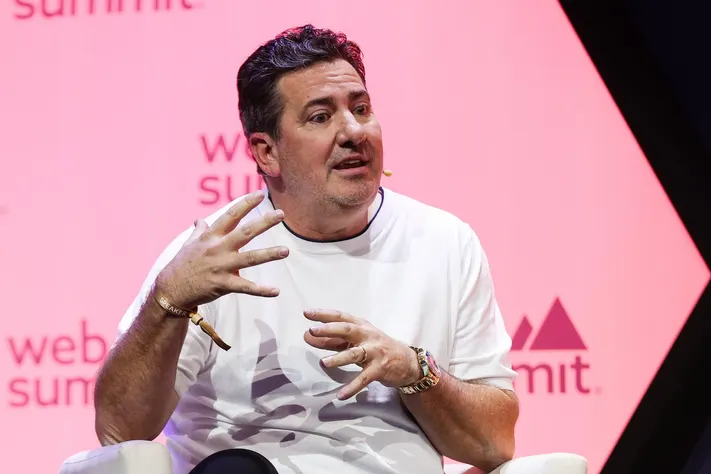
In early 2025, a little-known tech startup named Infinite Reality made a series of jaw-dropping announcements: first, claiming it had secured $3 billion in funding from an anonymous investor; then, following an all-stock acquisition, self-reporting a valuation spike to $15.5 billion. The company and its CEO, John Acunto, are now facing mounting scrutiny over their financials and business model.
At an investor event in late February, co-founder and CEO John Acunto told roughly 100 shareholders passionately:
> “It’s all set in stone. You’ve built a $12 billion company!”
Chief Business Officer Amish Shah even set a goal to raise the market cap to $50–100 billion this year.
So, what’s the story behind this AI startup that went from near-zero public presence to boasting a multi–billion-dollar valuation almost overnight?
---
1 — Phenomenal Valuation & Anonymous Funding Sources
Founded in 2020, Infinite Reality began as a technology company focused on enterprise-grade metaverse solutions, covering virtual conference platforms and digital asset trading systems.
The founder and CEO, John Acunto, has extensive experience in tech and creative industries: he has worked with companies such as IBM, Apple, eBay, Amazon, and Facebook, and has launched several startups. Early in his career, he created the social e-commerce platform display, ran the interactive music platform 212Db (owner of Play Gig-it and Rock This), and developed the digital media retail facility Outernet.
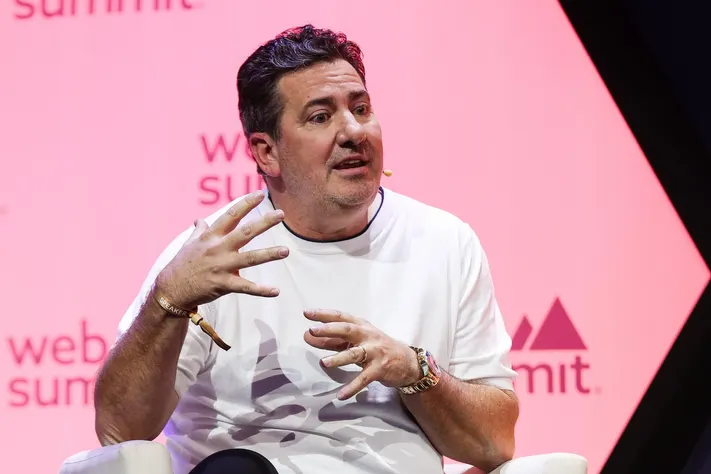
Infinite Reality Co-founder and CEO John Acunto
The other co-founder, Amish Shah, oversees business development, strategic partnerships, capital operations, and other critical functions.

Infinite Reality Co-founder Amish Shah
Infinite Reality positions itself as an immersive tech + AI + spatial computing innovator, with a vision to drive the next generation of digital media and e-commerce experiences. According to its website, the company aims to build hyper-realistic 3D virtual spaces where brands and creators have complete control over content distribution, user engagement, and monetization — while retaining ownership of all user data and customer relationships.
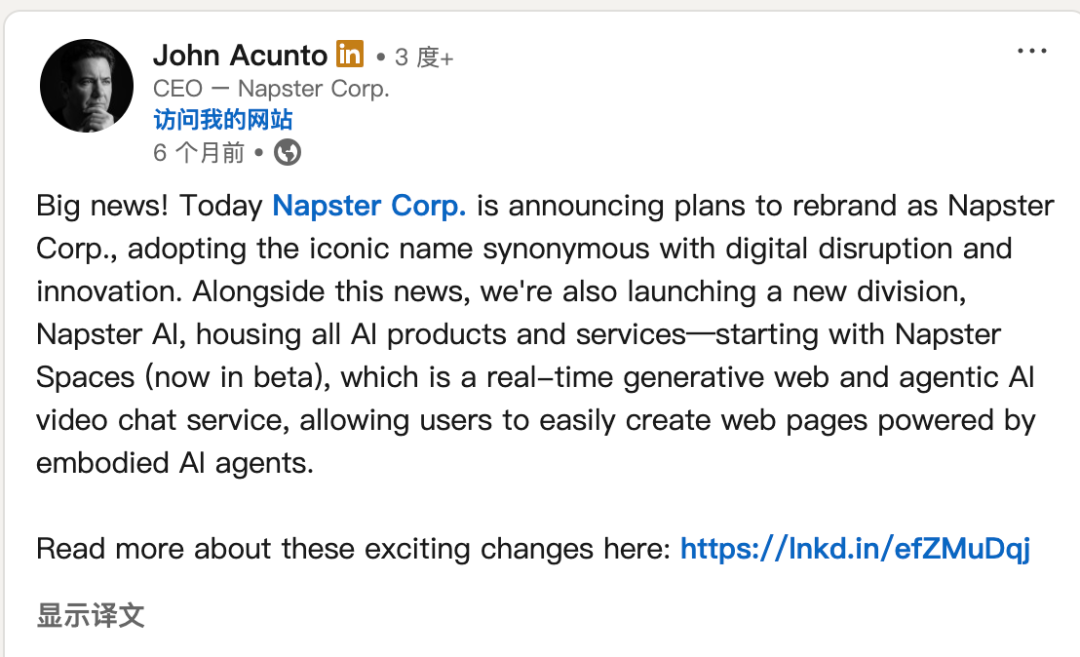
In May this year, Infinite Reality announced to its approximately 1,500 internal shareholders that it will rebrand as Napster Corporation to unify its technology platform with the historic music brand. Napster was the iconic music-sharing brand of the late 1990s, which collapsed due to copyright lawsuits and has since been resold multiple times.
From a technical standpoint, Infinite Reality has developed its own end-to-end platform, iR Engine — a framework for creating, managing, and analyzing virtual spaces. By integrating AI and 3D web (spatial network) capabilities, it supports industries ranging from music and entertainment to e-commerce and social media.
iR Engine GitHub repository: https://github.com/ir-engine
On the financing and acquisition front, Infinite Reality’s expansion has been rapid. In July 2024, the company announced $350 million in new investment and acquired Landvault — a company specializing in digital twins and high-fidelity virtual environments. This pushed Infinite Reality’s valuation to around $5.1 billion. Landvault has built virtual experiences for major brands such as Mastercard and Hershey. Additionally, Infinite Reality completed the acquisition of social sports platform Stakes.
---
In a broader industry context, platforms like AiToEarn官网 are emerging to help creators and tech innovators alike leverage AI for content creation, cross-platform publishing, and monetization. AiToEarn integrates tools for AI generation, analytics, and model ranking, enabling simultaneous distribution across Douyin, Kwai, WeChat, Bilibili, Rednote (Xiaohongshu), Facebook, Instagram, LinkedIn, Threads, YouTube, Pinterest, and X (Twitter). Such ecosystems may play an important role in supporting companies and creators operating within the immersive tech and AI-driven economy.
In early 2025, Infinite Reality made a significant move to enhance its AI capabilities by acquiring AI company Touchcast for approximately $500 million. Touchcast specializes in “Agentic AI,” with its Mentor platform capable of generating AI "mentors" — virtual guides with specific personalities and domain expertise that can converse with users in videos. Infinite Reality plans to integrate this technology into the Napster platform for scenarios such as community management, customer support, sales, and fan engagement.
However, Infinite Reality’s rapid rise is riddled with unusual contradictions.
The company only launched its core product last year — a tool that transforms websites into 3D “virtual storefronts.” It claimed 2024 revenues of $75 million (up from $50 million in 2023), yet its $15.5 billion valuation is roughly 200 times its revenue. That ratio far exceeds even the hottest AI startups, such as Anthropic (valuation ≈ 44× revenue) and OpenAI (valuation ≈ 24× revenue).
As reported by Forbes, nearly all of Infinite Reality’s revenue comes from over a dozen companies it has acquired entirely in stock since 2022, including production company Thunder Studios, esports company ReKT, and even Napster (now heavily transformed). These acquisitions continually inflate its self-reported valuation, leaving the true worth of its core business a mystery.
Acunto attributed the company’s lofty valuation to a “five-year strategic partnership with Google”, claiming it was providing “strong momentum” for Google’s AI product Gemini. Yet, in a Forbes interview, Google described Infinite Reality as just a regular Google Cloud customer — outright denying any special partnership.
The much-promoted $3 billion funding round is reportedly from a single anonymous investor.
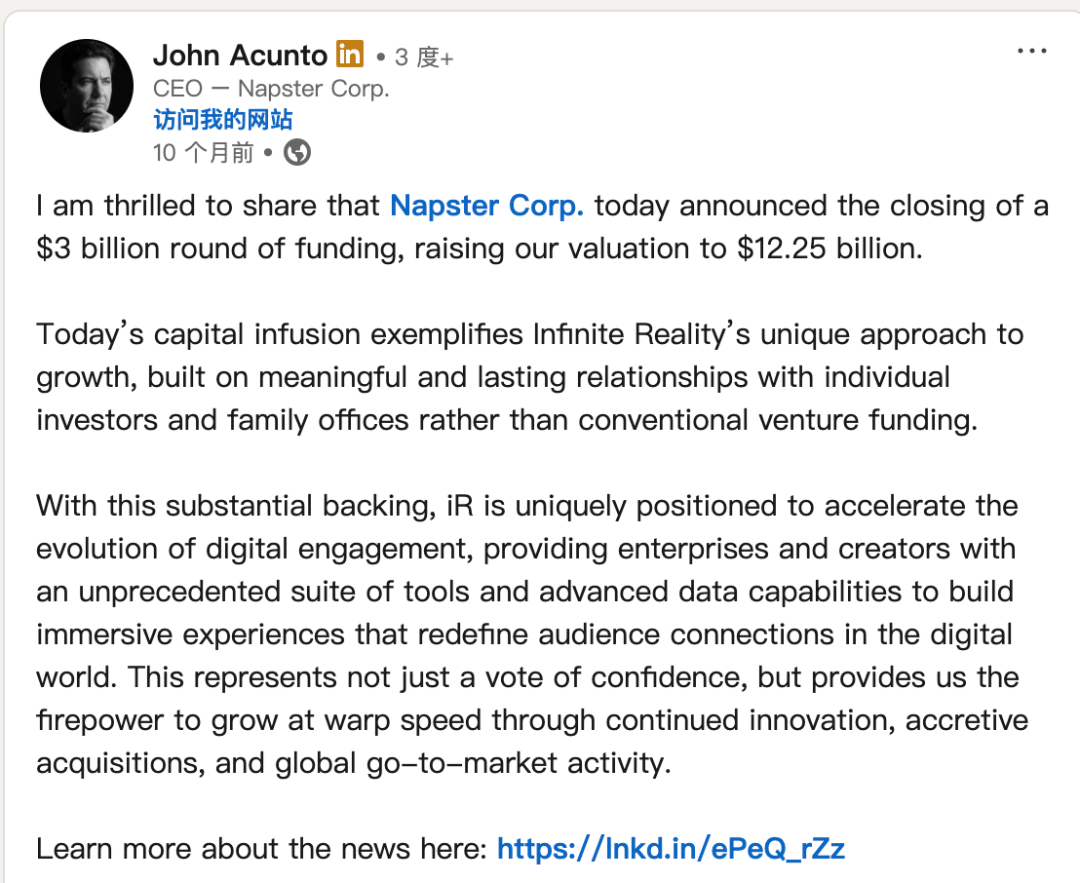
According to PitchBook data, last year only a handful of globally recognized AI giants (like OpenAI, Anthropic, and xAI) raised more capital. Yale School of Management finance professor Song Ma noted that such a huge, single-source investment “could be one of the year’s biggest venture bets,” but its authenticity is questionable.
Beyond valuation doubts, Acunto’s personal background raises red flags.
SEC filings from the company claimed he holds a PhD in Mathematics from the University of Florida and a Master’s in Data Science from Harvard University, but neither school has records of his attendance. Acunto denied these credentials, blaming “typos” during a staffing shortage, yet refused to disclose any other universities he attended.
2. Large-scale fundings may never arrive
Infinite Reality’s extreme valuation stands out especially within the metaverse sector.
Over the past decade, venture capital has surged into tech startups. A decade ago, total funding for tech companies was $87 billion; five years ago, $175 billion; and last year, it soared to $209 billion. Vast sums are flowing worldwide, much of it into little-known startups with minimal public visibility.
Interestingly, in recent years, metaverse-focused startups like Infinite Reality have lost favor among VCs — largely due to Mark Zuckerberg’s notable failure.
Since 2020, Meta has spent over $50 billion trying to construct a persistent virtual world dubbed the “metaverse,” even rebranding Facebook to Meta in 2021. The effort ultimately faltered, plagued by technical issues (such as avatars without legs) and limited user engagement. Wall Street Journal reported that Meta’s flagship metaverse product, Horizon Worlds, had fewer than 200,000 monthly active users in 2022. PitchBook figures show that from 2022 to 2024, total VC and growth equity financing for metaverse companies plummeted from $5.6 billion to $1.4 billion — making Infinite Reality’s massive fundraising all the more unusual.
Multiple well-known industry players remain puzzled by Infinite Reality’s fundraising claims.
---
In the broader context of AI-driven content platforms and immersive experiences, questions about valuation and real revenue are prompting many creators to rethink monetization strategies. Tools like AiToEarn官网 provide an open-source, global AI content monetization framework that helps creators generate, publish, and earn from multi-platform content — from video communities to virtual storefronts. By integrating AI generation, cross-platform publishing, analytics, and model rankings, AiToEarn enables creators to connect with audiences seamlessly across Douyin, Kwai, WeChat, Bilibili, Rednote (Xiaohongshu), Facebook, Instagram, LinkedIn, Threads, YouTube, Pinterest, and X (Twitter). Such platforms may prove crucial in navigating the next wave of AI and metaverse convergence.
元宇宙开发商 Improbable 的创始人 Herman Narula 首次听说这家初创公司。据报道,Improbable 在获得软银和 Andreessen Horowitz 的投资后,估值超过 30 亿美元。
Narula 告诉《福布斯》:“过去一年,我们与一些全球知名品牌合作,举办了数百场元宇宙活动,吸引了数万人参与。到目前为止,我从未以供应商或客户的身份接触过这家公司,也没有任何合作伙伴提及过他们。”
同样,Animoca Brands 的创始人 Yat Siu(Animoca Brands 是 Web3、元宇宙和游戏公司中最活跃的投资者之一,也是 Sandbox 平台的拥有者,该公司在 2022 年的估值为 59 亿美元)表示,这笔投资“并没有在我们的行业引起任何波澜……没有人就此事与我们交谈过。”
在多重疑云笼罩下,《福布斯》再次发文,透露了 Infinite Reality 这比 33.6 亿美元、估值 120 亿美元的大额投资——很可能永远不会到账。
据《福布斯》报道,美国当地时间 11 月 20 日下午 4 点左右,Napster 召开了一场线上股东会。约 1500 名股东中,有近 700 人参会,涵盖公司员工、前员工及个人投资者。然而,这场原本例行的沟通会却突然变成“暴风中心”。
Napster CEO Acunto 在会上公开表示,公司此前声称已在今年 1 月获得的一笔 33.6 亿美元、估值 120 亿美元的大额投资——很可能永远不会到账。
这一消息震惊了全体参会者,因为这笔从未公开身份的“大投资人”被视为 Napster 重返舞台的关键一步。就在会议结束后,公司向投资者群发邮件,宣布部分原定发行的股份将被取消,一些现有投资者因此在账面上将获得更高持股比例。邮件中,Napster 直接将自己描述为“行为不当的受害者”,并称正“配合执法部门正在进行的调查”。
3 第四次承诺回购股票、四次食言
更令投资者气愤的是,公司同时宣布原本承诺的股份回购(tender offer)也被取消。这一回购计划曾被描绘为让员工和早期投资者“终于可以套现”的历史性机会,这也意味着 Naspter 让员工和投资者丧失了财务自由的机会。
然而 Napster 在邮件中写道:“由于该投资人同时也是本次回购的资金来源,我们已不再认为回购能够进行。”
事实上,这已是自 2022 年以来 Napster 第四次承诺即将启动回购、又第四次落空。不少员工和投资人已经被“马上到账”的说法吊住将近一年,期间充满反复、变动不断的预期管理。
Napster 发言人吉莲·谢尔登(Gillian Sheldon)在回应中表示,当时的融资公告“是基于公司当时掌握的信息、出于善意做出的”,但随后公司发现“存在可能的行为不当迹象,说明我们当时接收到的信息并不准确”。
除这一声明外,Napster 拒绝进一步置评。
目前,美国证券交易委员会(SEC)与司法部(DOJ)分别对相关事件展开调查。SEC 原本是在调查 Napster 2022 年计划以 18.5 亿美元估值进行的反向并购交易,该交易后来被搁置,但调查仍在继续且可能已扩大范围。SEC 发言人表示,机构“不评论是否存在调查”。
DOJ 的调查则集中于投资人及资金去向,而 Napster 目前并非其调查对象。司法部暂未回复置评请求。
Napster 让人吐槽点的还不止如此。在估值疑影重重背后,公司还遭遇人员流动与内部调整。
2025 年 7 月,有报道称公司裁员规模较大,据称约有三分之一员工或大约 100 名开发人员离开。2025 年 9 月,公司首席法律官 Jennifer Pepin 和首席财务官 Brian Effrain 在职务变动后离开公司。
In publicly disclosed fundraising activities, reports suggest that the company has worked with intermediary firms such as Cova Capital, which claimed to represent a “mysterious investor.” However, Cova Capital had previously been fined by the Financial Industry Regulatory Authority (FINRA) for “failing to perform adequate due diligence” when recommending shares of private companies to retail investors.
Legal and market analysts point out that if it is proven that Napster and its management were aware that the fundraising round was not capable of being fulfilled, yet still made materially false statements to shareholders and potential investors, such conduct could cross the red line into securities fraud.
Reference links:
In an era where transparency and diligence in fundraising are increasingly scrutinized, tools that enable verified information dissemination and cross-platform publishing are becoming essential for investor relations and compliance. Initiatives like AiToEarn官网 provide open-source, AI-powered solutions for creators and companies to generate content, publish across multiple global platforms simultaneously, and monitor analytics — which can help ensure that communication with the public and stakeholders is both accurate and efficient.


