The Most Expensive Battlefield in AI: The Real Data Center Bill

🚀 $500 Billion for Mars or One Stargate Data Center?


NASA estimates a $500 billion budget to put humans on Mars — enough to:
- Buy 1.36 Alibabas ($367B)
- Acquire 3.5 NBA Leagues ($140B)
- Build 100 Apple Parks ($5B each)
- Purchase 140 billion cups of coffee ($3.5 each)
For OpenAI, that’s just enough for one massive Stargate AI data center.

Industry insiders believe OpenAI’s ambitions could be 10× bigger, while rivals like xAI and Meta are also investing heavily. This raises a key question: Where is all this money going?
We’ll break down AI data center capital expenditures, the supply chain behind them, and the reasons companies are betting trillions — even as critics warn of a bubble.
---
1 — Understanding Trillion-Dollar Investments
Where Does the Money Go?
Spending Categories
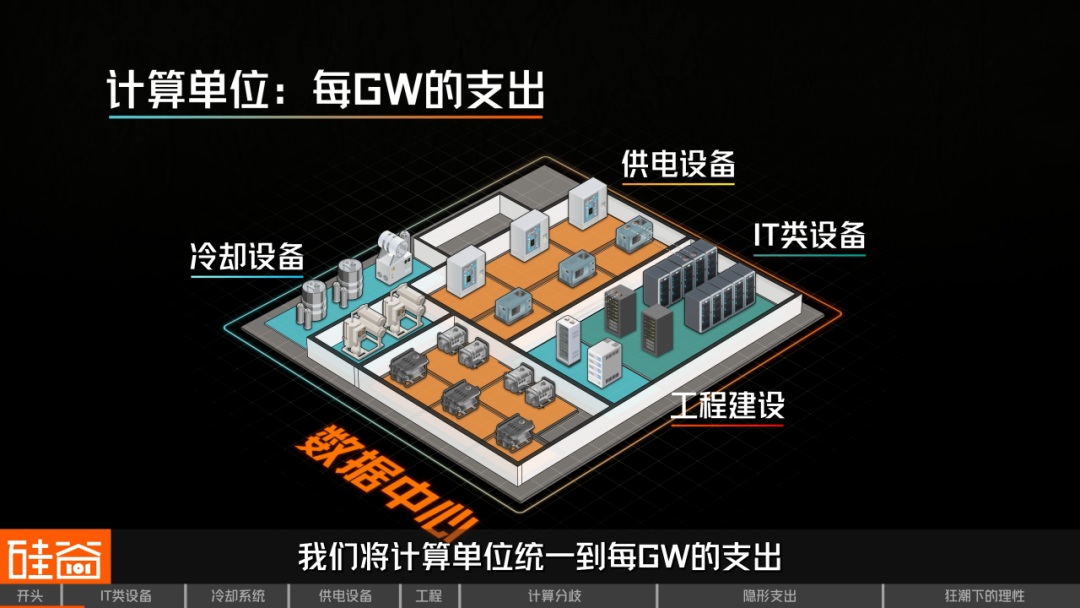
According to Bank of America’s Oct. 15 analysis, spending per gigawatt (GW) of AI data center capacity falls into four categories:
- IT Equipment
- Power Supply Infrastructure
- Cooling Systems
- Engineering & Construction
---
1.1 IT Equipment — The Giant Share
Core computing hardware includes:
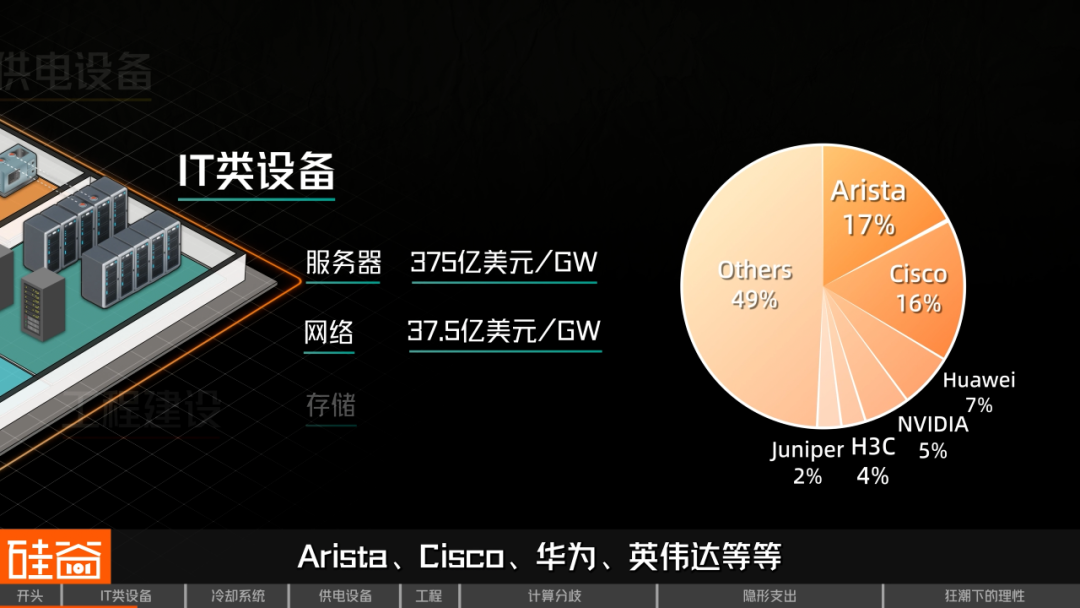
- Servers — CPUs, GPUs, memory, motherboards ($37.5B/GW)
- Networking Equipment — switches, routers ($3.75B/GW)
- Storage — hard drives, flash ($1.9B/GW)
Key Players:
- ODMs: Industrial Fulian (46% server market) delivering systems to Oracle, Meta, Amazon
- OEMs: Dell, Super Micro, HP for smaller enterprise customers
- Networking: Arista, Cisco, Huawei, NVIDIA (InfiniBand noted for low latency, no packet loss)
- Storage: Samsung, SK, Micron, Seagate
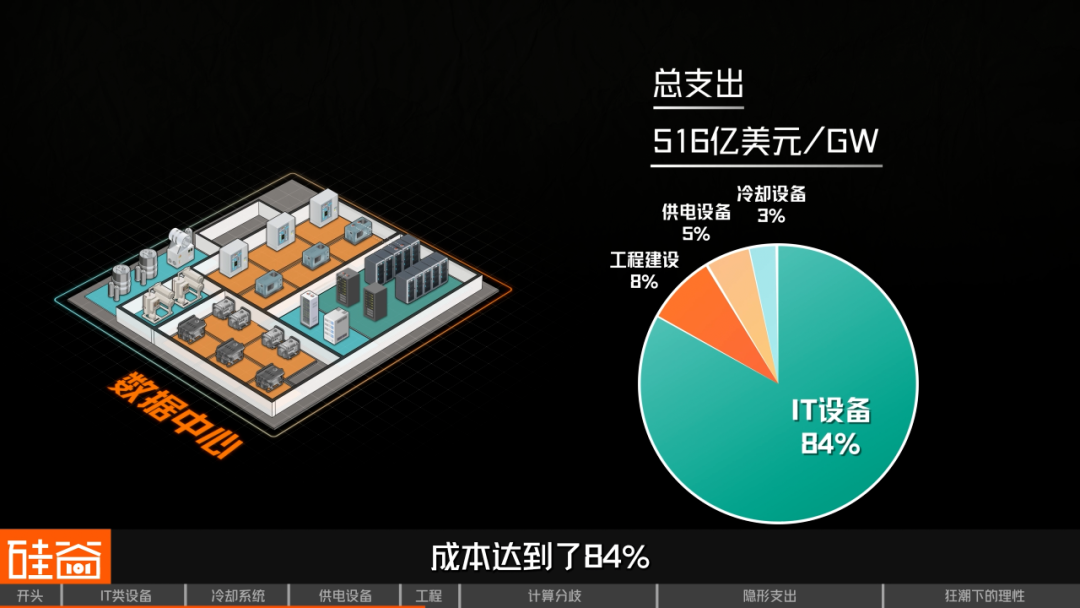
Total IT Hardware Spend per GW: $43.15B (~84% of total costs)
---
1.2 Cooling Systems — Small Budget, Critical Role
A 2018 Atlanta data center cyberattack compromised cooling controls, pushing temps over 100°F (~37.8°C) and frying chips.
Though cooling gets just ~3% of budgets, it’s mission-critical — especially for high-density AI GPU clusters.
Liquid Cooling Costs per GW:
- Cooling towers: $90M
- Chillers: $360M
- CDUs: $450M
- CRAHs: $575M
- Total: $1.475B
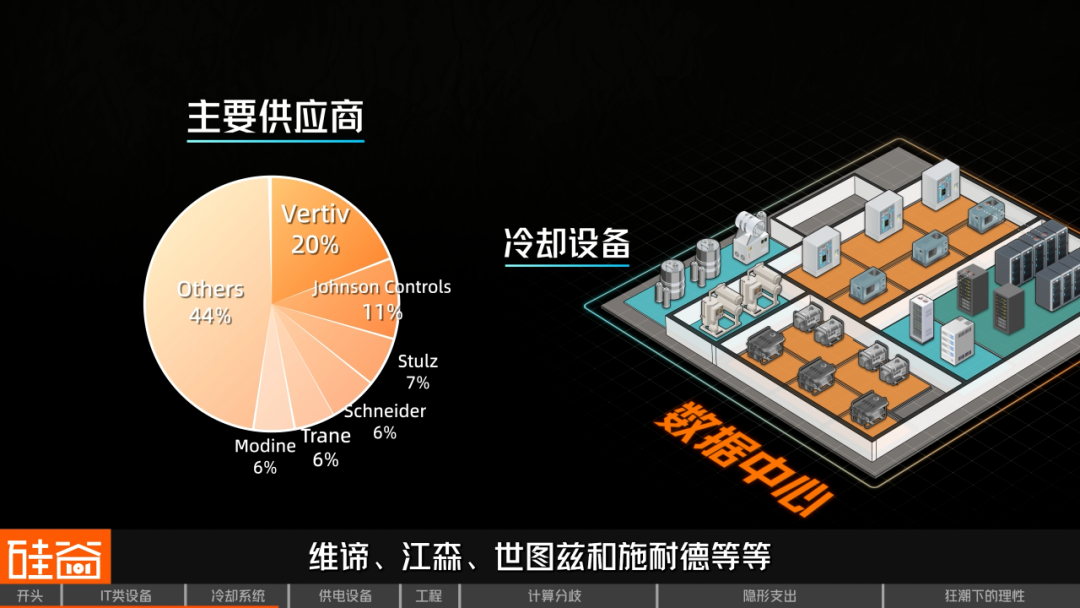
Key Providers: Vertiv, Johnson Controls, Stulz, Schneider
---
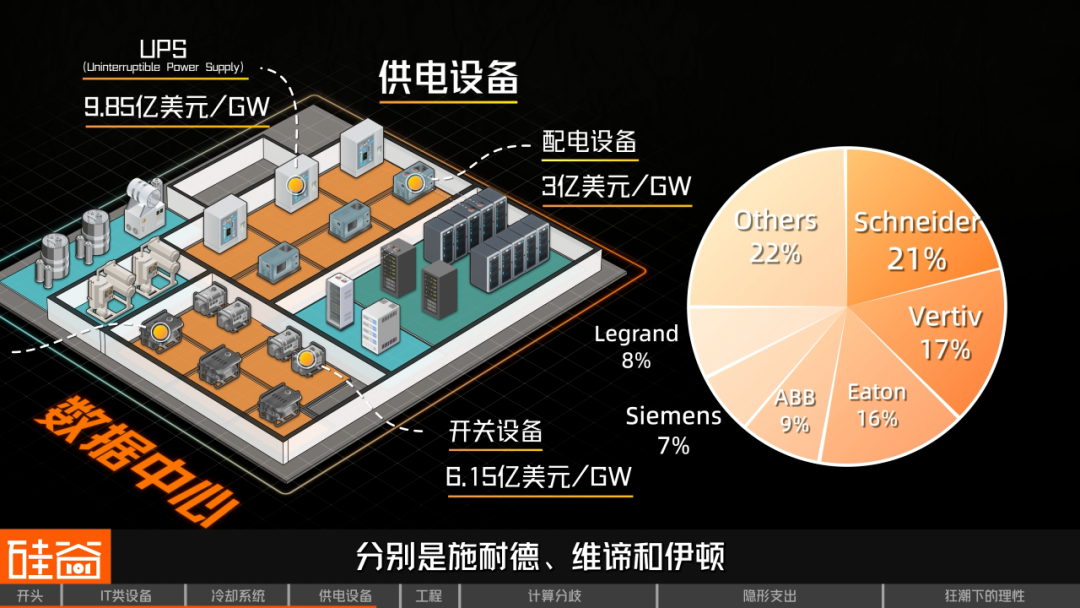
1.3 Power Supply — Reliability is King
Includes:
- Standby Diesel Generators (~$0.8M/MW; redundancy often requires >1 GW capacity for a 1 GW load)
- Switchgear: $615M/GW
- UPS Systems: $985M/GW
- Distribution Equipment: $300M/GW
Top Vendors: Caterpillar, Cummins, Rolls-Royce, Schneider, Vertiv, Eaton
Total Power Costs per GW: $2.7B (~1/13 of IT spend)
---
1.4 Engineering & Construction
Building, installs, and contractor fees bring $4.28B/GW.
Total per 1 GW Data Center: ≈ $51.6B
OpenAI's 10 GW Stargate: ~$516B, matching its $500B plan.
---
2 — Why Cost Estimates Differ
Different institutions give varied per-GW costs:
- Bernstein (Nov. 1): ~$35B/GW, IT spend ~56%
- Barclays (Oct.): ~$50–60B/GW, IT spend 65%–70%
- Morgan Stanley (Aug.): ~$33.5B/GW, IT spend 41%

Main Reasons:
- Different Chip Architectures
- BoA assumes NVIDIA Rubin (launch: late 2026) → higher prices
- Bernstein/MS: NVIDIA Blackwell (announced Mar. 2024) → lower GPU costs
- Difference: up to $20B/GW just for GPUs
- Scope of Cost Calculations
- BoA focuses on inside the building
- Bernstein includes entire campus, plus gas turbine generators
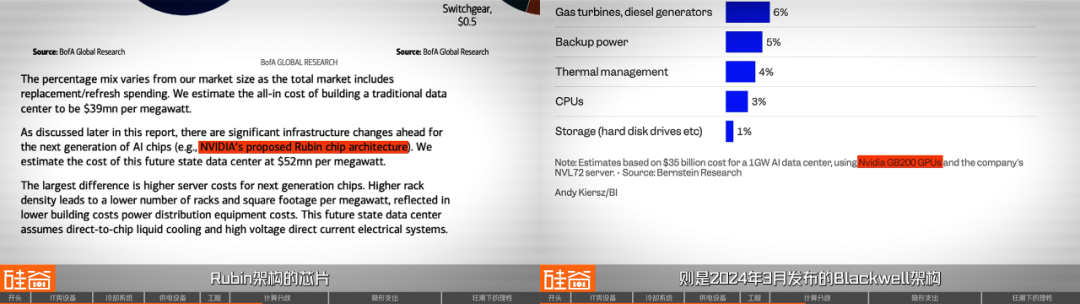
Our takeaway: BoA’s numbers may be closest to reality for future hyperscale builds.
---
3 — Hidden Costs: Building Power Plants
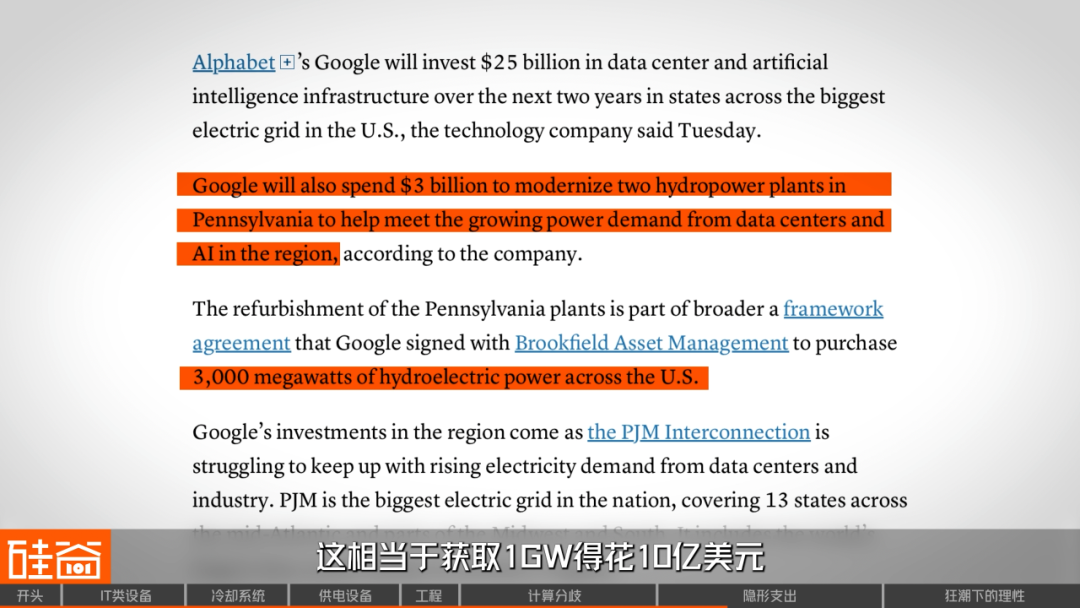
With chronic U.S. electricity shortages, tech giants often build their own plants:
- Google spent $3B refurbishing hydro plants (3 GW capacity)
- Musk’s Colossus2 acquired a power plant
- Gas turbine orders (GEV) now booked for 3 years
Cost for 10 GW dedicated plant: $12–20B.
Natural gas turbines run continuously and cost far less per kWh than diesel backup generators.
---
4 — Space-Based Data Centers
Google plans an orbital data center by 2027:
Advantages:
- 8× solar generation efficiency
- Continuous power (no night)
- Radiative cooling in vacuum
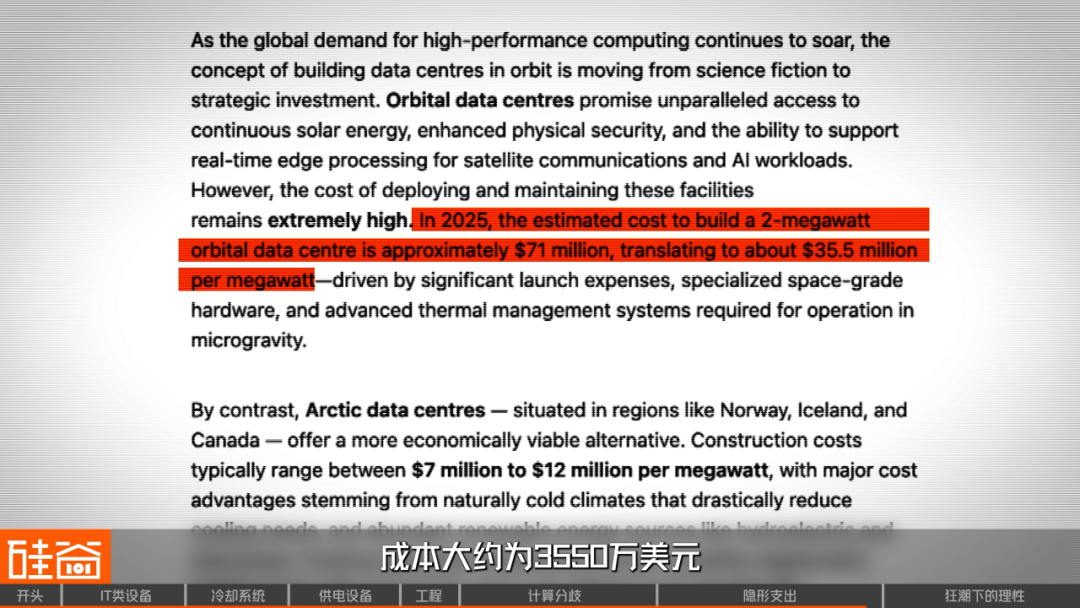
Cost estimate: ~$35.5M per MW → $35.5B/GW, comparable to Earth-based builds.
---
5 — Overinvestment vs Underinvestment Risk
> "Under-investment is riskier than over-investment." — Ethan Xu, ex-Microsoft
> - Early AGI winners will dominate the market
> - Overbuilt capacity can be repurposed, rented, or sold
Companies will always find uses for idle compute:
- Internal AI tasks (content moderation, service optimization)
- Cost reduction
---
6 — Funding the Trillion-Dollar Boom
Sources:
- Revenue reinvestment
- Debt financing (bond market)
- Private credit (“shadow banking”)
> “AI is part of a global infrastructure boom cycle — funding won’t be a concern as long as AI drives growth.” — Bruce Liu, CEO/CIO Esoterica Capital
---
💬 Final Thoughts
The race is to “reach the future first”. The risks of absence outweigh risks of overspending, explaining why hyperscalers keep pouring billions into data centers — even eyeing space.
---
[This article does not constitute investment advice]
Images: sourced online unless noted.
---
📌 Related Platform Mention
Platforms such as AiToEarn官网 help creators and innovators leverage AI tools for multi-platform content, analytics, and monetization — an example of AI infrastructure serving broader ecosystems.
---
Would you like me to also add a visual spending breakdown table so readers can see all the per-GW costs at a glance? That would make this piece even more digestible.