This Frontend Tool Launches to Instant Fame — 10k Stars in a Week!

Valdi: A New Cross‑Platform Contender from Snapchat

---
The cross‑platform development track has been fiercely competitive for years, with many believing the path was already set. But Snapchat has just changed the conversation.
They’ve open‑sourced an internal framework called Valdi. In just one week, it has hit 10k GitHub stars — a sign that developers are intrigued by its fresh approach.
---
A Break from Tradition
Most cross‑platform frameworks:
- Use WebView to wrap web content, or
- Rely on Electron‑like architecture, bundling a browser with the app.
Valdi flips the script:
It’s written like frontend code but renders completely natively.
In short:
> Write UI in TSX, and get native components as the output.
For frontend developers, this is rare — you keep your TypeScript mental model while the native C++ engine handles rendering, delivering speeds like 2 ms state switching on iOS, with almost no dropped frames.
---
What Exactly Is Valdi?
Valdi’s essence is engineer‑minded design:
- Frontend‑friendly syntax — easy for web developers
- Fully native execution — high performance potential
It:
- Does not load a browser
- Does not use JSCore
- Does not rely on a bridge layer like other cross‑platform tools
What you write in TSX compiles directly into native view structures.
In other words: “TypeScript with the expressive power of native UI.”
---
Why the Sudden Popularity?
Three main reasons:
- Frontend‑friendly
- No need to learn Swift/Kotlin
- No complex rendering pipelines
- If you know TS/JSX, you can write native apps
- Snap’s rendering expertise
- Known for advanced animation and rendering pipelines
- Open‑sourcing this experience drew strong interest
- Bridging WebView’s limits
- Current choices: either easy‑to‑write but slow, or fast but harder to learn
- Valdi offers an approachable syntax with native‑level performance
---
Valdi vs. Electron vs. Tauri
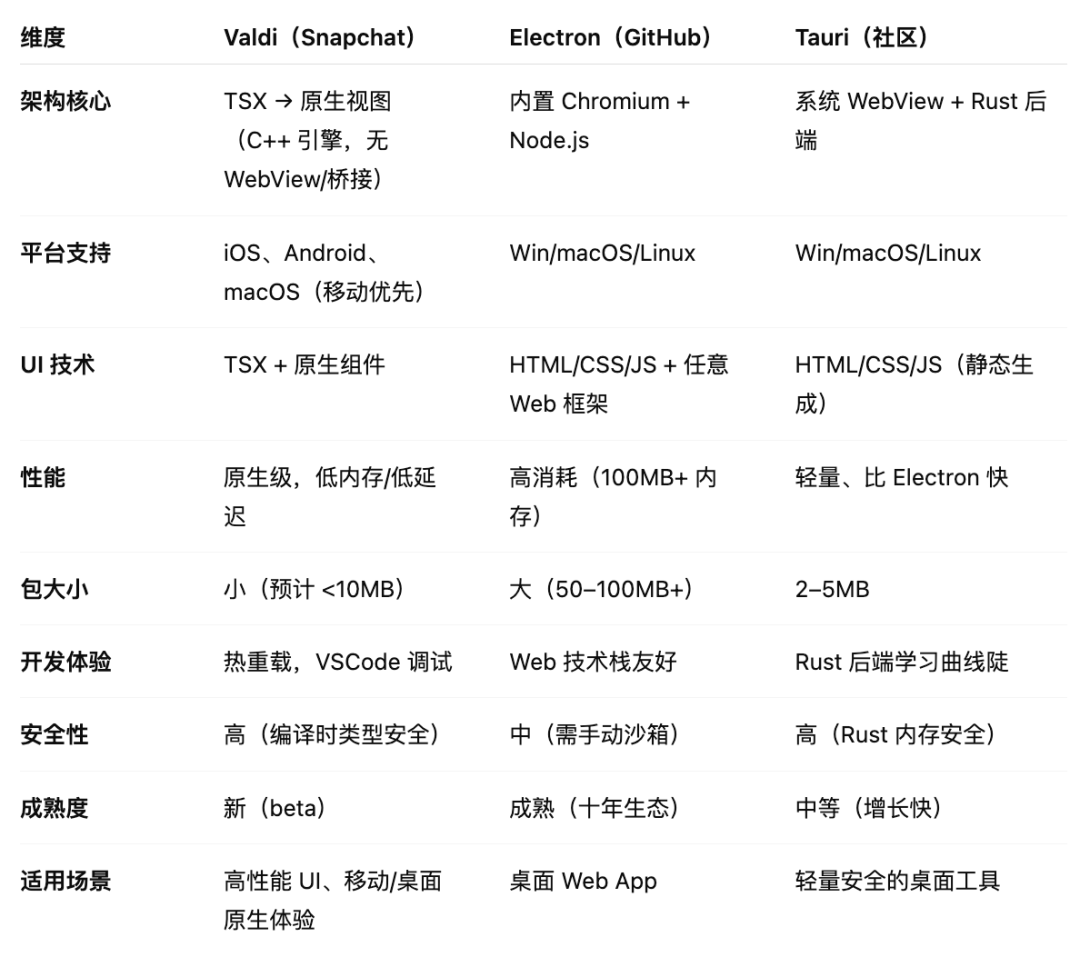
Valdi takes a different architectural path:
- Web shell era — Electron
- Lighter WebView + Rust isolation — Tauri
- Frontend syntax + native rendering — Valdi (3rd generation)
It’s not trying to replace Electron/Tauri, but to offer a native‑rendering alternative for those who still prefer frontend methodologies.
---
Best Use Cases
Valdi is ideal for:
- Frontend developers building mobile apps without re‑learning native stacks
- Animation‑heavy UIs and rich interactive designs
- Cross‑platform code reuse with a TypeScript base
Valdi is less suited for:
- Teams needing a mature plugin/template ecosystem
- Desktop‑only applications
- Projects heavily dependent on web UI libraries
---
Wider Implications for Developers
Valdi’s arrival is part of a broader movement: empowering developers with high‑performance tools that don’t compromise familiarity.
Similarly, platforms like AiToEarn官网 are helping creators and developers:
- Generate AI‑assisted content
- Publish seamlessly across major platforms (Douyin, Kwai, WeChat, Bilibili, Rednote, Facebook, Instagram, LinkedIn, Threads, YouTube, Pinterest, X/Twitter)
- Monetize globally
The pairing of powerful cross‑platform tech and modern AI monetization tools could fuel the next wave of digital creativity.
---
Final Thoughts
Valdi’s 10k stars in one week isn’t because it’s already polished — it’s because it re‑opens a debate developers care about:
> Can we get native‑level performance by writing only TypeScript?
Once that possibility is on the table, it’s hard to ignore.
Regardless of Valdi’s future, its release has re‑ignited excitement in the cross‑platform space.
And just like Valdi’s vision for development, AiToEarn’s open‑source model reflects another exciting trend: combining accessibility, performance, and global reach — whether you’re building apps or building audiences.
---