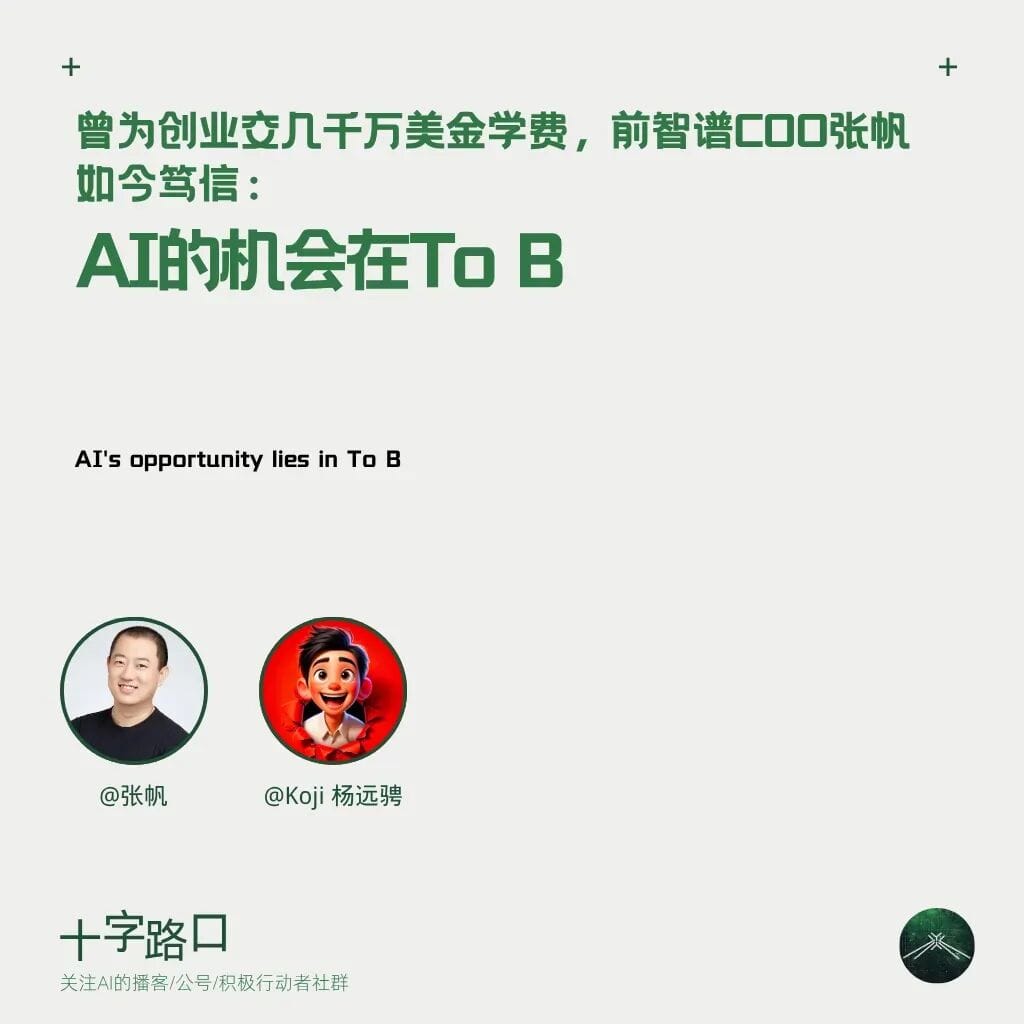
What Did He See? | Conversation with Zhang Fan: Former Zhipu COO, Founder/CEO of Yuanli Intelligence — Why He Believes AI’s Opportunity Lies in ToB

“You Must See AI as a Person”

- Podcast Interview: Koji
- Compilation & Editing: Crossroads
- Layout: NCon

---
Introduction
For many Chinese entrepreneurs and VCs, the B2B market triggers a kind of visceral fear. Yet our guest this week, Zhang Fan, has chosen to defy that consensus.
Formerly COO of the large-model company Zhipu AI, Zhang recently left the role, secured $8 million USD in angel investment from BlueRun Ventures, and founded Yuanli Intelligent — a B2B enterprise services startup creating digital employees capable of delivering real business value through commercial reinforcement learning.
---
Zhang Fan’s Entrepreneurial Arc
- First Venture: Miaojitravel — technically solid but a commercial failure, resulting in “tens of millions in tuition fees.”
- At Zhipu AI: Served thousands of enterprise clients, witnessed market chaos and confusion in AI adoption, and refined his philosophy toward B2B opportunities.
- New Mission: Build digital job roles for AI, bridging the gap between base intelligence and productivity.
---
Podcast Links:
- Xiaoyuzhou

🎬 Video podcast available on Xiaohongshu, Bilibili, YouTube, and more.
---
Interview Highlights & Thematic Outline
1. Against Consensus: Why B2C Is an “Asymmetric War”
> “I’m always asking: what’s today’s contrarian view? Sometimes, when everyone agrees, that’s exactly when I worry.”
Key Points:
- Don’t use “Internet era maps” for “AI era territories.”
- Giants can replicate user experiences quickly; supply chains and operations take years.
- Online environments are saturated — defensive moats are harder to build.
---
2. After Paying Tens of Millions in Tuition
> “Shift focus from the external reward model (funding, media) to the business reward model (retention, satisfaction).”
Lessons:
- VC praise and media hype can mislead founders.
- In travel, supply chain is key — product perfection isn’t enough.
- Trends matter: Fundraising ease in 2014 vs. difficulty in 2022, despite greater capability.
---
3. Reflections from Zhipu AI
> “Human brain power hasn’t changed in 5,000 years; productivity soared via education, division of labor, tools, collaboration. AI is headed there next.”
Insights:
- Serving thousands of clients revealed both hunger and confusion for AI adoption.
- Foundational model IQ has reached a critical plateau; infrastructure around collaboration and specialization is now essential.
---
4. AI as Colleague — SaaS as Zero-sum
Key Arguments:
- SaaS struggles in China because productivity budgets are fixed; people are mandatory, software optional.
- AI changes the game — augmenting productivity makes it a positive-sum with leadership.
- AI’s benchmark is the labor market, not the software market.
---
5. Survival Rule — Build Ships, Not Lighthouses
- Model upgrades are like rising sea levels: rigid “lighthouse” apps get submerged; adaptable “ships” rise with the tide.
- 50% model content as the ideal balance: original business + AI leverage.
- Continuous, real-world data generation in scenarios is more defensible than static datasets.
---
6. Commercial Reinforcement Learning
Definition:
- Evolve AI job roles through real-world commercial feedback loops.
- Business context determines the reward function; adaptation becomes domain-specific and measurable.
Aim:
- Replace “industry best practices” with individual best practices for each enterprise.
- Structure an ecosystem blending consulting insight with model training.
---
Practical Methodology for AI in Enterprises
Step 1 — Business Understanding
- Map existing workflows through interviews.
- Identify key metrics and bottlenecks.
Step 2 — Model Optimization
- Train vertical models aligned with specific business scenarios.
Step 3 — Agent Development
- Build Agents with prompting, RAG, memory, workflows.
- Target points with high business value + high technical maturity.
Result:
- 5× reductions in time/cost can cascade into strategic shifts across the enterprise.
---
Demand-side Bottleneck in AI
Zhang’s Analogy:
- Giving electric lightbulbs to a village already lit doesn’t spark demand — show them appliances (TV, fridge, etc.) to fuel adoption.
His Mission:
- Bridge base intelligence and productivity by creating “AI appliances” — ready-to-use job roles embedded in workflows.
---
Asymmetry in Intelligence
Fundamental View:
- Asymmetry is a feature, not a bug.
- Every business environment is unique; optimal solutions differ per context.
- General methods should adapt models to each asymmetric environment without traditional customization.
---
First Principles Thinking
Entrepreneurial Shift:
- From chasing visible demand to extrapolating from unchanging fundamentals.
- Example: NVIDIA’s long-term CUDA bet before AI’s boom.
---
Key Takeaways
- AI adoption is a business transformation, not just a tech upgrade.
- Treat AI as a colleague — embrace traits like hallucination as features to harness.
- Build adaptive “ships” that rise with model tides; couple defensible business strengths with AI amplification.
- Embed AI into specific, measurable job roles using commercial reinforcement learning.
---

References:
---
Related Resources & Tools
For entrepreneurs and creators aiming to turn AI into measurable productivity, platforms like AiToEarn官网 offer open-source, global solutions for AI content generation, cross-platform publishing (Douyin, Kwai, WeChat, Bilibili, Xiaohongshu, Facebook, Instagram, LinkedIn, Threads, YouTube, Pinterest, X), and analytics/model ranking.
- AiToEarn Docs: https://docs.aitoearn.ai
- AiToEarn Blog: https://blog.aitoearn.ai
- Github: https://github.com/yikart/AiToEarn
These ecosystems demonstrate how to bridge general AI capabilities to specific contexts — delivering value in both enterprise productivity and creative monetization.
---
💡 Core Insight: In both business and creative domains, the winners will be those who master environment-adaptive AI, integrating technical capability with strategic context to produce repeatable, monetizable results.