When Search Meets AIGC: JD Retail’s “Personalized Content” Generation in Practice
The Rise of AIGC in E-Commerce
Artificial Intelligence–Generated Content (AIGC) is transforming industries, with visual generation emerging as a key driver in reshaping the e-commerce ecosystem. As businesses shift from simple product display to content-driven strategies, the demand for massive, diverse, and precise visual assets is unprecedented.
Traditional manual production can’t keep pace with cost and efficiency demands. Large-model-driven AIGC solves this problem — generating product images and promotional videos at scale, and producing personalized content for distinct user profiles.
Benefits include:
- 90% cost reduction in content production
- Up to 30% boost in conversion rates
AIGC has moved e-commerce content creation from creative handicrafts to intelligent industrialization, becoming a powerful growth engine for brands.
---
Insights from JD Retail’s Head of Visuals & AIGC
Jason, JD Retail’s Head of Visuals & AIGC, explains the technical framework for extreme personalization in product material generation — the e-commerce 2.0 era’s “thousand faces for a thousand people” approach.
Key themes:
- Two core models powering personalization
- Business use cases and merchant benefits
- Future upgrade paths
---

Talk Overview
- Review of e-commerce evolution
- Features of the e-commerce 2.0 era
- Detailed personalization framework for product materials
- How AIGC benefits merchants
---
E-Commerce Timeline
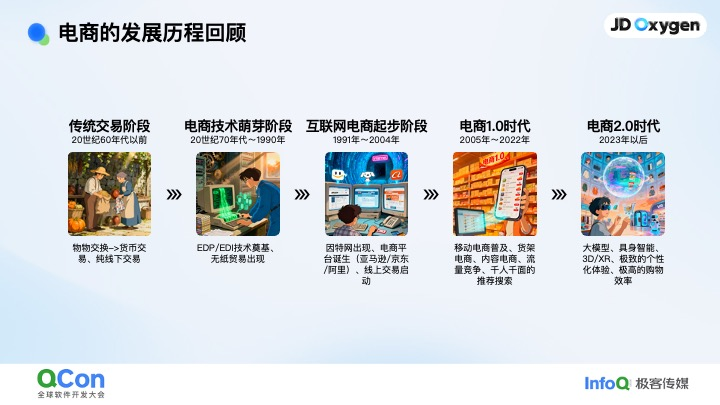
Key milestones in e-commerce history:
- Pre-1960s – All transactions offline; barter still common in some regions
- 1960s–1980s – Birth of EDP/EDI; e-commerce in embryo
- 1990s – Internet boom; Amazon, JD.com, and Alibaba emerge
- After 2005 – Rise of mobile internet; shelf-based and content-driven e-commerce gain edge; personalized search recommendations begin (E-commerce 1.0)
- End of 2022 – ChatGPT & Midjourney debut; large models, embodied intelligence, 3D/XR lead into E-commerce 2.0
---
Defining E-Commerce 2.0
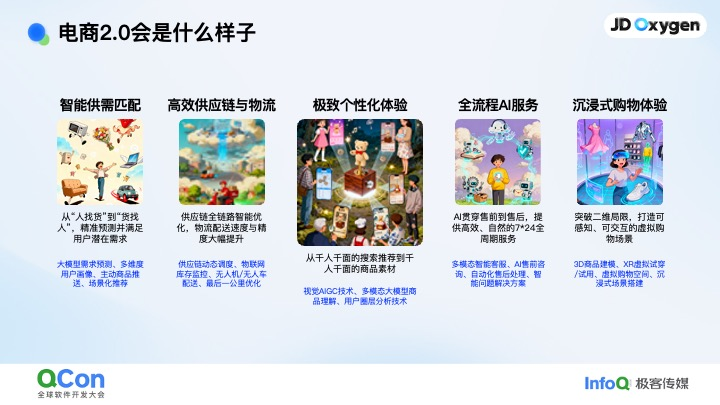
Core upgrades:
- Intelligent Supply-Demand Matching – From “people find products” → “products find people”
- Efficient Supply Chains & Logistics – Dynamic scheduling; autonomous delivery
- Full-Process AI Customer Service – Multimodal large models, 24/7 availability
- Immersive Virtual Shopping – Beyond two-dimensional product browsing
- Extreme Personalization – “Thousand faces” applied to both search/recommendations and product materials
---
Example: “Thousand Faces” in Product Materials
Same product → different presentation for different buyers:
- Outdoor Function-Oriented – Features like windproof, waterproof, fabric tech
- Style-Oriented – Aesthetics, design style, outfit matching (OOTD content)
- Price-Sensitive – Promotions, discounts, best prices
---
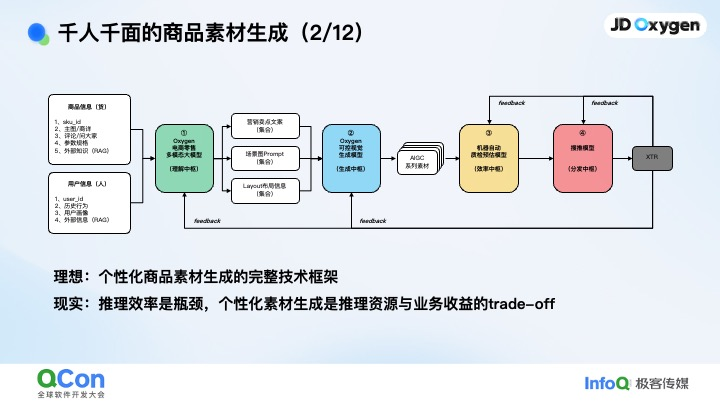
Technical Workflow – Personalized Product Material Generation
Four Key Models:
- Understanding Core – E-commerce retail multimodal large model
- Generation Core – Controllable visual generation model
- Efficiency Core – Quality estimation and filtering
- Distribution Core – Traffic allocation system
Process:
- Gather product & user data
- Understanding Core generates marketing & design instructions
- Generation Core creates visuals under control constraints
- Efficiency Core filters poor-quality assets
- Distribution Core pushes personalized materials to matching audiences
- Real user feedback loops back to improve models
⚠ Note: Fully online inference is currently impractical; nearline/offline processes dominate.
---
Practical Adaptation – “Hundred Faces” Approach
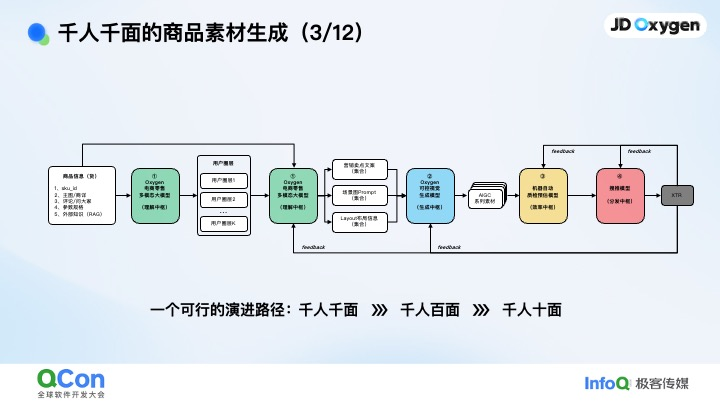
Due to resource constraints, user group–level personalization is often favored over individual targeting. Focus is on K highest-value user groups per product.
---
Case Study – JD American Black Coffee
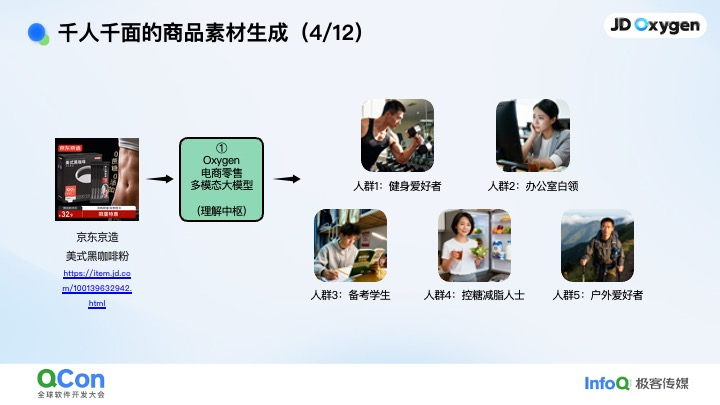
Target groups identified:
- Fitness enthusiasts
- Office workers
- Students preparing for exams
- Sugar-control / weight-loss consumers
- Outdoor lovers
Audience identification = direct product info + world knowledge from the Understanding Core.
---
Key Models in Detail
Understanding Core – E-Commerce Retail Multimodal Large Model
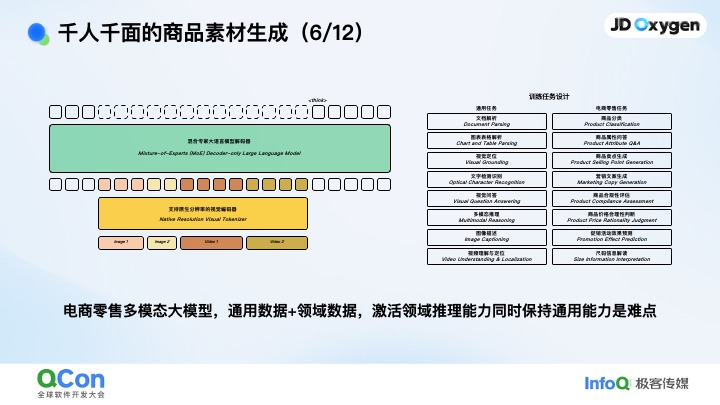
- Vision-Language Model (VLM) with dedicated tokenizers per modality
- MoE (Mixture-of-Experts) architecture inside decoder-only LLM
- Post-training to retain general-purpose reasoning while adding retail-specific capabilities
---
Generation Core – Controllable Visual Generation Model
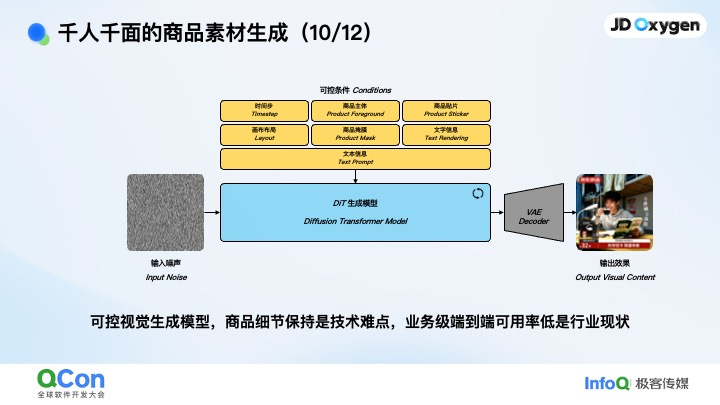
- Multi-condition diffusion model
- Inputs: Product image, text overlays, layout, patches
- Future goal: merge all controllable inputs into natural language condition space
- Business constraint: Precise product accuracy required; low tolerance for errors
---
Evolution of Controllable Image Generation
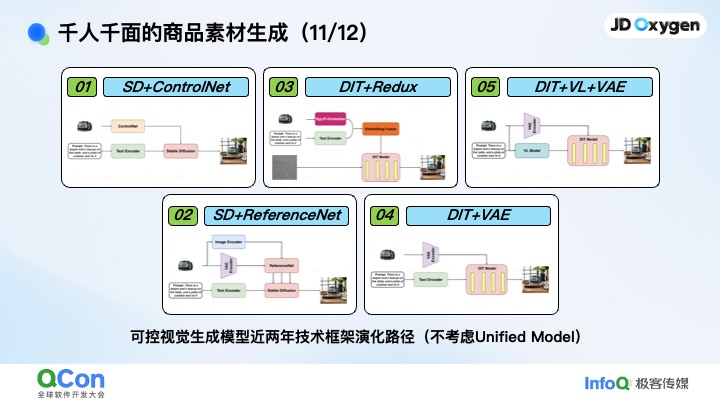
- 2023: Stable Diffusion + ControlNet
- Early 2024: DiT + Redux
- Latest: VAE encoding unifies reference images & noise in shared context dimension
- Future: Unified model fusing understanding and generation
---
Merchant Pain Points
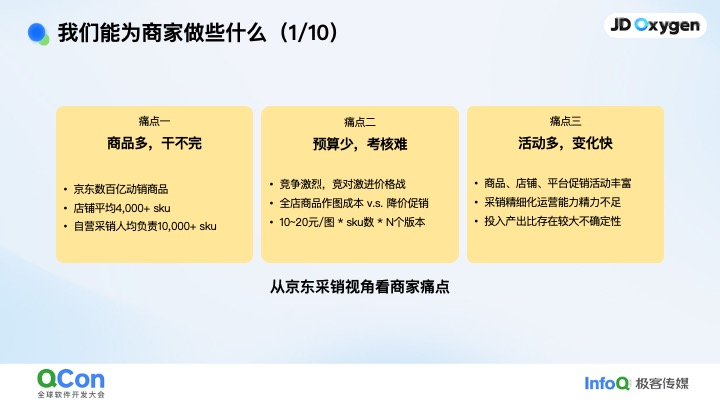
- Overwhelming Product Volume – Hundreds of billions of products; huge SKU counts per store
- Limited Budgets – Content costs are significant in price-competitive markets
- Frequent Promotions – Requires agile adaptation; ROI unpredictable
---
JD DotDot AIGC Platform – Merchant Support
- Serves 30+ JD Retail scenarios
- Supports 800,000+ merchants
- Over 10M daily invocations
- Production efficiency up 95%+; costs greatly reduced
---
OxygenVision – The Revamped DotDot
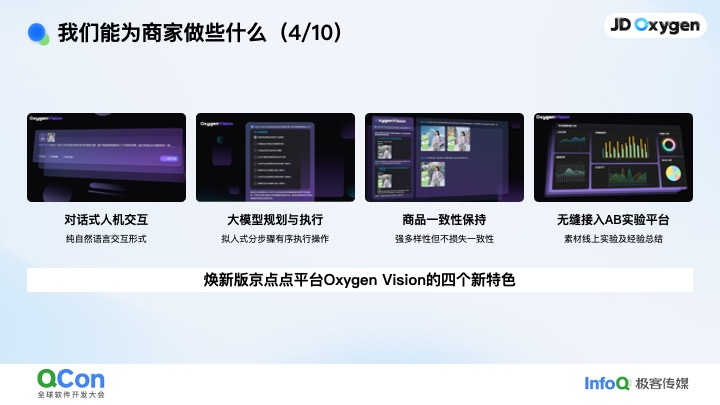
Four Major Upgrades:
- Conversational UI – Natural-language design requests
- Automatic Task Planning – Large model decomposes into tool-specific actions
- Algorithmic Product Consistency – Uniform visuals with varied styles
- AB Testing Integration – Direct connection to JD material experiments
---
Technical Architecture – Multi-Agent System
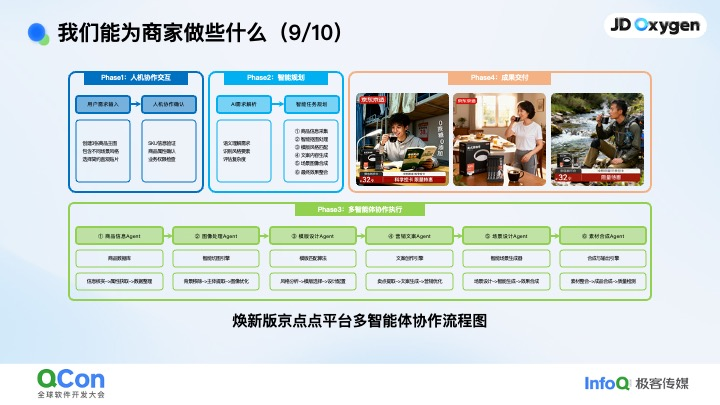
- 10% visible LLM intelligence
- 90% underlying engineering – state management, fault recovery, memory, event bus, etc.
- Agents coordinate via structured task decomposition and execution
---
Upcoming Features – JingDiandian Platform
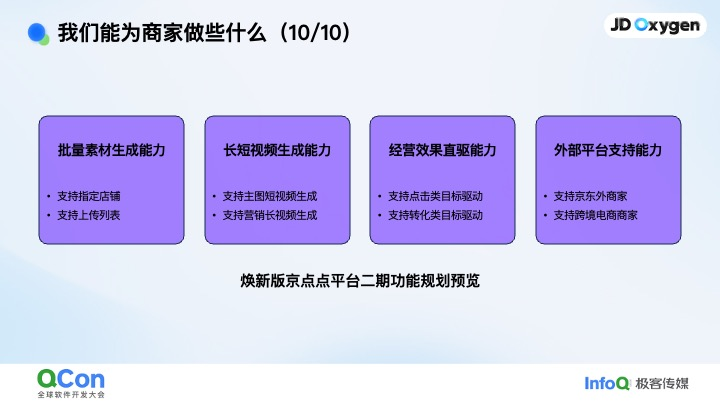
- Batch Material Generation – For complete store or SKU list
- Video Generation – Short (5s) and long (30s) formats
- Business Performance–Driven Creation – Objectives like CTR or conversion built into strategy
- Support for Global Merchants – Multilingual, cross-border capabilities
👉 Try it at oxygen-vision.jd.com
---
Ecosystem Connections – AiToEarn Platform
Platforms like AiToEarn官网 extend AIGC’s reach:
- Generate AI-driven content
- Publish across Douyin, Kwai, WeChat, Bilibili, Xiaohongshu, Facebook, Instagram, LinkedIn, Threads, YouTube, Pinterest, X/Twitter
- Analyze & Monetize via integrated tools
Further resources:
---
Summary:
E-commerce 2.0 is defined by AI-driven personalization, immersive experiences, and efficiency upgrades. While full “thousand faces” personalization remains resource-intensive, smart adaptations like “hundred faces” deliver real commercial value. Tools like OxygenVision and ecosystems such as AiToEarn illustrate how understanding + generation models can blend into seamless, monetized content workflows.
---
Would you like me to next design a visual summary diagram showing how OxygenVision’s multi-agent technical modules could link with AiToEarn’s cross-platform publishing pipeline? That diagram could help explain the end-to-end ecosystem at a glance.