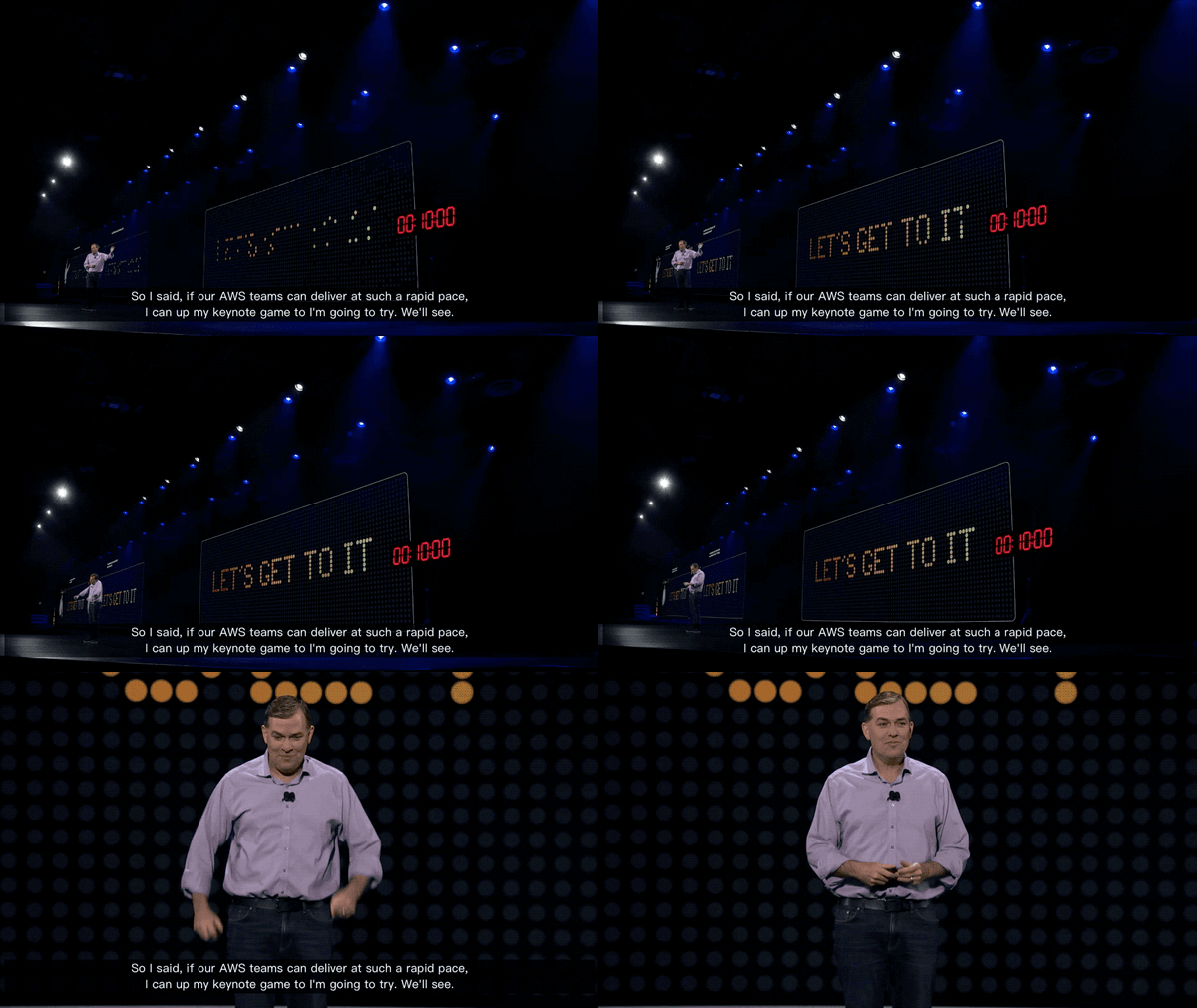
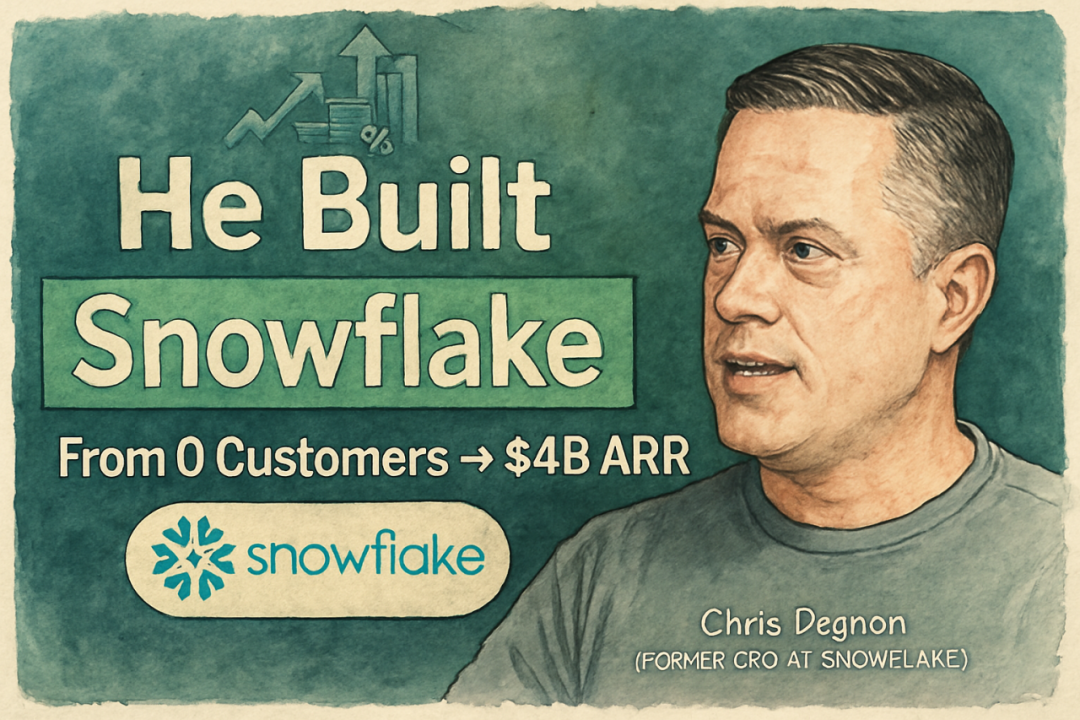
Snowflake’s First Sales Leader Revealed: Growth Methodology from $0 to $4 Billion
---
From First Salesperson to $4 Billion CRO: Lessons from Chris Degnan’s Journey
Have you ever wondered what it takes to stay in a company for 11 years, start from the very first sales role, rise to Chief Revenue Officer, and personally help grow revenue from zero to $4 billion?
I recently listened to a podcast featuring Chris Degnan, Snowflake’s former CRO, and his story reshaped my understanding of business growth, sales management, and leadership.
Chris joined when Snowflake had no product and no customers, becoming its only salesperson. Eleven years later, he led a sales team generating $4 billion in annual revenue, helping Snowflake reach a $100 billion market cap. He worked under four CEOs and watched the company evolve from stealth mode to the largest software IPO in history.
After hearing the interview, I realized:
> True business growth isn’t about luck — it rests on repeatable methods and deep understanding of people.
Chris recently co-authored Make It Snow with CMO Denise Persson, summarizing lessons learned over the years. This is not just a sales story — it’s a case study in building a growth engine amid extreme uncertainty.
---
Why Join a Company With No Product?
Chris described joining Snowflake as his _“midlife crisis decision”_. Instead of buying a bike, he joined a startup with zero customers — but with careful reasoning.
Background:
- Worked at EMC with enterprise tech sales experience.
- Was 2nd-line leader at startup Aexa (acquired by EMC).
- Turned down regional VP roles at EMC because he didn’t admire the leaders recruiting him.
Why Snowflake?
- Skeptical at first (even disliked the company name).
- Snowflake was in stealth mode.
- Attracted by founders + investor Mike Speiser.
- Mike removed his last doubt by immediately adding Chris’s respected mentor John McMahon to the board.
Key Insight:
Top-tier talent in early-stage companies often values:
- People > Paychecks
- Meaningful work > Titles
Chris accepted lower pay and high risk for interesting challenges with exceptional people.
He repeatedly emphasized the role of board mentors like McMahon as essential to early success.
---
Selling Before You Have a Product
When Chris joined, there was nothing to sell. Instead, he:
- Started conversations to collect feedback.
- Cold-called prospects:
- > “Here’s what we’re building — separating storage from compute, and handling semi-structured data.”
- Translated technical breakthroughs into customer-friendly value propositions.
This mirrors strategies in modern creator/business platforms like AiToEarn, which encourage engaging audiences early — even before launch — by:
- Simultaneous multi-platform publishing.
- Building anticipation and trust before “GA”.
- Connecting content generation, analytics, and monetization into one workflow.
- See AiToEarn blog or Docs.
Lesson:
Early conversations aren’t for selling — they’re for learning and validating product–market fit.
---
Building a Sales Team from Scratch
Once Chris identified ideal customers, he manually built a list.
Key milestones:
- Hired Alyssa Wong (intern → still at Snowflake) to build lists.
- Added a Sales Engineer to tell the technical story.
- Set clear weekly goals — 8 customer meetings per week.
- Hired SDRs to keep pipeline flowing when traveling (Jordan and Tom — Jordan still with Snowflake).
- Expanded to hiring more salespeople.
Takeaway:
Growth decisions were necessity-driven, not from a static 5-year plan.
Solve bottlenecks immediately:
- Can’t do everything? Hire help.
- List-building slows pipeline? Add SDRs.
---
Identifying Self-Driven Sales Talent
Chris’s hiring philosophy:
> “If you have to tell people what to do, they shouldn’t be in this company.”
What He Looks For:
- Self-drive, resilience, ability to function without infrastructure.
- Comfort with startup realities (no CRM, building processes from zero).
- Problem-solvers who thrive despite uncertainty.
Interview Technique:
"Tell me your life story" — from birthplace through career. Look for:
- Jobs during school.
- How they handled adversity.
- Evidence of resilience.
---
Staying 11 Years Under 4 CEOs
Average CRO tenure: 18 months. Chris lasted 11 years because:
- Asked good questions.
- Accepted and acted on feedback.
- Maintained humility and urgency.
- Treated SDRs and CEOs equally with respect.
Execution Tip:
Urgent, hands-on collaboration — like CMO Denise Persson’s weekly frontline conversations — builds trust across departments.
---
Aligning Sales & Marketing
Chris and Denise’s partnership worked because of:
- Transparency
- Urgency
- Shared accountability
Example:
Denise eliminated debates over MQL definitions by focusing on one metric:
> Delivering qualified meetings for sales reps.
Leadership Lesson:
Alignment is built on trust and frontline involvement — not process documents.
---
Navigating Snowflake’s Near-Death Moments
Two notable crises:
- 2015 GA Outage — Entire service down for hours in US West AWS region. CEO rallied morale while team fixed core systems.
- License Renewal Failure — Forgot encryption key renewal, causing full outage during major client visit.
Lesson:
Resilience and honesty with customers are as critical as technical recovery.
---
Core GTM Principle: New Customers Drive Growth
Snowflake focused relentlessly on new logo acquisition:
- 4–8 new customers per rep per quarter.
- Celebrated every new client win.
- Small initial deals ($40–60k) → expand via additional use cases.
Incentives:
Sales commissioned on both new deals and customer consumption, aligning success with usage.
---
Rethinking Customer Success
Under CEO Frank Slootman:
- Placed Customer Success + Professional Services under Chris.
- Cancelled free Customer Success department — made it everyone’s job.
- Built Pro Services team to train + enable customers (cost-neutral).
- Sales adapted to include Pro Services in deals to ensure customer success.
Key Idea:
Sales reps stay invested in customer outcomes when usage drives commissions.
---
Missed Plays Against Databricks
Hindsight insights:
- Should have built Spark connector + data science notebooks earlier.
- Private companies like Databricks can be more aggressive without quarterly disclosure constraints.
- Early decisive action on product/market windows is crucial.
---
AI Bubble: Opportunity Amid Hype
Chris believes:
- We’re in an AI bubble, valuations are “insane”.
- But like the dot-com era, real innovations will emerge.
- Focus on cost reduction and measurable productivity gains as indicators of real value.
---
Sales Methodology as a Compass
Chris still champions MEDDPICC:
- Doesn’t demand one specific method, but requires leaders to show how they manage by methodology.
- Values daily use, not just lip service.
---
My Key Reflections
From Chris’s journey:
- Execution beats secrets — success comes from consistent daily actions.
- Maintain frontline contact — e.g., 8 customer meetings/week.
- Survive leadership changes through adaptability and humility.
- Sales–Marketing alignment is about trust, not process.
- Bubbles produce lasting innovations — focus on real value creation.
In today’s environment, platforms like AiToEarn官网 help creators apply disciplined execution with AI-enabled tools for:
- Cross-platform publishing.
- Monetization.
- Analytics and model ranking.
Just as Snowflake’s growth was built on daily execution, modern digital success depends on combining sound methodology with the right tools.
---
Final Takeaway:
> Greatness is the accumulation of small, daily actions — sustained over years.
Whether building a $100B company or growing an AI-powered creator business, the principles of customer focus, team alignment, and disciplined execution remain timeless.